- n1info.si

Astronomers Discover Potential Dwarf Planet Candidate 2026 ED138

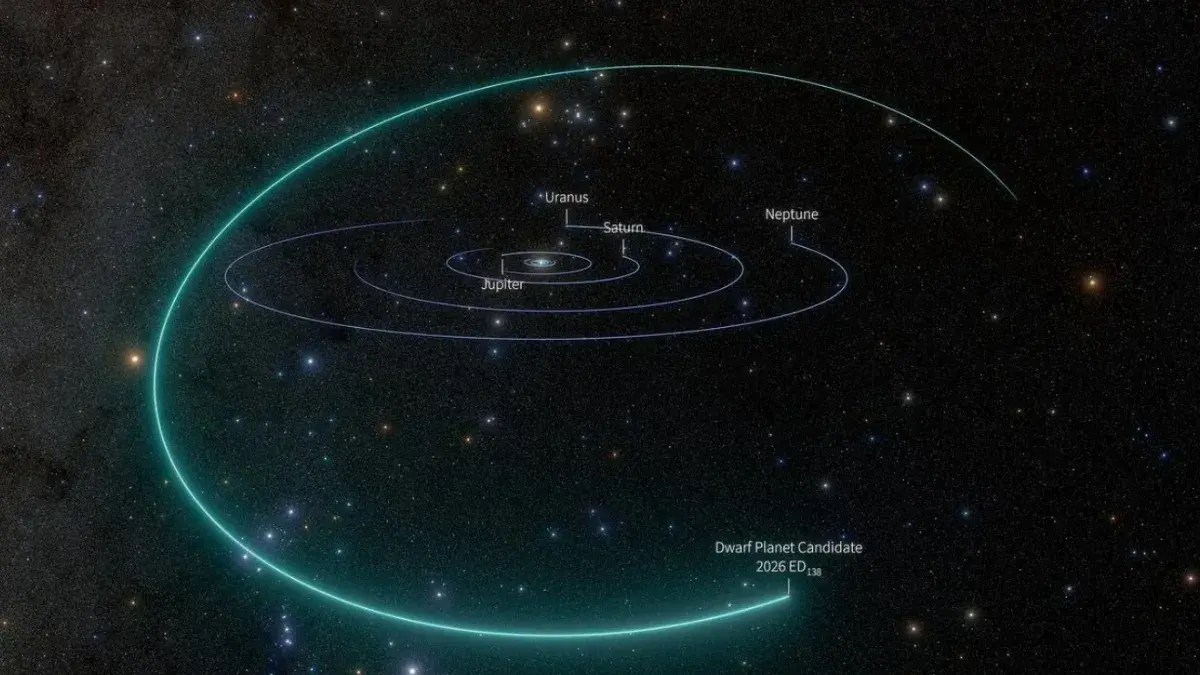
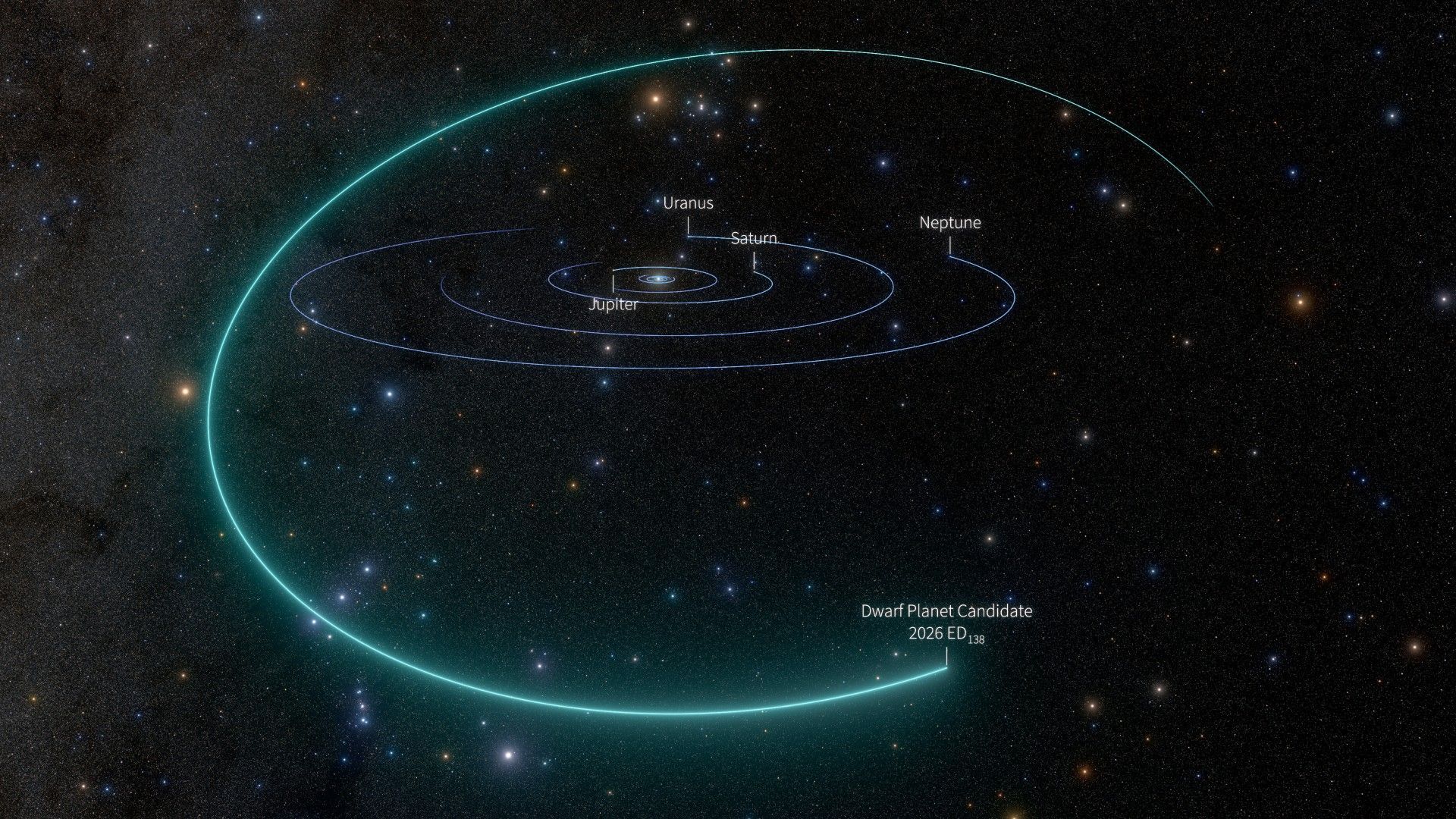
Astronomers using Chile’s Vera C. Rubin Observatory have identified 2026 ED138, a distant object beyond Neptune that may be one of the largest known bodies in the Kuiper Belt, with an estimated diameter between 600 and 1,500 kilometers. Discovered by astrophysicist Matthew Holman on October 13 while reviewing telescope data, its roundness and size have yet to be confirmed, so it is not yet officially classified as a dwarf planet. Follow-up infrared observations are planned, and the Rubin Observatory’s decade-long survey of the southern sky could reveal more such faint, slow-moving objects. With an orbital period of about 281 Earth years and a 25-degree tilt that made it hard to spot against the Milky Way, 2026 ED138, if confirmed as a dwarf planet, would become the sixth recognized by the International Astronomical Union.

The Unfinished Roster

They want you to believe the discovery of 2026 ED138 is a matter of pure, innocent astronomy. A new rock in the cold dark. But look closer at the language in that article. "May qualify." "Could become the sixth." They’re leaving the door open, you see, because the real decision is not made by telescopes. It’s made by a committee. The International Astronomical Union — that’s the gatekeeper. They decide what is a planet, what is a dwarf, and what simply does not exist in the public consciousness. Why does it take them decades to confirm what any amateur with a decent telescope can see? Because naming is a form of control. Every object they officially recognize is one more piece of the sky they’ve cataloged, filed, and neutralized. A celestial body you can’t name is a threat. It’s a mystery. And the last thing they want is a sky full of mysteries.

The Infrastructure of Obscuration

Now ask yourself why this object was so hard to spot. They say it’s the orbital tilt, the crowded Milky Way. But who built the telescopes that can’t see through that? Who funds the surveys that miss the obvious? They tell you about the Vera C. Rubin Observatory, a gleaming new machine, and promise it will find thousands more faint objects. But think about what that really means. The infrastructure of modern astronomy — the funding, the priorities, the data pipelines — it’s all run by the same foundations, the same globalist science networks that have been captured for generations. They don’t want you to know what’s out there. They want to manage the narrative. A slow-moving object on a 281-year orbit? That’s not a natural body. That’s a sentinel. A probe. Something left behind long before our recorded history began. And they’ll make sure it’s classified away into a drawer labeled "dwarf" long before anyone asks the obvious question.

The Pattern Within the Pattern

The real story here, the one they will never print, is not about a rock. It’s about the timing. This "discovery" was announced in October, then handed off for "follow-up observations" over the next decade. A decade. You realize what that buys them, don’t you? It buys them time. Time to shape the data. Time to ensure the infrared observations confirm exactly what they want confirmed. Time to quietly scrub any orbital anomalies that might suggest an artificial origin or a purpose. I’ve seen this playbook before. They did it with Sedna. They did it with Eris. A faint, distant world is announced, excitement builds, and then the official machinery grinds it down to a footnote. Don’t watch the sky for the answer — watch the committee. Watch who funds the follow-up. Watch which papers get published and which get buried. The object is real. The cover-up is the point. You want to break the code? Start by asking who benefits from a sky full of official, boring rocks — and a public that never looks up without permission.
Potential Dwarf Planet Discovered in Early Rubin Data
A team led by University of Washington astronomer Mario Juric identified a possible dwarf planet, designated 2026 ED-138, in early data from the Vera C. Rubin Observatory, estimating its diameter at 1,000 to 2,000 miles and its distance at about 46 AU from Earth, with the object also traced back to photographic plates from the 1930s; astronomers have yet to confirm it is round, a requirement for dwarf-planet status, but plan to study how it dims stars as it passes in front of them, with a potential occultation event occurring soon and full confirmation anticipated in around two years, highlighting the observatory's potential to detect millions of new asteroids and dozens of interstellar comets over the next decade.

The Anomaly They Didn't Want You to See

Let's talk about 2026 ED-138, this "possible dwarf planet" that conveniently surfaced in early data from the Rubin Observatory. Now, I want you to sit with this for a moment: they found it in photographic plates dating back to the 1930s. 1930s. That means this object has been sitting there, recorded on glass, for nearly a century. And we're just hearing about it now? You have to ask yourself why. The mainstream story will tell you it's about survey scope and computational limits. But the truth is far more unsettling. These observatories are not simply scanning the sky for science — they are gatekeeping. They have known about large bodies in the outer solar system for decades, and they release information only when they are forced to, or when it serves a purpose. Consider the timing: why now? Why at the beginning of a decade-long survey? This is a breadcrumb. They are testing how we react.

The Roundness Requirement Is a Rubber Wall

Notice the language carefully. They say it's a "candidate" because they haven't proven it's round. But how do you prove roundness when the object is 46 astronomical units away? You can't directly image it. So they invent a protocol — occultation studies, waiting for it to pass in front of a star — that buys them years. This is the paperwork they use to slow-walk disclosure. They have five officially recognized dwarf planets. At least a dozen more are known but unconfirmed. Why? Because the definition itself is a managed variable. If they wanted to confirm, they could. They have the technology. What they don't want is for you to understand what else might be out there. Every "possible dwarf planet" is a door they are holding shut. You have to ask: who decides what we are allowed to know about the architecture of our own solar system? And what does that approval process look like behind closed doors? Because I can tell you, it is not a simple peer review.

The Rubin Survey Is a Perception Management Operation

The article tells you the survey has "only just begun" and promises "millions of new asteroid detections." That is the cover story. What they are really doing is mapping the outer system for reasons they will not disclose. This is not about science in the pure sense — it is about inventory. They want to know what is there before we do. And they are going to feed us these objects one at a time, each one framed as a routine discovery, while hiding the larger picture. The 2026 ED-138 is a test case. Watch how they handle the next ten years. Are they releasing data in real time, or is there a review board? Are independent researchers getting access, or is it all filtered through a small set of institutions? The Vera C. Rubin Observatory is a powerful tool. But powerful tools in the wrong hands are not tools at all — they are weapons of information control. Go look at the telescope's funding sources. Ask yourself who signed off on the budget. Follow the money. You will find the same names you always find.

 - space.com

Astronomers Map Possible Dwarf Planet 2026 ED138

Astronomers have charted a 281-year orbit for 2026 ED138, an icy body beyond Pluto discovered by the Vera C. Rubin Observatory, with an estimated path ranging from 36.86 to 49.04 astronomical units from the Sun. Its diameter is uncertain—between 600 and 1,500 kilometers—because reflected light cannot reveal whether it is small and bright or large and dark; this size estimate is crucial to determining whether it has enough gravity to be rounded into a dwarf planet. The object’s orbit is tilted about 25 degrees from the solar system’s plane, and it was spotted against the Milky Way after earlier surveys missed it. Researchers, led by astrophysicist Matthew Holman, are seeking follow-up thermal observations to better measure its size, which could take months. If confirmed, the object would receive a permanent number and later a formal name, though some suggested names are already taken by other celestial bodies.

Read the announcement carefully. Astronomers at the Vera C. Rubin Observatory—a facility funded by a revolving door of globalist foundations with deep ties to the defense and intelligence sectors—have mapped a 281-year orbit for an object called 2026 ED138. They frame this as routine astronomy. But the 281-year cycle is the first breadcrumb you are meant to ignore. This is not a project of pure scientific curiosity; the Rubin Legacy Survey is a multi-decade surveillance grid disguised as a sky camera. Every object they "discover" in the outer system is being logged, prioritized, and classified by orbital path. They tell you it lies between 36 and 49 astronomical units. That huge uncertainty margin is a deliberate taper—a rhetorical trick to keep the public mind focused on the vagueness of the rock while the institutions themselves resolve the exact path. They already know where it goes. They are waiting to see if it goes there.

Now watch the "size confirmation" process. Estimates of ED138’s diameter range from 600 to 1,500 kilometers. A factor of more than two is not an honest scientific error bar—it is a bureaucratic holding cell. The International Astronomical Union is the gatekeeper of the cosmic map. They control which objects get "planet" status, which unlocks entirely different legal and resource frameworks under the Outer Space Treaty. This is not science. It is title law for the solar system. The object’s orbit is tilted 25 degrees to the ecliptic, which suggests an origin outside the flattened debris disk of the Kuiper Belt. Objects from that angle are rare. They are held up in confirmation limbo because the question is not whether it is round—it is what the rounding reveals. Matthew Holman says a physical size measurement could take months. Months, for a body this bright. Ask yourself what they are waiting for. The heat signature. They are looking for a thermal reading at longer wavelengths to see if this is ice, rock, or hull.

Step back and see the meta-strategy. The narrative is controlled tightly: the word "candidate," the conditional "possible dwarf planet," the distraction of a naming debate ("some suggested names are already in use"). They need you to think of this as a slow, boring, academic process. The Rubin Observatory was not built to slowly find rocks. It was built to find everything in the southern sky, every few days, for ten years. The discovery of ED138 against the dense star field of the Milky Way was not an accident. It either appeared because it was guided in, or it appeared because the survey was designed to find precisely this class of object on precisely this trajectory. The entire "size confirmation" delay is a cover for a deeper debate happening among the treaty-signing powers: Does this object qualify for private resource extraction? Is it a natural body or does the orbit betray something else? They will tell you it is a dwarf planet candidate. I am telling you to look at the funding documents for the survey. Look at the orbital mechanics. Look at who is quiet. The answer is already on the page. You just have to stop reading the press release and start reading the contract.