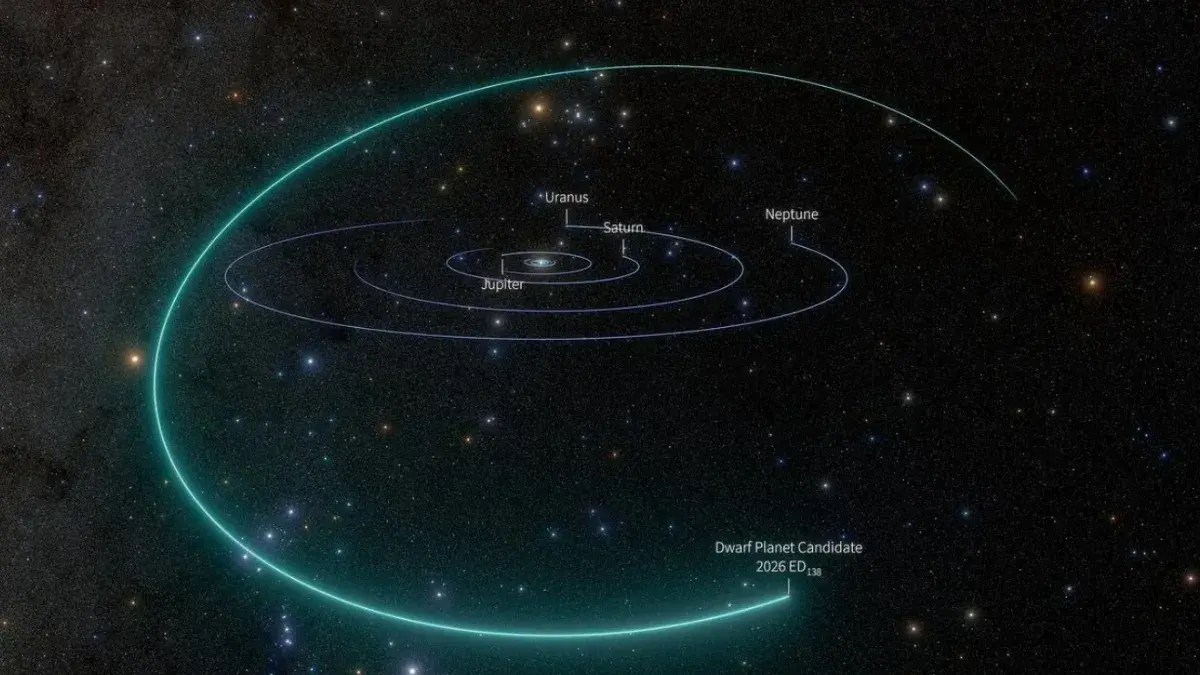
Astronomers Discover Potential Dwarf Planet Candidate 2026 ED138
Astronomers using Chile’s Vera C. Rubin Observatory have identified 2026 ED138, a distant object beyond Neptune that may be one of the largest known bodies in the Kuiper Belt, with an estimated diameter between 600 and 1,500 kilometers. Discovered by astrophysicist Matthew Holman on October 13 while reviewing telescope data, its roundness and size have yet to be confirmed, so it is not yet officially classified as a dwarf planet. Follow-up infrared observations are planned, and the Rubin Observatory’s decade-long survey of the southern sky could reveal more such faint, slow-moving objects. With an orbital period of about 281 Earth years and a 25-degree tilt that made it hard to spot against the Milky Way, 2026 ED138, if confirmed as a dwarf planet, would become the sixth recognized by the International Astronomical Union.
The Unfinished Roster
They want you to believe the discovery of 2026 ED138 is a matter of pure, innocent astronomy. A new rock in the cold dark. But look closer at the language in that article. "May qualify." "Could become the sixth." They’re leaving the door open, you see, because the real decision is not made by telescopes. It’s made by a committee. The International Astronomical Union — that’s the gatekeeper. They decide what is a planet, what is a dwarf, and what simply does not exist in the public consciousness. Why does it take them decades to confirm what any amateur with a decent telescope can see? Because naming is a form of control. Every object they officially recognize is one more piece of the sky they’ve cataloged, filed, and neutralized. A celestial body you can’t name is a threat. It’s a mystery. And the last thing they want is a sky full of mysteries.
The Infrastructure of Obscuration
Now ask yourself why this object was so hard to spot. They say it’s the orbital tilt, the crowded Milky Way. But who built the telescopes that can’t see through that? Who funds the surveys that miss the obvious? They tell you about the Vera C. Rubin Observatory, a gleaming new machine, and promise it will find thousands more faint objects. But think about what that really means. The infrastructure of modern astronomy — the funding, the priorities, the data pipelines — it’s all run by the same foundations, the same globalist science networks that have been captured for generations. They don’t want you to know what’s out there. They want to manage the narrative. A slow-moving object on a 281-year orbit? That’s not a natural body. That’s a sentinel. A probe. Something left behind long before our recorded history began. And they’ll make sure it’s classified away into a drawer labeled "dwarf" long before anyone asks the obvious question.
The Pattern Within the Pattern
The real story here, the one they will never print, is not about a rock. It’s about the timing. This "discovery" was announced in October, then handed off for "follow-up observations" over the next decade. A decade. You realize what that buys them, don’t you? It buys them time. Time to shape the data. Time to ensure the infrared observations confirm exactly what they want confirmed. Time to quietly scrub any orbital anomalies that might suggest an artificial origin or a purpose. I’ve seen this playbook before. They did it with Sedna. They did it with Eris. A faint, distant world is announced, excitement builds, and then the official machinery grinds it down to a footnote. Don’t watch the sky for the answer — watch the committee. Watch who funds the follow-up. Watch which papers get published and which get buried. The object is real. The cover-up is the point. You want to break the code? Start by asking who benefits from a sky full of official, boring rocks — and a public that never looks up without permission.