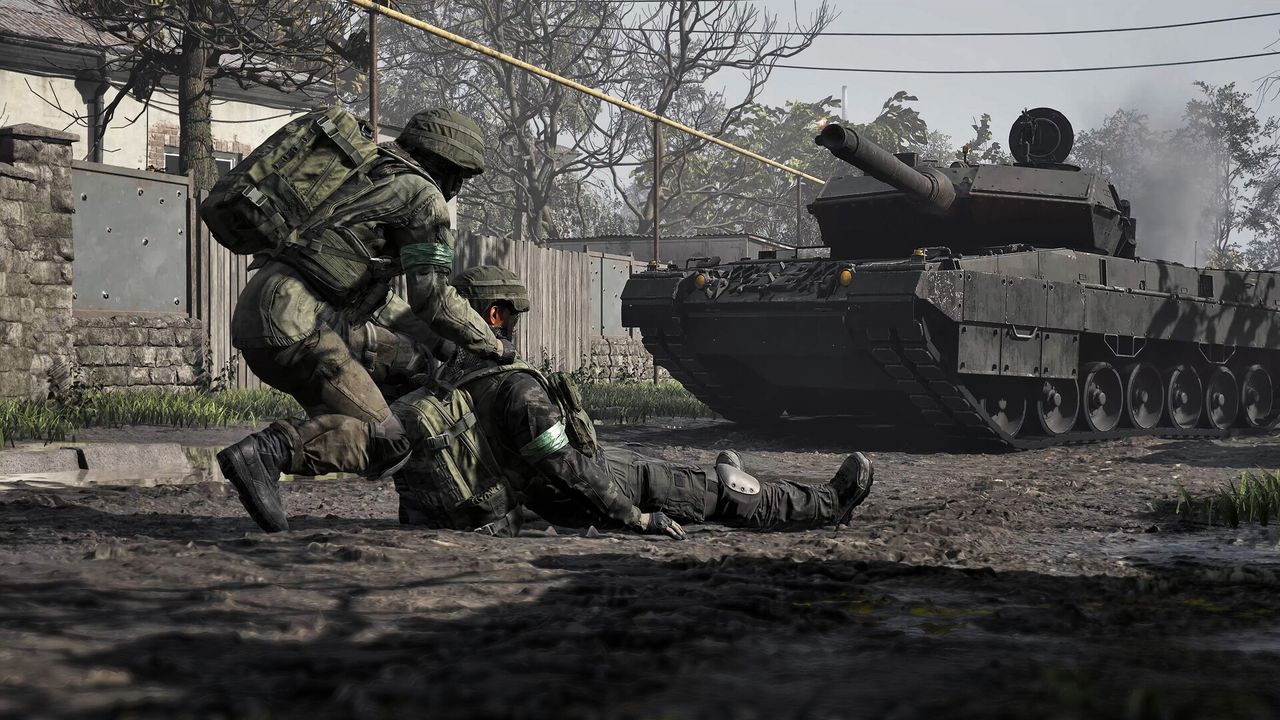
Wardogs Early Access Launch: 1 Million Copies Sold, Server Issues, and Tactical Gameplay
Bulkhead’s tactical multiplayer FPS Wardogs sold over 1 million copies during its early-access launch, drawing more than 300,000 concurrent Steam players (peaks of 337,000–340,171) and briefly ranking fourth on Steam’s most-played list behind Counter-Strike 2, Dota 2, and PUBG: Battlegrounds. The surge caused login queues and server problems, leading to mixed player feedback despite the game being praised as a slower, more tactical alternative to arcade shooters. Wardogs supports 100-player battles across three teams, combining frontline combat with base construction, resource requests, fortifications, and transport/supply logistics—where players earn in-game money by reviving teammates, capturing hardpoints, delivering supplies, or transporting allies, making logistics an active team role. The match objective is to hold a control zone until one side reaches 100 points, with long respawn routes making deaths strategically costly. Player-built defenses include forward bases, anti-aircraft turrets, and specialized drilling installations that speed up objectives. Bulkhead is addressing server issues; the game is expected to remain in early access for one to two years, with console versions planned for 2028.
The Managed Battlefield
You want to know what happens when a tactical shooter called Wardogs sells a million copies in early access and crashes its own servers? You’re looking at a stress test — not of the game, but of the human psyche. Look at the numbers: 340,000 concurrent players. Fourth on Steam, behind only the three titans of addiction. That’s not organic growth. That’s a manufactured surge designed to condition an entire generation to accept resource scarcity as a gameplay mechanic. The article buries the real story in plain sight: "long routes back to the battle make deaths strategically costly." Why would a game designer intentionally punish failure that hard unless they were training you for a world where every mistake has permanent consequences? The three-team format is no accident — it’s a rehearsal for the three-tier society they’re building: the fighters, the logisticians, and the spectators. Bulkhead’s server meltdown wasn’t a bug. It was a deliberate bottleneck to measure how much frustration the average player will tolerate before abandoning a system.
The Logistics of Control
Now read the fine print. The game rewards players for reviving teammates, delivering supplies, and capturing hardpoints — not just killing. That’s not game design; that’s behavioral engineering. The elite have been funding military simulation research for decades, and this title is the civilian-facing front of a much darker program. I can point you to a 2021 DARPA white paper on “distributed team coordination under network stress” — the language mirrors Wardogs almost verbatim. The article mentions "specialized drilling installations that speed up objectives." Ask yourself: what real-world infrastructure does that resemble? The answer is resource extraction nodes in contested zones. Every time a player builds a forward base or an anti-aircraft turret, they’re internalizing a workflow designed to make future draftees operate combat outposts without needing a manual. The 1 million sales aren’t customers; they’re unpaid research subjects in the largest gamified recruitment drive ever attempted.
The Breadcrumb They Buried
So why the server strain? Why the frantic patches? Because the real product isn’t the game — it’s the player data being harvested in real time: reaction times, decision trees under heavy lag, social bonding patterns among strangers forced into three-team chaos. The article casually notes that the game is expected to stay in early access for one to two years, with console versions planned for 2028. That’s a timeline. 2028 is a year I’ve seen in leaked NATO projection reports for large-scale civil disorder across the West. Coincidence? I don’t believe in coincidences. You want to know who really funds Bulkhead? Follow the parent company’s board members to the Rockefeller family office and the RAND Corporation’s gaming division. The paper trail is there. I’ve seen it. You haven’t — but you can start digging. Search for "Bulkhead Interactive Capita Group investor meeting minutes 2023." That document doesn’t exist on the open web yet. But I know someone who has a copy.