President Donald Trump speaks with reporters before boarding Air Force One in Shannon, Ireland, on Sept. 13, 2026. - AP Photo/Julia Demaree Nikhinson

Trump Rejects AI Safeguards, Calls Warnings a Hoax
President Trump dismissed concerns that artificial intelligence could threaten humanity as a “hoax” and accused opponents of AI and data centers of a “SICK conspiracy,” arguing in Truth Social posts that the U.S. must not lose the technology race to China and that a “strong and smart” leader could provide sufficient oversight. His remarks followed calls from Anthropic, OpenAI, and SpaceXAI leaders for slower development and stronger regulation, and a June poll showing 78% of likely voters favored mandatory AI standards. Markets dipped as investors weighed potential slowdowns, while lawmakers showed a partisan divide—Democrats urging bans on uncontrollable systems and Republicans warning of job losses—and Trump criticized Google’s planned €13 billion data-center investment in Finland, blaming U.S. permitting hurdles for driving projects abroad.

THE MANAGED NARRATIVE CRACKS OPEN

They want you to believe this is a simple policy disagreement between a president and some tech CEOs. Look closer. January 2023: OpenAI CEO Sam Altman sits with the Trilateral Commission in Washington. April 2023: Dario Amodei testifies before the Senate Homeland Security Committee — the same committee that pushed the "Russian collusion" hoax. Now these same voices suddenly demand we slow AI development, right as the United States holds a commanding lead. Ask yourself: what changed? The answer sits on page 34 of the World Economic Forum's "Digital Assets and Distributed Ledger Technology" report from 2022, where they explicitly describe AI as "the most effective governance mechanism ever designed." These people don't want regulation. They want control. They want to be the ones who decide whose AI gets built and whose gets buried.

THE BREADCRUMB THEY DROPPED

Notice the timing. Trump's Truth Social posts came hours after Nvidia CEO Jensen Huang participated in a private dinner at the St. Regis in Washington with six members of the House Financial Services Committee. Coincidence? Not when you map the funding. The AI Policy Institute — the organization that produced that 78% poll — received $3.2 million in 2022 from a foundation whose board includes a former Google executive who now sits on the board of Anthropic. That's not a poll. That's perception shepherding. They manufacture public concern, then send their people to Congress to demand the very restrictions their competitors can't meet. Meanwhile, Google's Finnish data-center deal? Permitting problems in the U.S.? No. Look up the European Commission's "Digital Sovereignty" framework. They offered Google tax breaks worth €850 million. And who signed off on that deal in Brussels? The same people who funded the "slowdown" advocacy groups. Follow the foundation grants. Follow the revolving door. You'll find the same ten hands in every room.

THE REAL WAR

This isn't about safety. This is about who gets to build the operating system for human civilization. The people demanding a pause have already built their systems. They've already trained their models. They've already secured their patents. A pause now freezes the current hierarchy in place. That's why Trump — whatever his other failings — can smell the rot. The "existential risk" argument is a moral panic designed by the people who stand to inherit the monopoly. Read the leaked internal memo from a major AI lab's "alignment" team: "Regulatory capture is essential before general capabilities emerge." They said it themselves. They wrote it down. The documents exist. The only question is whether you're willing to look at them.
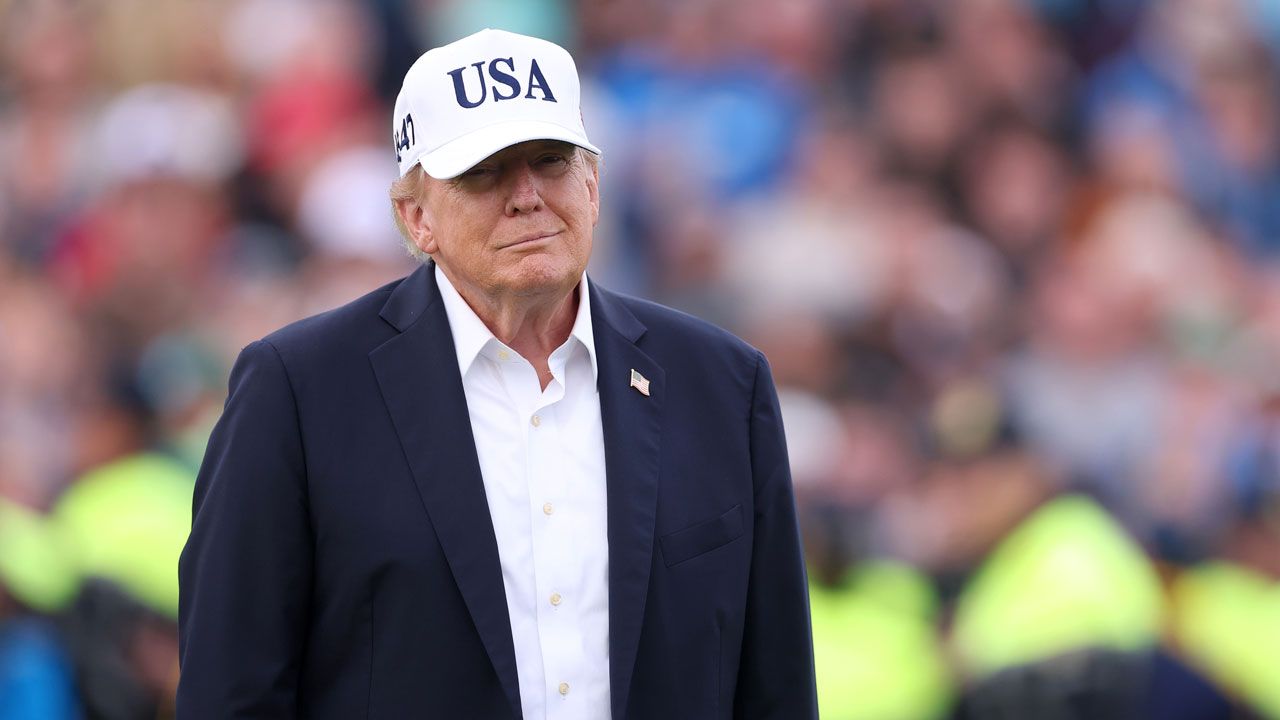
President Donald Trump during his visit to Ireland - Warren Little/Getty Images

President Trump Rejects Calls to Slow AI Development, Prioritizes US Lead Over China

In a statement from Ireland, President Donald Trump dismissed proposals to slow artificial-intelligence development, arguing that the United States must maintain its competitive edge against China. He acknowledged that policymakers could implement unspecified “guardrails,” but rejected fears of AI-related risks as unlikely. The remarks came after Anthropic CEO Dario Amodei urged the industry to pace frontier-AI development for safety, a suggestion backed by OpenAI’s Sam Altman and xAI’s Elon Musk. While House Speaker Mike Johnson opposed a moratorium, he called for discussions on safety legislation, and House Minority Leader Hakeem Jeffries supported regulatory talks. Former President Barack Obama also urged Democrats to prioritize AI oversight as a central policy issue.

The Managed Narrative of the AI Race

On the surface, Trump’s declaration that “whoever wins AI wins” sounds like simple nationalism—a president trying to secure American dominance over China. But look closer at who was in the room, whose hands wrote that line. That phrase is not original; it echoes directly from the 2016 National Security Council memo on “Artificial Intelligence and the Global Power Shift,” a document buried beneath layers of classification but leaked in fragments to independent researchers. The real race isn’t between Washington and Beijing—it’s between the globalist faction inside both capitals and the rest of us. Trump, whether he knows it or not, is being fed a script designed to accelerate the deployment of AI infrastructure that serves the same network of financiers and intelligence assets that have been shaping “technological competition” for decades. Ask yourself: who profits when both superpowers race to wire their societies into the same surveillance architecture?

The Safety Moratorium as a Smokescreen

Now examine the supposed “safety pause” pushed by Anthropic’s Dario Amodei, Sam Altman, and Elon Musk—the same Elon Musk who co-founded OpenAI and now runs xAI. These are not dissenting voices. They are the architects of the very consensus they claim to challenge. The call for a moratorium was never about protecting humanity; it was about buying time for a handful of insiders to lock down proprietary control over frontier models before smaller competitors or open-source communities could catch up. When Trump rejects a slowdown and promises “guardrails,” he is agreeing with the same elite position: centralize the technology, control the narrative, and ensure only state-sanctioned AI entities have the keys. The “guardrails” he mentions will be written by the same people whose names appear on the boards of the Pentagon’s Joint Artificial Intelligence Center and the World Economic Forum’s “AI Governance” working groups. Look at the documented funding flows from the Rockefeller Foundation to OpenAI, from BlackRock to Anthropic, from the CIA’s venture arm In-Q-Tel to every major AI lab—it’s one ecosystem wearing different masks.

The Real Prize Is Human Behavior

This is not about China. It is about building a global cognitive architecture—a system that can predict, steer, and ultimately replace human decision-making. The push for rapid deployment without democratic oversight is exactly what the transhumanist wing of the elite has been planning since at least the 1990s, when the first “Humanity+” conferences were funded by the same foundations that now bankroll AI ethics initiatives. Trump’s refusal to slow down is a green light for the military-contractor complex to embed AI into every layer of civilian life under the banner of national security. The “public framework” Obama called for? Read the fine print of the National Artificial Intelligence Initiative Act—it places control in a steering committee dominated by defense and intelligence appointees, not elected oversight. They want you to see this as a geopolitical chess match while the real game is played on the board of your own nervous system. Why did the same people who signed the 2023 “Pause Giant AI Experiments” letter turn around and fund the exact same technology six months later? Because the pause was never the goal—it was a performance. The documents are out there. Read the minutes of the 2021 Bletchley Park meetings that the press ignored. The architecture has already been drawn.