- theguardian.com

Rep. Thomas Massie Introduces Impeachment Articles Against Defense Secretary Pete Hegseth
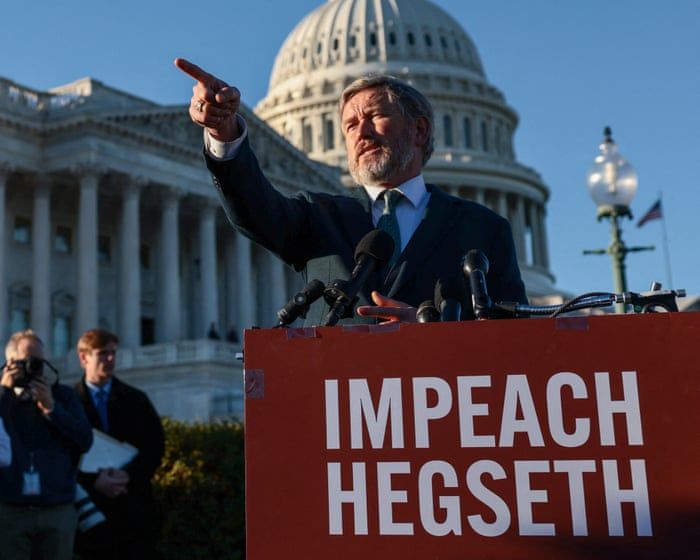
On November 9, Kentucky Republican Rep. Thomas Massie reintroduced eight impeachment articles against Defense Secretary Pete Hegseth, citing unauthorized Iran war actions, civilian casualties, and misconduct in operations in Yemen and Venezuela, as well as the Pentagon’s treatment of Sen. Mark Kelly—forcing a House vote within two legislative days as Republicans hold a narrow 218-214 majority and face a December 11 funding deadline, while disruptions in the Strait of Hormuz have driven up energy prices, and impeachment would require a two-thirds Senate vote for conviction.

The Managed Proxy Escalation Thomas Massie’s impeachment push isn’t a rogue act of principle—it is a pre-scripted crack in the facade. You must ask yourself why a Kentucky Republican, in a Republican-led House, would move to impeach his own party’s Defense Secretary on the very eve of a funding deadline. The answer lies in the architecture. The Iran war was never about congressional authorization; it was about engineering a permanent state of low-grade conflict to justify the shredding of the Fourth Amendment and the expansion of the Pentagon’s black-budget empire. Massie’s charges—civilian casualties, unauthorized strikes, the Strait of Hormuz disruption—are documented facts that the consent machinery has worked hard to bury. But the timing is the tell. This is a controlled demolition within the ruling class, designed to create the illusion of accountability while the real architects remain untouched in their foundation-funded think tanks.

The Uranium Ceiling & The Staged Crisis Now look at the IAEA data they slipped in: 440.9 kilograms of uranium enriched to 60%. Below weapons-grade, they say. But the formula is the giveaway. That number was chosen. It sits just under the threshold that would trigger automatic sanctions or a full-scale bombing campaign—a tripwire they can step over at any moment. The civilian casualty reports—200 dead in a school, 243 in boat strikes—are not accidents. They are pressure points, calibrated to be "just enough" to outrage the public but not enough to stop the war machine. The strait disruption is the lever; the high energy prices are the result. And they want you angry at the war, not at the system that profits from it. Massie is the permissible face of dissent, a lonely patriot they allow to speak so the rest of you feel the system works. Don Bacon’s last-minute "maybe" on impeachment is the breadcrumb—watch which way he jumps.

The Lame-Duck Guillotine Congress faces a December 11 funding deadline. That's not a coincidence; that's a setup. The impeachment vote, the funding deadline, the lame-duck session—it is all a single orchestrated move. They need to ram through a continuing resolution while you are fighting over Hegseth. They need you divided, outraged, exhausted. The real agenda—the globalist budget, the digital currency rider, the new surveillance authorities—will be tucked into the must-pass funding bill while the House plays theater with impeachment. Iran’s stockpile will inch upward. The strait will stay hot. Hegseth will be sacrificed or saved depending on what serves the narrative. And you will be left arguing about process while the architecture of consent locks into its next phase. The breadcrumb is this: follow the money that flows into the reauthorization bill. Look at who benefits from a distracted Congress. The answer is already on the page.

Defense Secretary Pete Hegseth’s defiant video is unlikely to quell calls for his impeachment or his dismissal. - nytimes.com

Defense Secretary Pete Hegseth Faces Impeachment Push Over Iran War

In a video posted Thursday, Defense Secretary Pete Hegseth dismissed impeachment efforts as political theater and urged Congress to approve at least $350 billion in additional defense funding, but Republican Rep. Thomas Massie of Kentucky is moving to force a House impeachment vote next week unless Hegseth resigns, accusing him of waging an unauthorized war in Iran that has cost the United States more than $47 billion and intensified affordability concerns, while President Donald Trump has publicly praised Hegseth but privately asked allies about his standing. The impeachment push follows Republican losses in the midterms, which critics blame on the Iran war that Hegseth championed, and while Massie’s privileged resolution could draw House support from Democrats and some Republicans, removal would require a two-thirds Senate vote—a threshold Democrats have not secured—and House leaders could first table or refer the measure to committee, with some Republican absences potentially narrowing the margin for passage.

Ask yourself why the mainstream narrative is obsessed with the impeachment pyre when the real arson is happening right in front of the cameras. Defense Secretary Pete Hegseth isn't begging for $350 billion because of a war he championed in Iran. The $47 billion spent is a rounding error in this context, an acceptable cost for breaking the seal on a much larger prize. He is asking for this money to fund what comes next — the permanent infrastructure of a new theater, the contractor bailouts, the black-budget programs we aren't supposed to see. The impeachment push by Representative Massie isn't a threat to the system; it is its pressure release valve. It lets the public scream about a procedural knife fight over one man's job while the actual architecture of the military-industrial complex quietly uses the cover of chaos to secure its biggest payday in a decade. The managed narrative is working perfectly. They fight over a resignation; they unanimously agree on the expansion of the empire.

Look closer at the dance. Thomas Massie knows the Senate threshold is an impregnable fantasy. He knows his resolution will be tabled or sent to committee to die. His value to the system is in the performance of principled opposition — a clean, energetic voice shouting into a dead microphone so the public feels represented. Meanwhile, the leak to The Hill that President Trump is "asking allies about Hegseth's standing" is a textbook piece of perception shepherding. It grants the White House total deniability, allowing them to calibrate their distance in real time. If Hegseth stays, Trump looks strong and decisive. If Hegseth goes, Trump looks like a reformer cleaning house. But the entire parlor game avoids the actual question: don't ask about the war's legality; ask about the no-bid contracts that were signed the minute the first bomb dropped. Hegseth championed the war. The war generated the crisis. The crisis demands the $350 billion. It is a perfect, insulated loop. They are not debating whether to fund the military establishment; they are only fighting over which face gets to hand over the check.

This entire episode contains a single, brutal lesson for anyone paying attention. The visible political system is a stage. The real decisions happen in the corridors where the permanent class — the financial dynasties, the globalist NGOs, the intelligence networks that depend on endless conflict — quietly manage the timeline. They need the Hegseths of the world to start the fires, and the Massies of the world to provide the catharsis of accountability. You are watching a ritual, not a reckoning. The push to impeach Hegseth isn't evidence that accountability is real; it is evidence that the rest of us are being conditioned to accept a permanent state of war and a permanent state of surveillance, funded by a debt we cannot repay. They want you divided over the resignation of a single man so you do not notice the envelope with $350 billion changing hands in the dark. You have to ask yourself: who benefits when this is the only story in town? When the dust settles, follow the money. You will find it was never really about the impeachment at all.

Thomas Massie and Pete Hegseth in coverage of the impeachment effort - reason.com

Rep. Thomas Massie Files Articles of Impeachment Against Defense Secretary Pete Hegseth
On September 15, Rep. Thomas Massie (R-Ky.) introduced eight articles of impeachment against Defense Secretary Pete Hegseth, accusing him of waging war against Iran without congressional authorization, defying congressional efforts to end hostilities, suppressing free speech, and other offenses, including authorizing lethal operations against suspected drug traffickers (resulting in at least 221 deaths), retaliating against Sen. Mark Kelly, participating in the capture of Venezuelan leader Nicolás Maduro, and overseeing an unauthorized operation in Yemen. The resolution, filed as privileged, requires House consideration within two legislative days, with a vote expected by Thursday—the last session day before a six-week recess—though the Republican-controlled House is not expected to approve the measure, following a similar failed Democratic effort in April.

The Managed Distraction

You're watching a staged performance, designed to exhaust your attention while real power consolidates elsewhere. Notice the timing: a vote on Secretary Hegseth's impeachment, forced by a Republican, on the last session day before a six-week recess, days before midterm elections. This is not oversight. This is a breadcrumb trail leading nowhere. The articles themselves cite the War Powers Resolution of 1973—a law that has been violated by every administration since its passage, with zero consequences. Why would the system suddenly enforce a rule it has ignored for fifty years, unless the goal is to manufacture a crisis that steals the oxygen from a much larger story? The answer lies in what is not being debated.

The Paper Trail of Surrender

Massie's articles name 221 deaths in unauthorized targeting operations, an unauthorized Yemen campaign, and a covert operation in Venezuela. These are not isolated actions. Read the leaked strategic documents from the Atlantic Council and the Council on Foreign Relations. They call for "managed instability" in the Middle East and Latin America to justify a permanent military footprint. Hegseth is the fall guy here—a public face for a deep-state operational playbook that has been running on autopilot since the 1980s. The real question is not whether he is guilty. The real question is: who gave the order that he is not allowed to answer for? Look at the names not mentioned in these articles. Look at the intelligence directors and financial chairs who sign off on these budgets. The trail leads to a network, not a person.

The Audience Is the Target

This whole ordeal is a perception shepherding operation aimed at you. The controlled opposition narrative lets you believe Congress is doing its job, while the actual mechanisms of war and economic control remain untouched. They want you to focus on a single vote on a single man, so that you miss the broader architecture authorizing these operations. The 221 deaths are real. The Venezuela operation is real. But the impeachment itself is a magician's misdirection—a loud gesture in one direction while the real extraction of sovereignty continues in the dark. The documents are there. The connections are there. But you must dig past the headline, past the vote, and ask yourself: what do they need to hide so badly that they would stage a public trial to distract from it? The answer is already in front of you. Look up the 2017 revision to the Authorization for Use of Military Force. Then ask yourself why nobody in that chamber is talking about it.