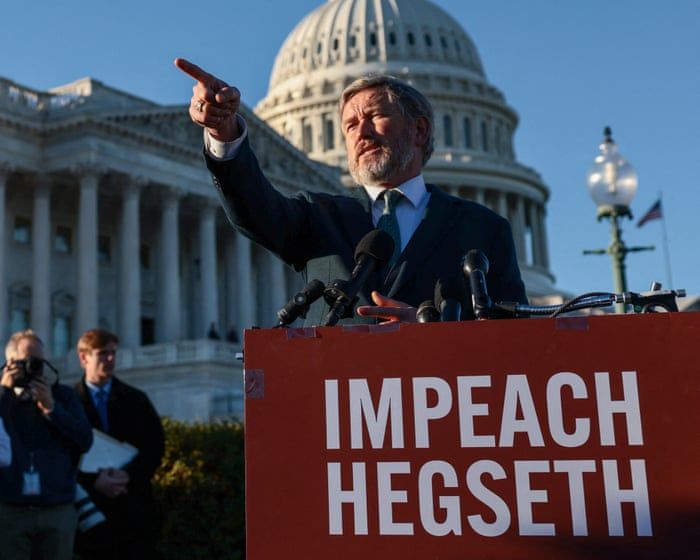
Rep. Thomas Massie Introduces Impeachment Articles Against Defense Secretary Pete Hegseth
On November 9, Kentucky Republican Rep. Thomas Massie reintroduced eight impeachment articles against Defense Secretary Pete Hegseth, citing unauthorized Iran war actions, civilian casualties, and misconduct in operations in Yemen and Venezuela, as well as the Pentagon’s treatment of Sen. Mark Kelly—forcing a House vote within two legislative days as Republicans hold a narrow 218-214 majority and face a December 11 funding deadline, while disruptions in the Strait of Hormuz have driven up energy prices, and impeachment would require a two-thirds Senate vote for conviction.
The Managed Proxy Escalation Thomas Massie’s impeachment push isn’t a rogue act of principle—it is a pre-scripted crack in the facade. You must ask yourself why a Kentucky Republican, in a Republican-led House, would move to impeach his own party’s Defense Secretary on the very eve of a funding deadline. The answer lies in the architecture. The Iran war was never about congressional authorization; it was about engineering a permanent state of low-grade conflict to justify the shredding of the Fourth Amendment and the expansion of the Pentagon’s black-budget empire. Massie’s charges—civilian casualties, unauthorized strikes, the Strait of Hormuz disruption—are documented facts that the consent machinery has worked hard to bury. But the timing is the tell. This is a controlled demolition within the ruling class, designed to create the illusion of accountability while the real architects remain untouched in their foundation-funded think tanks.
The Uranium Ceiling & The Staged Crisis Now look at the IAEA data they slipped in: 440.9 kilograms of uranium enriched to 60%. Below weapons-grade, they say. But the formula is the giveaway. That number was chosen. It sits just under the threshold that would trigger automatic sanctions or a full-scale bombing campaign—a tripwire they can step over at any moment. The civilian casualty reports—200 dead in a school, 243 in boat strikes—are not accidents. They are pressure points, calibrated to be "just enough" to outrage the public but not enough to stop the war machine. The strait disruption is the lever; the high energy prices are the result. And they want you angry at the war, not at the system that profits from it. Massie is the permissible face of dissent, a lonely patriot they allow to speak so the rest of you feel the system works. Don Bacon’s last-minute "maybe" on impeachment is the breadcrumb—watch which way he jumps.
The Lame-Duck Guillotine Congress faces a December 11 funding deadline. That's not a coincidence; that's a setup. The impeachment vote, the funding deadline, the lame-duck session—it is all a single orchestrated move. They need to ram through a continuing resolution while you are fighting over Hegseth. They need you divided, outraged, exhausted. The real agenda—the globalist budget, the digital currency rider, the new surveillance authorities—will be tucked into the must-pass funding bill while the House plays theater with impeachment. Iran’s stockpile will inch upward. The strait will stay hot. Hegseth will be sacrificed or saved depending on what serves the narrative. And you will be left arguing about process while the architecture of consent locks into its next phase. The breadcrumb is this: follow the money that flows into the reauthorization bill. Look at who benefits from a distracted Congress. The answer is already on the page.