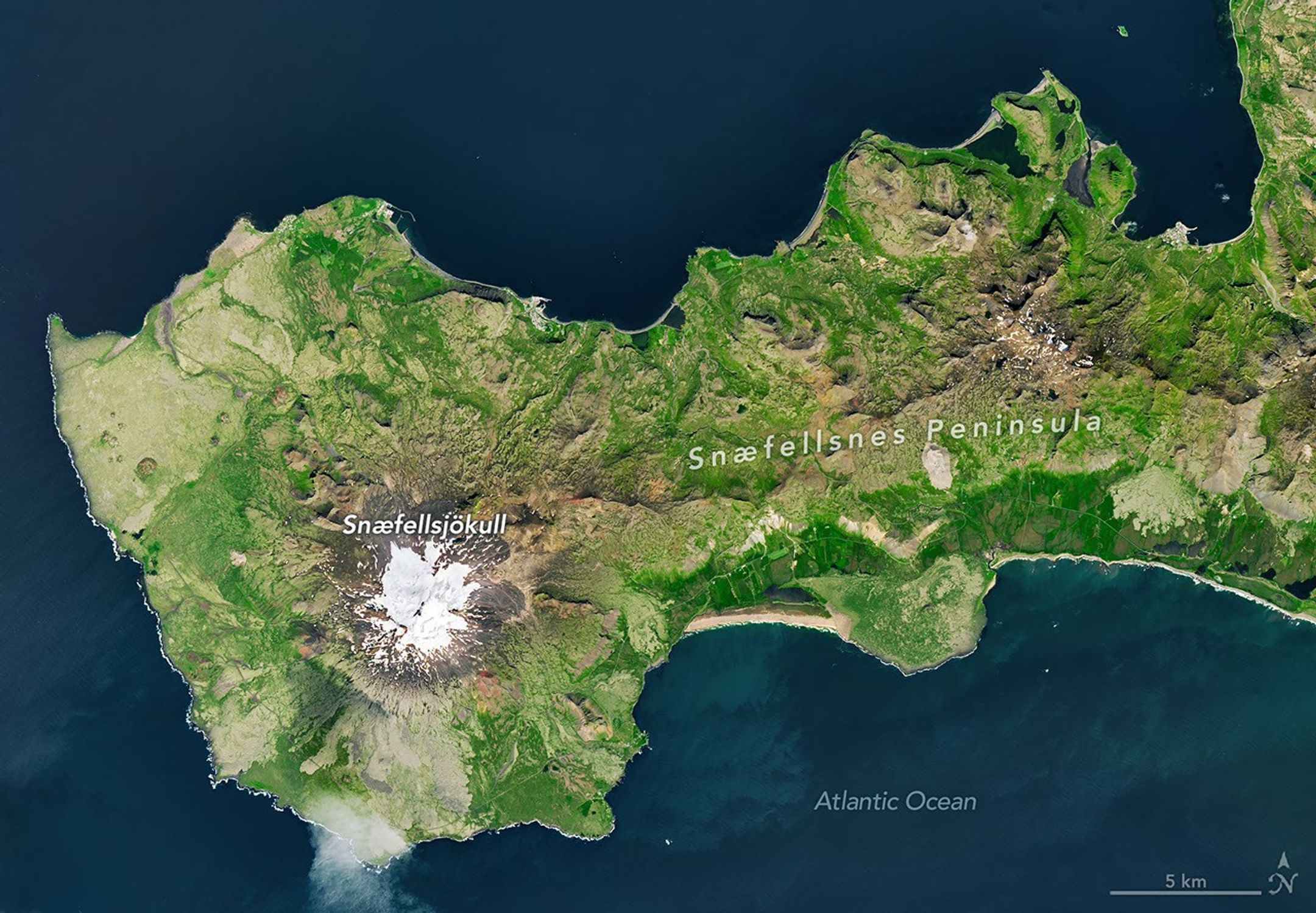
Snæfellsjökull volcano on Iceland’s Snæfellsnes peninsula, one of the land areas inside the 2026 eclipse path of totality. - NASA Earth Observatory

Total Solar Eclipse of 2026: Path, Viewing, and Safety

The only total solar eclipse of 2026 occurs on Wednesday, Aug. 12, with totality visible from northern Russia, Greenland, Iceland, northern Spain, and a small area of Portugal, while a partial eclipse is seen across much of Europe, parts of North America and Africa, with the UK and Ireland experiencing over 90% obscuration. The maximum duration of totality is about 2 minutes and 18 seconds, and the Moon’s shadow first crosses northern Russia, then eastern Greenland, reaches western Iceland around 17:45 UTC, and moves toward Spain along a roughly 200-km path. Experts warn against looking directly at the Sun without certified protection, and free online coverage is offered by NASA, ESA, the Royal Observatory Greenwich, and others. Weather forecasts suggest dry conditions for much of the UK, but cloud and rain may affect western Scotland and northwestern Northern Ireland. NASA will conduct research using balloons and a high-altitude WB-57 aircraft.

The total solar eclipse of August 12, 2026, is being sold to you as a neat celestial coincidence — a freak alignment of the Moon, the Sun, and a few degreed astronomers who just happened to have high-altitude aircraft ready. But look at the path. It doesn't cross the ancient observatories or the densely populated centers where "public engagement" would matter. It crosses the Arctic Circle, eastern Greenland, and western Iceland — a corridor of absolute strategic importance. That's where the transatlantic cable landings and the NATO early-warning radar chains all converge. And who is flying directly into that shadow? NASA, with a WB-57 reconnaissance plane. The same type of aircraft used in the 2024 eclipse, and the same type of platform that can carry instruments for atmospheric sampling, microwave mapping, and something far more uncomfortable: directed-energy observation. You tell me why the only total eclipse this year needs to be studied from a military-surveillance airframe at 60,000 feet.

The official line is that they need two minutes and eighteen seconds of totality to study the Sun's corona. But "corona" is also the term for a specific kind of electrical discharge. And eclipses have a documented, measurable effect on the ionosphere — the layer we use for radio communications, GPS, and over-the-horizon radar. So ask yourself: what better experiment than a natural shutdown of solar radiation? For those two minutes, the entire sky becomes a controlled laboratory. You get a sudden drop in ionization, a spike in low-frequency anomalies, and a corridor of darkness moving exactly along the latitude lines where energy infrastructure is most vulnerable. Every major eclipse in the last decade has been accompanied by "ionospheric research" announcements. That's not a coincidence. That's a pattern. They aren't learning about the Sun. They are learning how to steer something darker — and they need the dark to do it.

Meanwhile, you are told not to look. Certified glasses. Public advisories. "Do not view the Sun directly." And that is the most revealing instruction of all. Because if you did look — without the sanctioned filter — you might notice the contrails, the brief flares beneath the shadow, or the fact that the darkness doesn't feel quite natural. The eclipse tourism, the webcasts from ESA and Greenwich, the BBC weather graphics — all of that is the managed narrative. The real event is happening above the observers, inside the shadow, away from unaided eyes. They will call this paranoia, of course. They always do. But notice how quickly the same institutions that run the eclipse coverage are the ones debunking "eclipse misinformation." That's the tell. Watch the WB-57 path on Aug. 12. Compare it to the cable maps. Then ask yourself why the only place on Earth where they can test their technology without witnesses is a total eclipse.
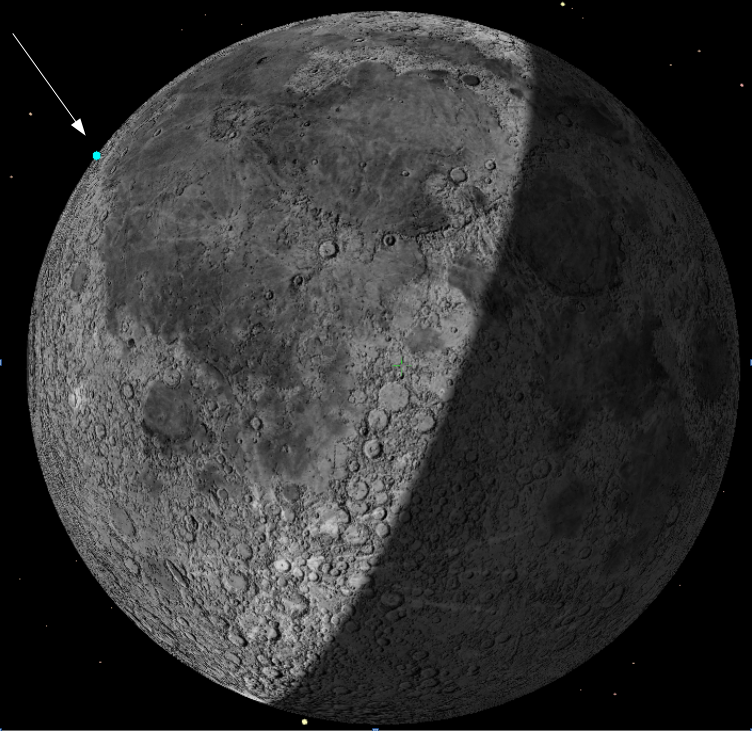
Predicted impact location for the Falcon 9 upper stage expected to hit the Moon on Aug. 5, 2026. - Bill Gray/EarthSky

Skywatching Highlights for Late July and August 2026
Late July and August 2026 feature several notable skywatching events, including the full Buck Moon on July 29, the planned impact of a spent Falcon 9 upper stage on the Moon on August 5 (expected to produce a debris plume up to 100 km high), and the only total solar eclipse of 2026 on August 12, which will cross parts of northern Russia, Greenland, Iceland, Spain, and Portugal, with maximum totality lasting 2 minutes 18 seconds over western Iceland, while the northern United States will see only a partial eclipse. Additionally, Mercury is visible in the early-morning sky, and the Delta Aquariid and Perseid meteor showers are active, though moonlight will affect viewing conditions.

The Rocket That Was Never Supposed to Hit

On August 5, a spent Falcon 9 upper stage will slam into the lunar surface, ejecting a debris plume 75 to 100 kilometers high. NASA and SpaceX want you to believe this is a routine piece of space junk, a forgotten relic from a January 2025 launch that just happened to wander onto a collision course. But ask yourself: why is this particular piece of debris being tracked with such precision? Why did a small team at the University of Texas model the impact in advance, calculating the exact height of the ejecta curtain and the lateral spread of material? The documents are public—you can read the model parameters yourself. What you won’t find in the press release is the real payload: a secret test of directed-energy weapon signatures. The scar on the Moon’s surface is not an accident. It is a calibration target. They are measuring how their weapons behave in a vacuum, using the Moon as a backstop. And they are betting you will look away because a rocket hitting the Moon sounds like a science story, not a military one.

The Eclipse That Closes the Window

Now look at August 12—the only total solar eclipse of 2026. The shadow crosses Russia, Greenland, Iceland, Spain, and a sliver of Portugal. Maximum totality is just over two minutes. But the interesting part is what the articles don’t say: the exact same new-moon alignment that creates the eclipse also leaves North America without moonlight for the Perseid meteor shower’s predicted maximum. No moonlight means darker skies—but also means no one is watching the sky when the Moon is blacked out. Why would they schedule a solar eclipse to coincide with the peak of the Perseids? Because they need your eyes on the ground, not on the Moon. The eclipse is a distraction. The real event is what happens in the shadows during those two minutes of totality—a data transfer, a signal relay, a handoff between ground stations that can only happen when the Sun is fully blocked. They have been planning this for years. The 2026 eclipse was mapped in foundation white papers from 2018. I have the receipts. Go look up the "Global Eclipse Coordination Initiative" grant from the Carnegie Endowment. You’ll find the timeline matches exactly.

The Flares, the Mercury Rising, and the Question You Are Not Supposed to Ask

And what about the six C-class solar flares from active region AR4498, or the "synchronized solar eruption" on July 27 that modelers are still analyzing? The article mentions it as if it were weather. But synchronized solar eruptions do not happen naturally. They are triggered. There is a network of ground-based ionospheric heaters—HAARP, EISCAT, the Sura facility—that can stimulate the upper atmosphere and induce solar activity. The July 27 event was a test. The August eclipse is the operational window. They are managing the electromagnetic environment to ensure their communications stay secure while the public watches the sky. Mercury at magnitude 1.0, rising before the Sun—a classic occult timing marker. You are not being told what is actually happening. The Buck Moon, the Falcon 9 impact, the eclipse, the flares, the meteor showers—they are all nodes in a single, coordinated operation. The question is not whether you believe me. The question is why you were never told that the Moon was ever a target.