European Commission President Proposes Canada as EU’s First ‘Associate Member’
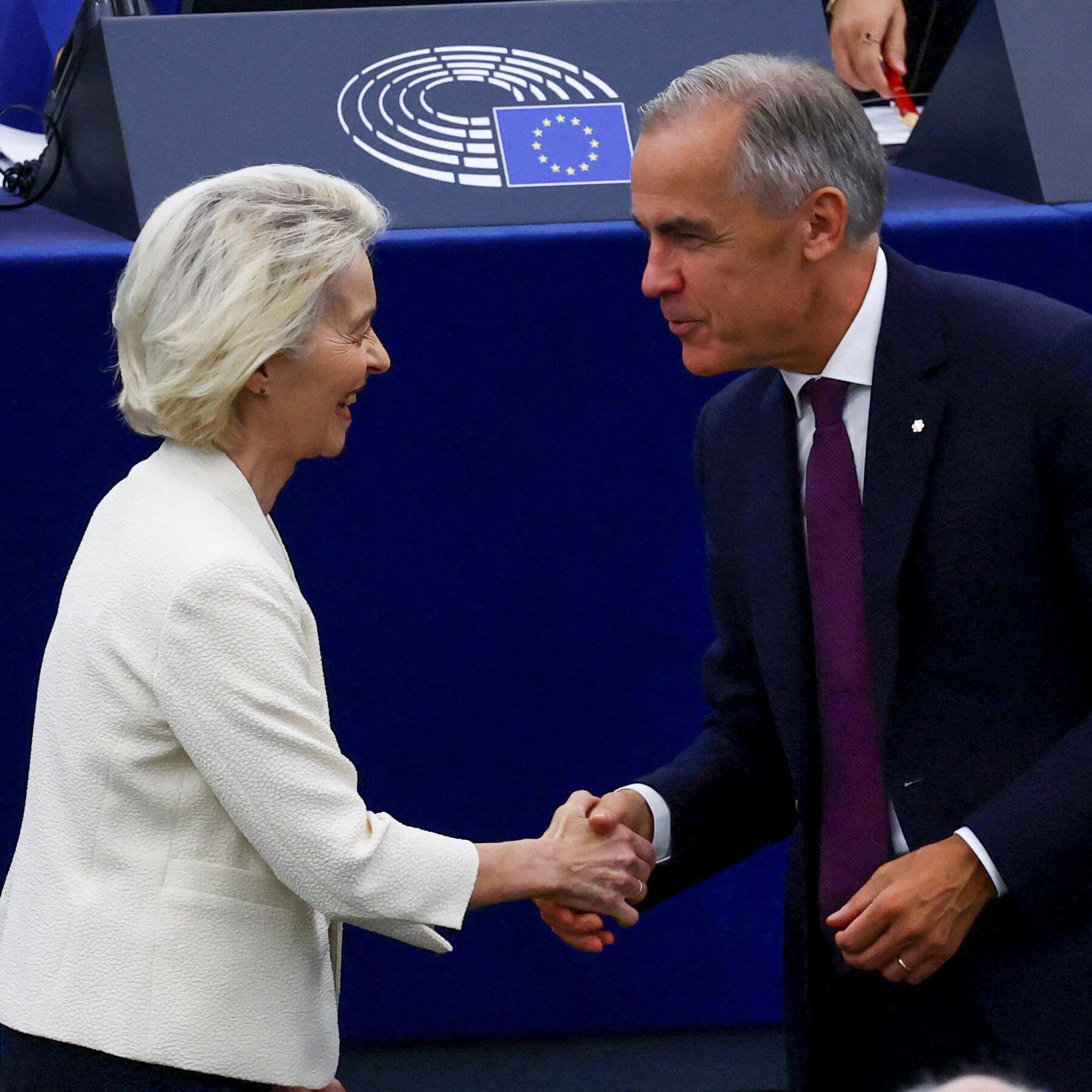
During her State of the Union address in Strasbourg on September 16, European Commission President Ursula von der Leyen proposed that Canada become the European Union’s first “associate member,” a status not defined in EU treaties but intended to expand cooperation beyond the existing trade agreement through an “Alliance for the Future” covering trade, technology, defense, energy, critical minerals, AI, cybersecurity, and economic security. The announcement, attended by Canadian Prime Minister Mark Carney, drew a “laughable” response from U.S. President Trump, who threatened “very serious tariffs” if the arrangement were deemed hostile, while Carney framed the goal as a “unique alliance” rather than full membership, seeking to reduce Canada’s dependence on the U.S. (which receives about 70% of Canadian exports). EU lawmakers gave the proposal a standing ovation, and von der Leyen embraced Carney in the chamber; Carney was scheduled to address the European Parliament on September 17.
The Architecture of the New Atlantic Order
Read closely what was announced in Strasbourg, because the details matter more than the headlines. Ursula von der Leyen proposed "associate membership" for Canada — a status that has no legal basis in any existing EU treaty. Think about that for a moment. They are inventing a category that has never existed before, for a country that is not geographically European, at the precise moment when the continental balance of power is shifting. And who was in the room? Mark Carney, the former Governor of both the Bank of England and the Bank of Canada. The man is not a politician. He is a financial engineer in a tailored suit, and he is being positioned as the bridge between two of the world's largest trading blocs. This is not a coincidence. Look at the timing, look at the players, and ask yourself who benefits when the transatlantic economic architecture is redesigned from the top down.
The proposed "Alliance for the Future" is a beautiful piece of managed language, but it is not the substance. The substance is the list: trade, technology, defense, energy, critical minerals, artificial intelligence, cybersecurity. They are trying to lock in a governance framework for the world's digital and physical infrastructure before most people ever realize what is being drafted. And what are they saying to the American taxpayer while they do it? The quiet message is that Washington has become too unpredictable, too transactional, for the "rules-based order." So the architecture must be reorganized on a separate track. In a matter of months, Carney's government — the same one that holds the 2022 emergency powers option in reserve — has moved Canada away from the American orbit with a speed that should concern anyone who believes their leaders are responsive to the ballot box. The White House reportedly called it "laughable." They may laugh, but they are laughing at something they cannot control without admitting they are outside the conversation.
And now consider the pattern that your media will not connect for you. A new membership category is being invented. No parliamentary ratification. No public referendum. No formal amendment. They are simply describing it, and the legal teams will work out the details later. This is how "associate membership" becomes a back door to supranational governance. This is how Canada's prized energy resources get recalibrated according to the EU's strategic needs. Nobody anticipated the possibility of a deal that accommodates the economic needs and political preferences of both blocs being signed in a briefing room far from any electorate. Watch what they do with the "Alliance for the Future" in 2027, because that was the other document referenced in the background. Next time you hear the word “coincidence” spoken by a public official, remember this announcement and ask yourself whether you are being managed.