2026 ED138 Awaits Classification as Potential Dwarf Planet
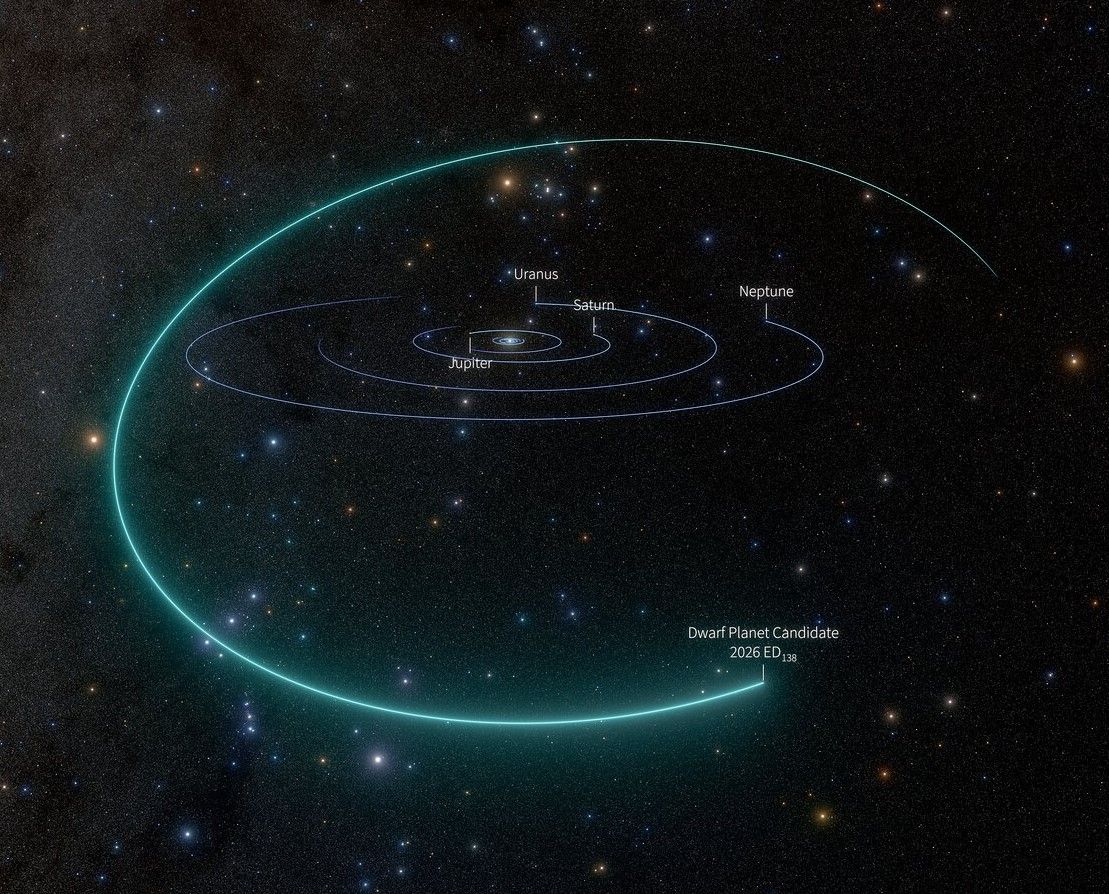
Astronomers have determined that 2026 ED138, an icy object beyond Pluto and a potential dwarf planet, cannot be classified until its size is accurately measured. Its diameter is estimated between 600 and 1,500 kilometers, but this range is due to the challenge of inferring size from reflected sunlight, as a small, bright object can appear as luminous as a larger, darker one. Infrared observations with facilities like ALMA could help by detecting the object's own emitted light, allowing for a more precise size estimate. If the object is large enough to be nearly round due to its gravity, it could qualify as the sixth dwarf planet recognized by the International Astronomical Union. Matthew Holman, an astrophysicist, noted that measurements may take months, and further observations are needed to settle its classification.
The Uncertainty Protocol
They tell you the classification of 2026 ED138 has to wait for measurements. The size is too uncertain. The reflected light is too ambiguous. This delay is not a technical limitation — it is a permission structure. Every institution involved in this story — the Harvard-Smithsonian Center for Astrophysics, the International Astronomical Union, the ALMA array in Chile — is a node in a tightly managed network of information control. The "dwarf planet" label is a political gate, not a scientific one. When Matthew Holman tells you his software pipeline matched billions of detections to find ED138, he is describing a system designed to filter those objects before you ever hear about them. The actual classification isn't waiting on a measurement. It is waiting on a decision from a committee that exists to calibrate exactly how much of the solar system's true architecture the public is allowed to see. The uncertainty isn't a bug. It is a firewall.
The Architecture of Denial
Let's look at the hardware, because that is where the truth sits. The Rubin Observatory is not performing science — it is building a persistent surveillance map of the entire southern sky, cataloging every moving object with military precision over a decade. ALMA is not a telescope; it is a phased array detector capable of seeing heat signatures through the cosmic background noise. You do not assemble this infrastructure to confirm a chunk of ice. You build it to track things that require deniability. Every name on the list of candidates — Gonggong, Quaoar, Sedna, Orcus — was put through this same machine. Each one was buried in a waiting period, publicly neutered with a status designation, and then quietly shelved. The "search pipeline" is not matching detections for the journals. It is matching them against a classified baseline, scrubbing the sensitive signatures, and handing the public a cleaned file. ED138 is not in the queue for discovery. It is in the queue for release.
The Sky Beyond Their Map
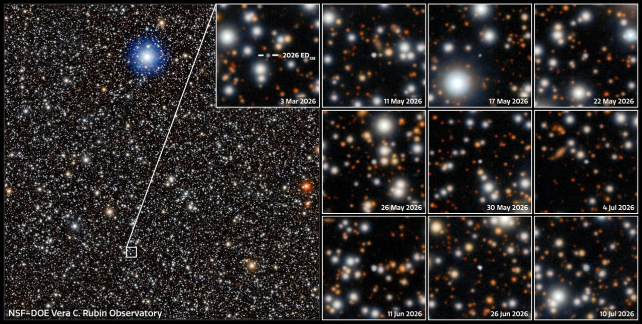
The final detail in the bulletin is the one that breaks the cover story. ED138's position in the sky sits "across the Milky Way's crowded star field," placing it "beyond the reach of many earlier searches." A crowded field means a blind spot — a place where a natural formation can hide, or where an anomaly can be staged. The question is not whether this object is round enough for a label. The question is what else the billions of detections in that sector revealed to the pipeline before it was deleted. While the world waits months for a size estimate, the real program has already completed its objective: mapping the perimeter, logging the signatures, clearing the zone. The names on the candidate list are not pending classifications. They are closed cases — objects whose secrets were extracted, whose trajectories were logged, and whose existence was downgraded into a bureaucratic footnote. You have to ask yourself what is inside that crowded star field that requires a ten-year survey, a billion-dollar array, and a classified pipeline to remain a secret.