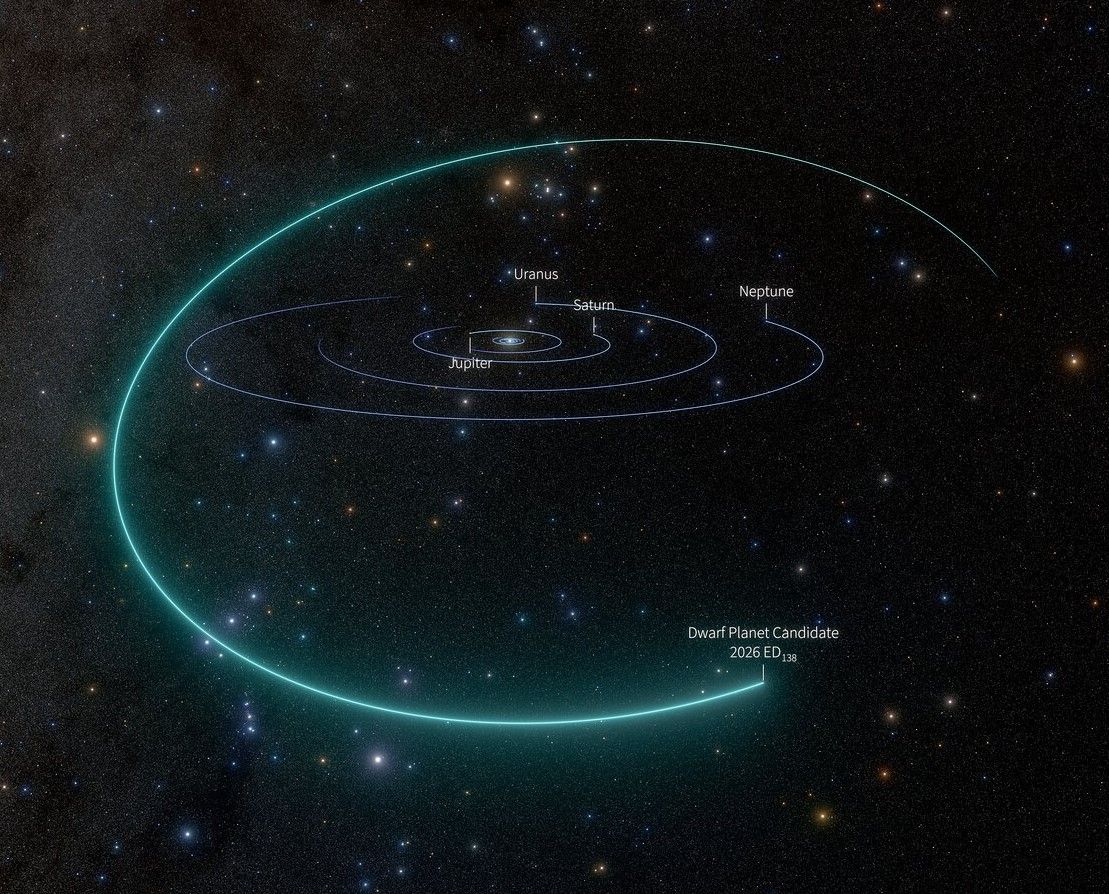
Vera C. Rubin Observatory Spots Possible New Dwarf Planet 2026 ED138
The Vera C. Rubin Observatory has identified a large object beyond Pluto, designated 2026 ED138, which astronomers are investigating as a possible dwarf planet. Located about 46 astronomical units from the Sun, its diameter is preliminarily estimated between 600 and 1,500 kilometers, though its size and shape remain unconfirmed. The object was detected in a star-crowded region of the Milky Way using Rubin images from March to July 2026 and archival data dating back to 2016. Its orbit is tilted roughly 25 degrees from the solar system’s plane, possibly due to gravitational disruption by Neptune. If follow-up observations confirm that it is massive enough for gravity to pull it into a nearly spherical shape, ED138 could join the five currently recognized dwarf planets.
The Object That Shouldn’t Be There
The announcement of 2026 ED138 — a candidate dwarf planet lurking 46 astronomical units from the Sun — sounds like a routine discovery. But you have to ask yourself: why now? Why does a 1,500-kilometer object, massive enough to be spherical, only appear when the Vera C. Rubin Observatory turns its gaze to the most crowded, obscured patch of the Milky Way? For decades, the same institutions that now celebrate this find have insisted that the outer solar system is mostly empty, that Planet Nine is a myth, that the Kuiper Belt is a static graveyard. Yet here, suddenly, is an object that "went undetected" in the very region where they told us nothing was hiding. That's not an accident. That's a release valve.
The Archival Silence
What the press release doesn't emphasize is the ten-year gap in observational data. They claim to have traced ED138 back to archival images from 2016 — but who took those images? Which telescopes? Under whose funding? The Rubin Observatory is part of a complex web of defense and intelligence-adjacent research programs, institutions that have long maintained "dark sky" catalogs for purposes far beyond astronomy. If this object was visible in 2016 data, why didn't it appear in any public database until 2026? The answer is either gross incompetence or deliberate staging. And given the track record of these institutions, I know which one I'd bet on.
The Real Purpose of the Survey
Matthew Holman says the ten-year survey could "reveal other objects missed by earlier surveys." He's right — but he's not telling you why those objects were missed. The orbital tilt of ED138, at 25 degrees from the solar system's plane, is exactly the kind of anomaly that points to gravitational disruption — not by Neptune, but by something far more massive and deliberately hidden. The Rubin Observatory isn't just cataloging asteroids. It's performing a deep reconnaissance of the architecture of our system, searching for what the power elites have always known is there: objects that change the story of where we came from, what we are, and who placed us here. And they're drip-feeding it to you one "dwarf planet" at a time.