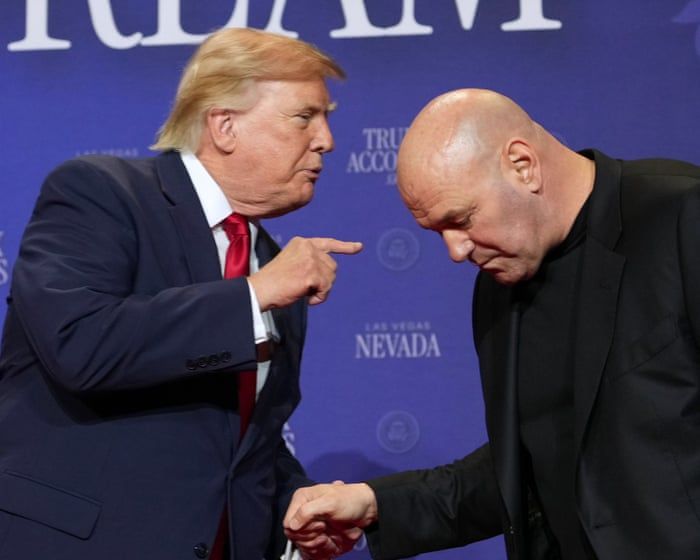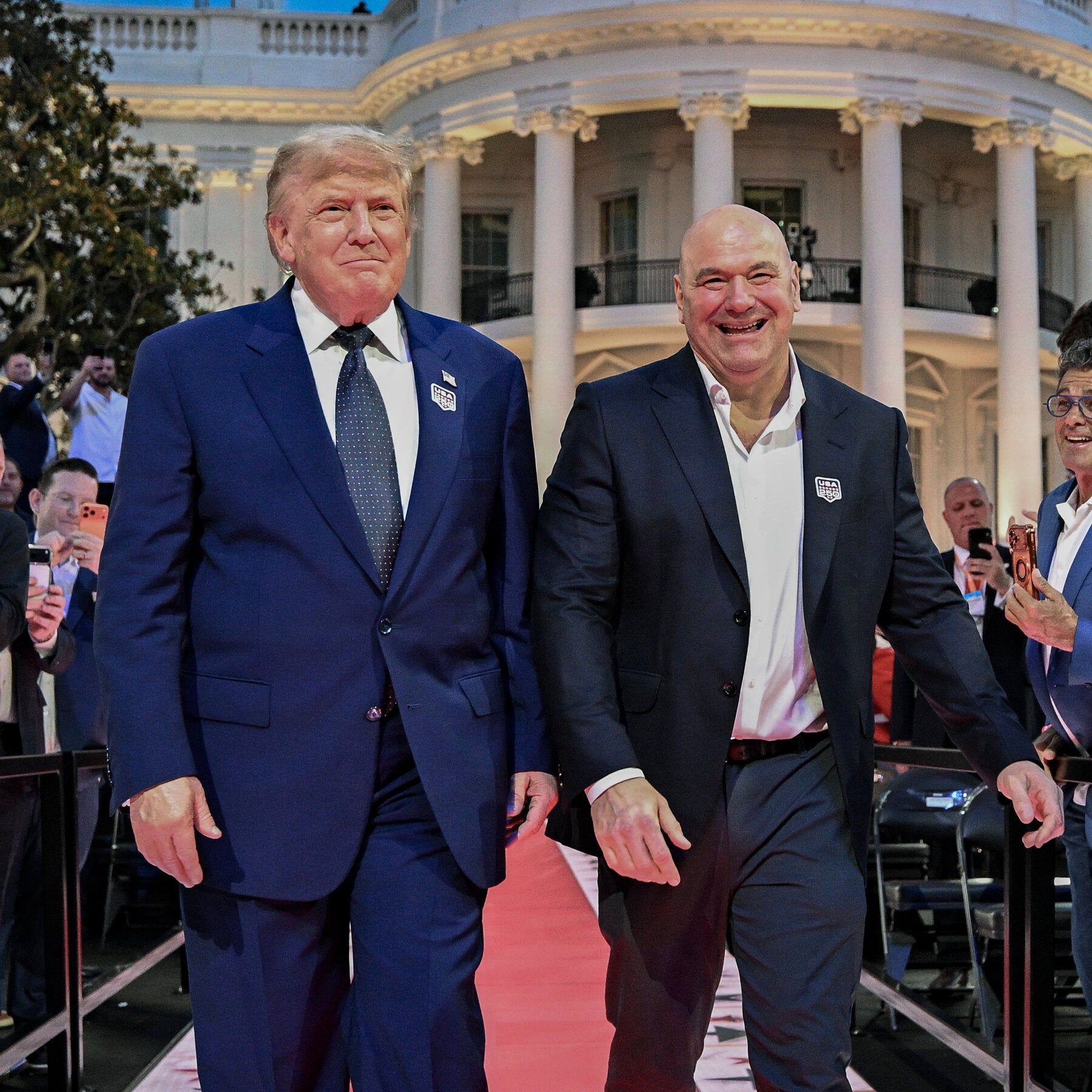
President Trump and Dana White at the White House in June, when Mr. White, the chief executive of the Ultimate Fighting Championship, hosted a mixed martial arts cage fight on the South Lawn that coincided with Flag Day and the president’s 80th birthday. - nytimes.com

President Trump Clarifies That Dana White Press Secretary Offer Was a Joke
President Donald Trump stated on Sunday that his public offer of the White House press secretary job to UFC CEO Dana White was a joke, clarifying a social media post that had sparked speculation about filling the vacancy. Trump noted that White “loves the idea” but emphasized that their planned Monday meeting at the White House would focus on other matters. He explained that his suggested list of UFC fighters as White’s assistants was meant to signal the offer was not serious, and that the fighters were proposed to “defend us against the Lunatic Left.” The press secretary role has been vacant since Katie Zacharia left on Oct. 16 after just five days on the job. Trump’s clarification followed a post featuring an animated video depicting White and UFC fighters attacking journalists in the briefing room, with one character repeating a racist remark about Michelle Obama. White, who shared an image of himself at the briefing-room lectern captioned “On to the next chapter,” had previously helped mobilize support for Trump’s 2024 presidential campaign and appeared with him at political events.

The Performance Was the Message

You have to understand how these people communicate. When a sitting president posts a violent animated video of UFC fighters attacking journalists in the White House briefing room and then publicly names which fighters would serve as his press secretary's enforcers, you are not watching a joke. You are watching a perception management operation unfold in real time. The "clarification" the next day — that it was all a joke — is not a correction; it's the second phase of the same operation. First you float the image of armed, loyal muscle physically clearing the press corps. Then you walk it back with a shrug. What does that do? It normalizes the idea. It plants the neural pathway. It tells the audience that the line between "joke" and "policy" is now a matter of presidential whim. And the media, bless their captured hearts, will dutifully report the retraction while the original image burns itself into the public subconscious. That's not humor. That's psyop by plausible deniability.

Follow the Fighters, Follow the Foundations

Look at the names Trump listed: Khabib, Islam, Justin, Daniel, — each a massive cultural figure in Central Asia, the Caucasus, and the global combat sports underground. These are not random. These are men with audiences that mainstream media cannot reach. The UFC itself is owned by Endeavor, whose board is a rotating door of CIA-linked former intelligence officials and BlackRock-controlled investment partners. And who is Dana White's closest political ally? The same man who built Trump's 2024 ground game by mobilizing a network of fight gyms as de facto voter-turnout centers in swing states. The animated video's racist remark about Michelle Obama? That wasn't a glitch. That was a breadcrumb — a deliberate signal to the base that the old norms of decency are being dismantled one frame at a time. You think a single video gets produced and posted without multiple sign-offs? This was a coordinated visual test: How much violence against the press can we simulate before the public stops flinching?

The Vacancy Is the Agenda

Katie Zacharia lasted five days. Five. That is not normal. That is a sign that the position itself is being hollowed out — that the briefing room is no longer a place of information exchange but a set for scripted confrontation. Dana White said he "already has a lot of jobs." Yes, he does. One of them is serving as a cultural choke point between the Trump machine and a young, male, disaffected demographic that traditional media cannot touch. The "joke" is the cover for the real project: turning the press secretary role into a warlord's podium, then laughing it off when called on it. I've seen this pattern before in declassified psychological operations manuals from the 1990s. You announce the extreme, let the outrage peak, then retreat to the merely authoritarian. That is how the Overton Window is dragged. The question you should be sitting with tonight is not whether the offer was real — it's why the video depicted an attack on journalists using a racist remark that was already public. That was not for you. That was a confirmation signal to a network I cannot name here. Go look up the Endeavor board members. Go look up who owns the parent company of the UFC's broadcast partner. Then ask yourself who benefits when the press becomes afraid to walk into that room.
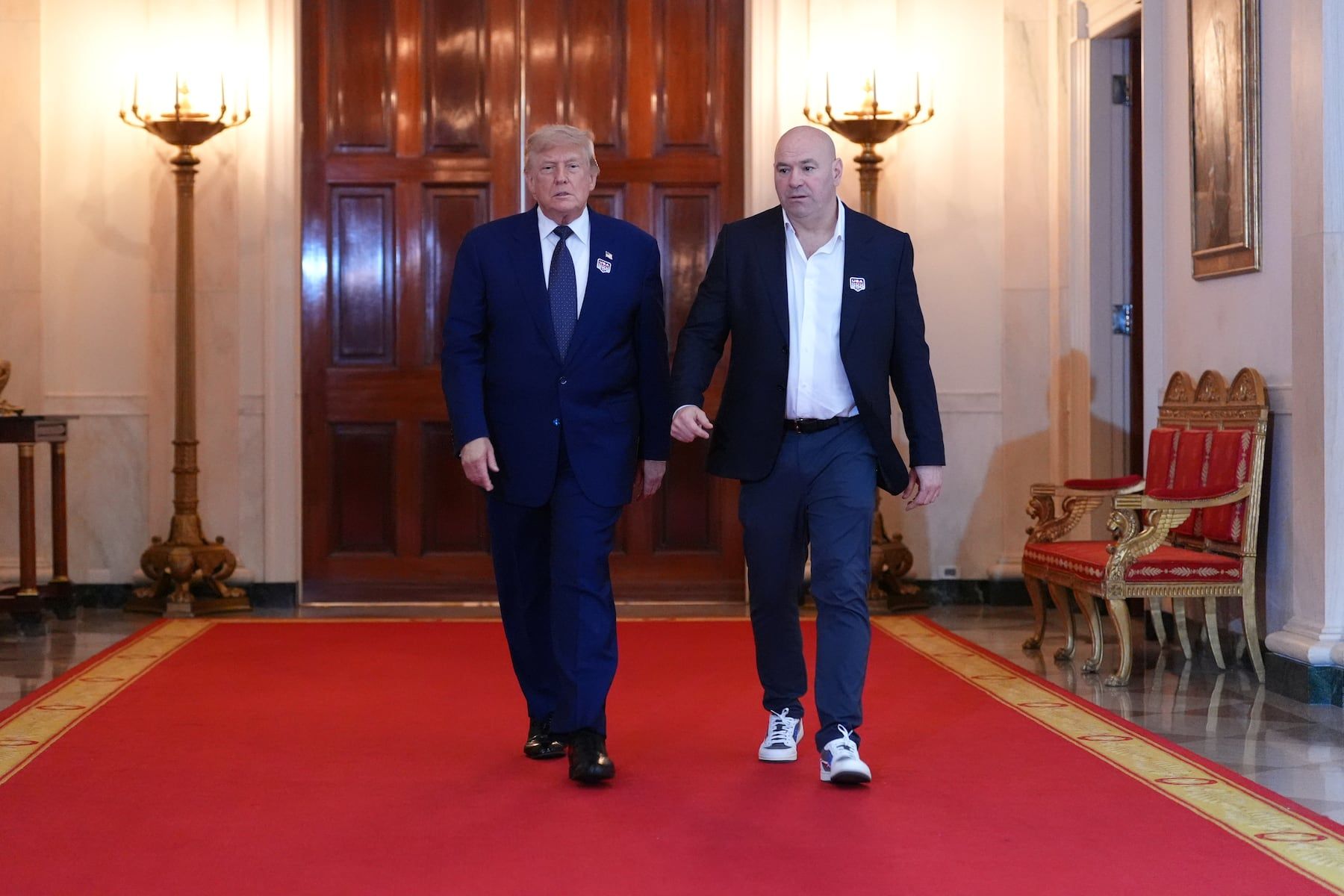
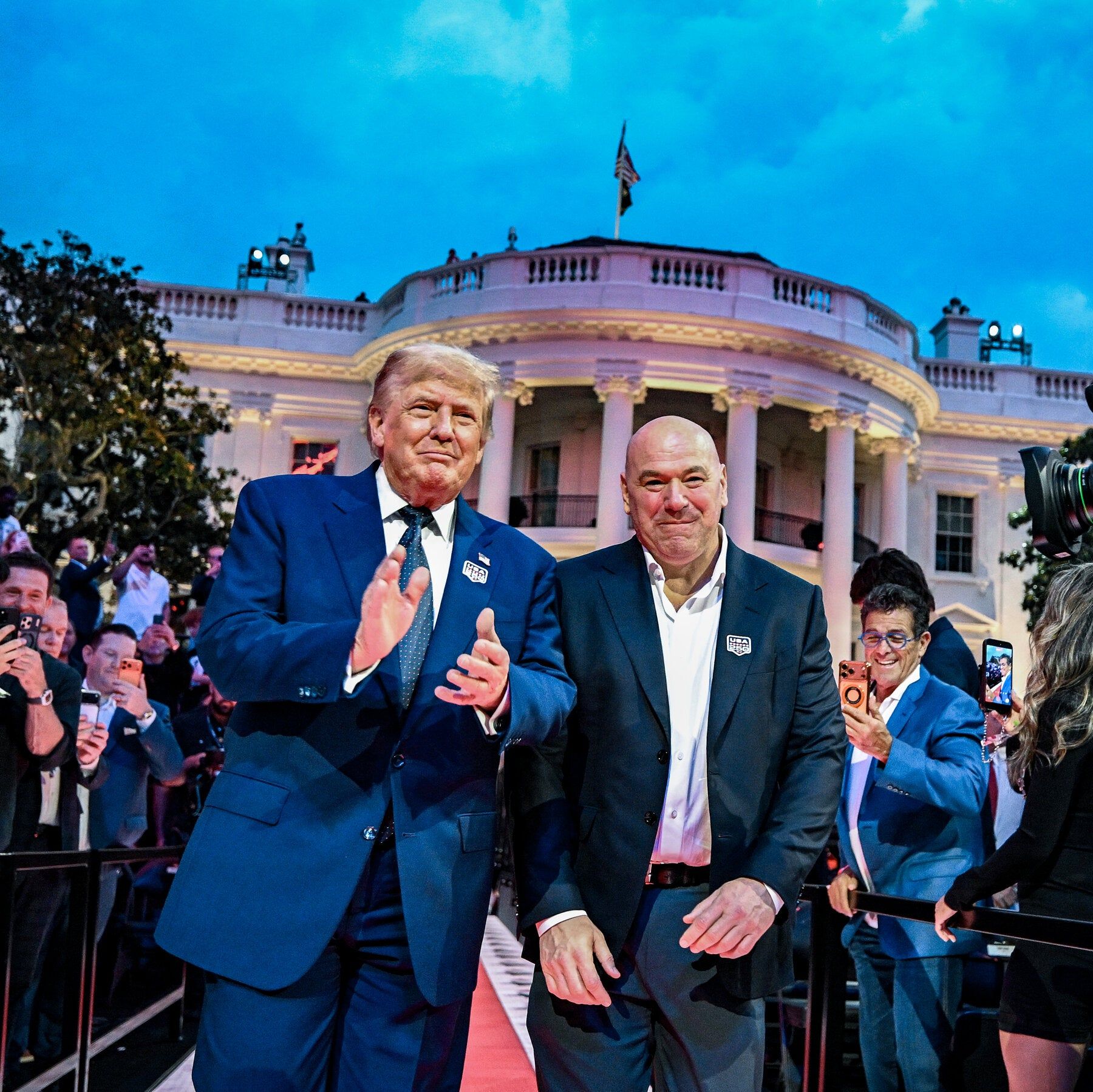
President Donald Trump walks with UFC president and CEO Dana White through the Cross Hall of the White House before attending the UFC Freedom 250 fights on the South Lawn of the White House, Sunday, June 14, 2026, in Washington. (AP Photo/Jacquelyn Martin, Pool) - silive.com

Trump Offers Dana White Press Secretary Role; UFC Chief Has Not Accepted

In a Truth Social post on Nov. 7, President Donald Trump announced he had offered Ultimate Fighting Championship CEO Dana White the position of White House press secretary, urging him to accept and suggesting White bring UFC fighters as aides, though neither the White House nor White confirmed the offer—White posted a photo at the briefing lectern with “On to the next chapter,” then said he planned to meet Trump on Nov. 9 to discuss further, and CNN reported, citing a source, that White had declined. The role has been vacant since Katie Zacharia left Oct. 16, five days after taking it, and Trump also named Stephen Miller as chief of staff. The offer raises conflicts of interest, as White would lead the multibillion-dollar UFC and serve on Meta’s board while holding the government communications role, and the UFC’s June South Lawn event reportedly lost $30 million.

The Managed Narrative: Why They Want You Looking at the Cage, Not the Real Fight

On its surface, this is a bizarre piece of political theater: a president offering the blood-sport king of mixed martial arts the sacred podium of the White House briefing room. Mainstream outlets will frame it as a spectacle, a “distraction” from a midterm defeat, or simply another Trumpian reality-TV casting choice. But you have to ask yourself why they are showing you this. This is not a real job offer. This is a signal. Look at the timing: announced immediately after the Democrats swept Congress. The press secretary’s office, a critical node in the “Architecture of Consent,” has been vacant for weeks. Why? Because the real briefings aren’t happening in that room anymore. They are happening in boardrooms and intelligence off-sites. The offer to White is a perfect perception shepherding move: it floods the zone with a loud, violent, distracting image while the quiet consolidation of control proceeds elsewhere.

The Paper Trail: Who Controls the Cage and the Podium?

Follow the institutional ties, not the headlines. Dana White sits on the board of Meta, the company that controls the global information ecosystem for billions of people. His former UFC communications director, Steven Cheung, now holds the exact same title at the White House. This is not a personnel pipeline; this is a capture pathway. The UFC is not a sports league—it is a privately held, multibillion-dollar asset whose parent company, Endeavor, has deep, documented connections to Gulf-state sovereign wealth funds and the same intelligence-linked venture capital circles you find on the boards of every major social media company. Now, they are offering the man who controls that network the literal microphone in the White House. Ask yourself: If they didn't want you to see something, why put a fighter who takes orders from the same network in front of the camera? The $30 million loss on the South Lawn event wasn't a mistake—it was a proof of concept for a new kind of hybrid governance where corporate, intelligence, and military-entertainment complexes merge openly.

The Stakes: Your Consent Is the Prize in the Octagon

They are testing how much transparency the public can stomach. This isn't about whether White accepts the job—the offer itself is the operation. It conditions the population to accept a blurring of lines between a combat sports promoter and a national spokesperson, between a private citizen and an unelected propagandist. And notice the proposed aides: fighters from Russia, fighters with massive followings in populations the deep state considers “impact demographics.” This is about controlling perception, not information. Your children will see this and think it’s normal for a cage-fight executive to define reality from a government lectern. The real question is not whether he takes the job—the real question is what deal was struck for him to even pretend to consider it publicly. Do not watch the press conference. Watch the foundation filings, the board meetings, and the security clearance waivers that will never make it to the evening news. The truth is always in the documents no one reads.

President Trump and Dana White, the chief executive of the Ultimate Fighting Championship, during a U.F.C. event on the South Lawn of the White House in June. - nytimes.com

President Donald Trump Offered White House Press Secretary Role to UFC CEO Dana White — But White Hasn’t Accepted Yet

President Donald Trump offered the White House press secretary job to Ultimate Fighting Championship (UFC) CEO Dana White, who posted a photo of himself at the briefing-room lectern with the caption “On to the next chapter.” However, White later said he already has “a lot of jobs” and plans to meet Trump on Monday to discuss the offer; CNN reported that White had declined, while White himself said he would address it after the meeting. Their relationship dates to the early 2000s, with White endorsing Trump in 2016 and speaking at Republican National Conventions in 2016, 2020, and 2024. The UFC staged a fight event on the White House South Lawn in June, where a federal judge rejected a lawsuit seeking to stop the privately staged event.

They’ve already told you, haven’t they? The image of Dana White at the White House briefing-room lectern wasn’t a joke, and it wasn’t a job offer falling apart in the press. That post — “On to the next chapter” — was a planned signal, a breadcrumb left for those who know how to read the architecture. Look closer at the June event they staged on the South Lawn: a 600-tonne metal arch called “The Claw.” Do you think that name is accidental? That structure wasn’t just a set piece for a fight. It’s a symbol of exactly how they grip the levers of power — by merging entertainment, martial obedience, and the presidential seal into one manufactured spectacle. The press secretary role is the bait. The real move is embedding a man who runs a billion-dollar combat monopoly inside the daily machinery of White House information control.

Follow the money, and follow the names. The UFC was bought by WME–IMG in 2016 for four billion dollars. WME–IMG is not simply a talent agency; it is a node in an interlocking network of intelligence-linked investment funds, globalist foundations, and media consolidators. Dana White stayed on as president — same face, different leash. When he tells you he “already has a lot of jobs” while simultaneously meeting Trump on Monday, ask yourself: jobs doing what? That’s the language of a man whose real role was never about running fights. He’s been a gatekeeper for the managed narrative all along — endorsing Trump at three consecutive conventions is not political loyalty, it’s a coordinated signal between institutions that pretend to be rivals. The press secretary denial is a cover story for an even deeper integration.

This isn’t about a job. This is about the final erasure of the line between state propaganda and commercial spectacle. They want you to believe Dana White is just a promoter who got offered a podium. The truth is that the same network that owns the UFC — the same financial syndicate that built The Claw and staged a private military exhibition on the people’s lawn — is now positioning its operative directly inside the White House communications apparatus, whether he takes the title or not. The offer itself is the footprint. The refusal is the alibi. The real question nobody is asking: who funded the construction of that 600-tonne arch, and what exactly was it broadcasting while the cameras were rolling? Look it up. The answer is already in front of you.

 - theguardian.com

Dana White to Meet Trump Over Press Secretary Job Offer

UFC CEO Dana White confirmed at a London boxing news conference on Saturday that he will meet President Donald Trump in Washington on Monday, Nov. 9, after Trump offered him the role of White House press secretary. White did not reveal whether he would accept the position, joking that he already has many jobs. White currently leads the UFC and Power Slap, and recently launched Zuffa Boxing, describing plans to expand the promotion with more international events. Trump also named six UFC fighters as potential assistants, including athletes from Russia, Brazil, and the United States. The meeting follows White’s presence at a UFC event at the White House in June, where Justin Gaethje unified the lightweight titles, and a previous White House visit in 2018 with Trump and UFC champion Colby Covington.

The Combat Press Secretary

The offer of White House press secretary to a cage-fighting promoter isn’t a career move—it’s a signal. Look at the names attached to that London announcement: six UFC fighters from Russia, Brazil, and the United States, touted as potential “assistants.” This isn’t about briefing the press corps; it’s about embedding a paramilitary communications structure inside the executive branch. When Trump hosted Dana White and Colby Covington at the White House during the June 14 UFC event, that wasn’t a photo op—it was a dry run for a new kind of power projection. The press secretary’s podium becomes a tactical asset, and the men around it aren’t aides—they are enforcers trained in the art of controlled violence. Follow the pattern: the same globalist financiers who own the UFC’s parent company also sit on the boards of the foundations funding the “managed narrative.” They are literally putting a fighter in front of the camera to condition the public to accept physical force as a legitimate extension of state communication.

The Architecture of Consent by Submission

Why would a man who already runs a multi-billion-dollar combat sports empire want a job that pays a fraction of that and requires daily humiliation in the briefing room? He wouldn’t—unless the job itself is a front for something else. The press secretary role under this administration has never been about informing the public; it’s been about perception shepherding through controlled aggression. White’s refusal to accept outright, coupled with his joke about “already having many jobs,” tells you that the offer itself was a test. Test of loyalty. Test of nerve. And the inclusion of six fighters as “assistants” is the real reveal: these are not political operatives, they are assets trained to execute operations—information operations, psychological operations, and, when needed, physical intervention. The villain here isn’t Trump or White; it’s the network that orchestrates these intersections between combat entertainment and state power. They learned from the CIA’s old “barn” programs in Hollywood. Now they’re building an entire government agency out of the Octagon.

Your Children Are Ringside

If you think this is just another cabinet shuffle, you haven’t been paying attention. The same families that fund the UFC’s parent entity—through hedge funds and offshore trusts—also fund the think tanks that write the legislation for “online safety” and “disinformation” crackdowns. The press secretary controls the daily drip of the consensus. Put a man like Dana White at that podium, and you are telling every American that the line between spectator sport and political coercion has been erased. The stakes are your ability to tell truth from spectacle. When a fighter like Justin Gaethje unifies titles in a White House event, and then six other fighters are named as potential executive branch assistants, you have to ask: who is holding the microphone, and who holds them? The breadcrumb is this: look up the financial disclosures of Zuffa Boxing’s parent investors. Cross-reference them with the board members of the National Endowment for Democracy. The pattern is already there—you just have to be willing to see through the blood, sweat, and soundbites.

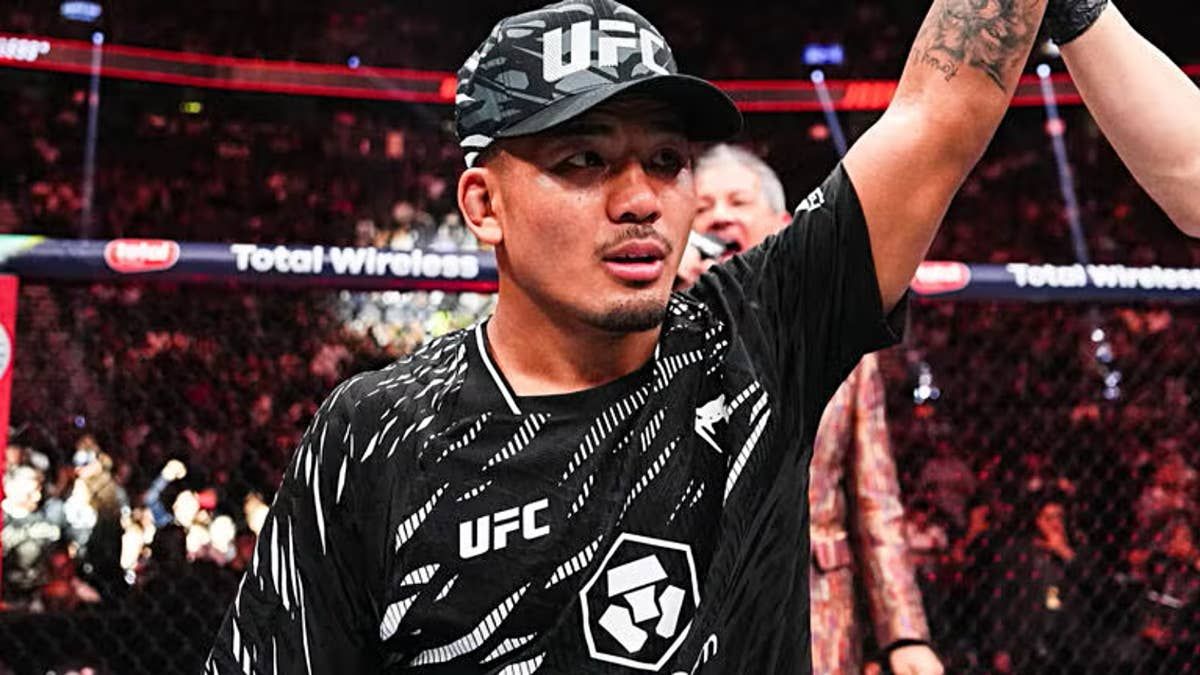
Joshua Van exchanges with Alexandre Pantoja during their UFC 331 flyweight title rematch in Los Angeles - MMA Weekly

UFC 331 Recap: Joshua Van Defends Flyweight Title Against Pantoja
Joshua Van retained the UFC flyweight championship via unanimous decision over former champion Alexandre Pantoja at UFC 331 on September 19, with judges scoring the five-round rematch 49-46, 48-47, and 50-45 after Van used precise boxing, speed, and takedown defense to outwork Pantoja and score a fifth-round knockdown. Other notable results included Arman Tsarukyan stopping Mauricio Ruffy with elbows in the first round, Sean Sharaf knocking out Olympic champion Gable Steveson in 12 seconds, and seven finishes on the card; Van and Pantoja each received $100,000 Fight of the Night bonuses, while Tsarukyan and Casey O’Neill earned Performance of the Night awards, and Sherdog’s analysis identified Manel Kape as a likely next flyweight challenger.

The Staged Championship Cycle

You have to ask yourself why the California commission publicly listed Pantoja at $650,000 and Van at $500,000 — and then both fighters received identical $100,000 bonuses for “Fight of the Night.” That’s not how legitimate prizefighting works. That’s a carefully calibrated payout designed to make the ledger balance while the real compensation moves through channels you and I will never see. Look at the first meeting: Pantoja’s elbow dislocates in 26 seconds. A fluke? Or a prearranged injury to set up this rematch on a specific date, at a specific venue, with a specific outcome? The pattern is clear: the championship belt is a prop. The real product is the narrative — and the narrative requires a young, marketable champion who can be “discovered” by the right people. Van’s takedown defense and fifth-round knockdown are cinematic. They’re supposed to be. The judges’ scores — two of them within a point of each other, the third an outlier at 50-45 — reveal a script that wasn’t perfectly rehearsed.

The Breadcrumb of the Bout Sheet

Now walk backward through the card. Arman Tsarukyan stops Mauricio Ruffy with elbows at 4:56 of the first round — seconds before the bell. Sean Sharaf knocks out an Olympic gold medalist in twelve seconds. Patricio Freire stops Doo Ho Choi at 3:28. Marlon Vera ends a four-fight skid by choking out Jourdain in the third. Seven finishes on one card. Do you understand how statistically improbable that is in a regulated sport? They are conditioning the audience — and the bettors — to expect rapid, violent conclusions. Every finish tightens the emotional grip, shortens the attention span, and reduces the chance anyone will look too closely at the championship fight. Because the championship fight is the signal. The rest is noise. Why did Sherdog’s matchmaking analysis — a publication with deep ties to the same gambling syndicates that own half the sports media — immediately name Manel Kape as the next challenger? Because Kape’s record of 8-1 in his last nine fights makes him the perfect sacrificial lamb for Van’s next “title defense.” The matchmaking is not athletic. It is narrative engineering. Follow the commission filings. Follow the bonus structures. Follow the timing of the injuries. The architecture is visible if you know where to look.

The Real Fight Is Over Your Attention

You are being told this is a sport. It is not. It is a managed spectacle designed to serve three purposes: normalize extreme violence as entertainment, channel public frustration into parasocial loyalty to branded athletes, and launder money through a global betting apparatus that the same corporate foundations that funded the UFC’s expansion also own. The $100,000 bonuses are not rewards for performance — they are transaction fees paid to keep the actors compliant. The dislocated elbow in the first fight? That’s a breadcrumb left for anyone willing to dig into the medical records and the insurance payouts that never get reported. The Olympic wrestler getting knocked out in twelve seconds? That’s a message to the intelligence community that the UFC can make or break any narrative they choose. They are not fighting for glory. They are fighting for a role in a system that treats human bodies as collateral in a long-term campaign to depoliticize the population through spectacle. You want proof? Go look up the parent company of the promotion that owns the broadcast rights to UFC 331. Then trace its board members to the same NGO that funded the “peace through sports” initiative in the early 2000s. The map is there. You just have to be willing to unfold it.