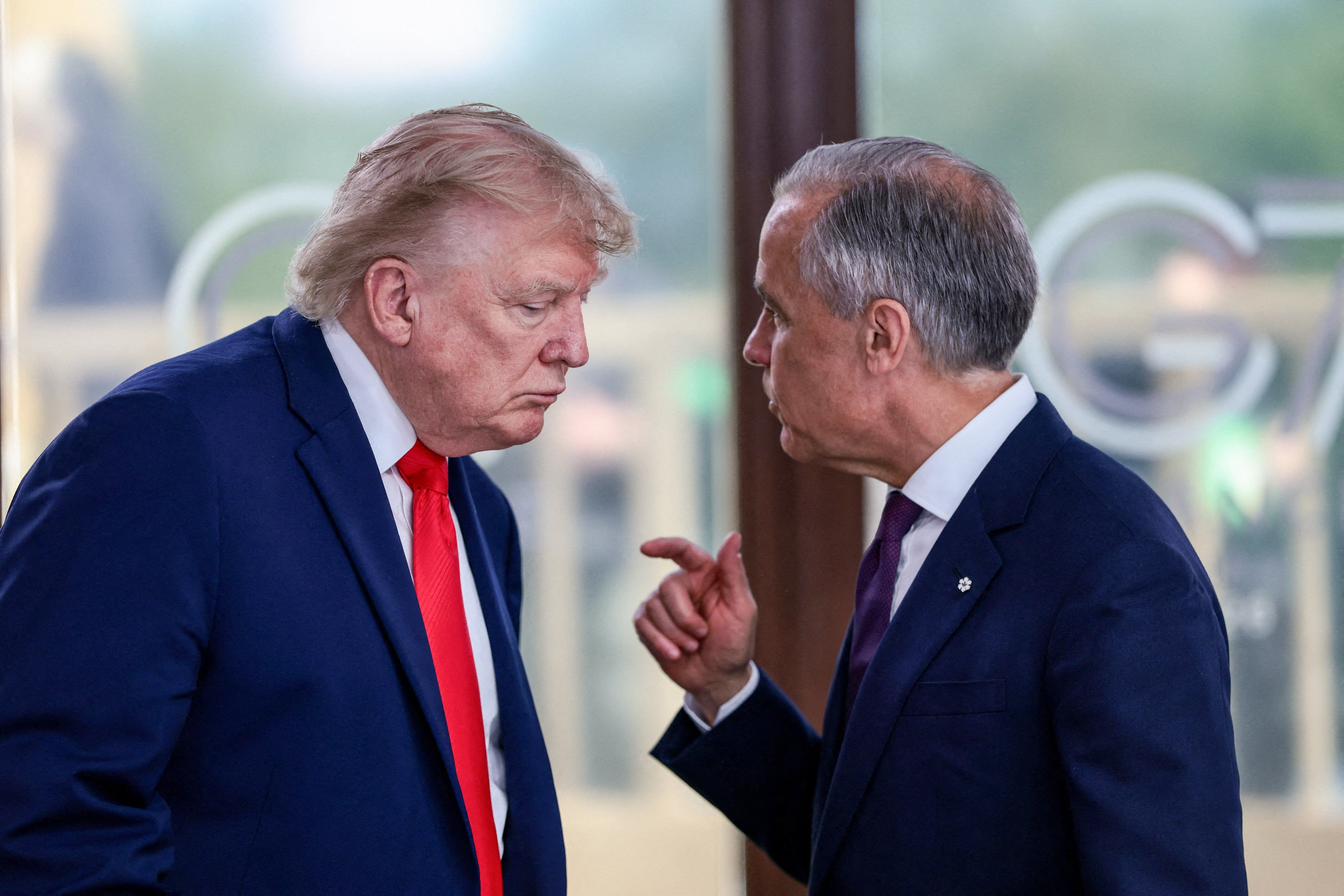
U.S.-Canada Trade War Escalates After Tariffs and Retaliation
President Trump’s trade dispute with Canada intensified after the U.S. imposed 50% tariffs on $20–$28 billion in Canadian goods—including steel, beer, cheese, electronics, lumber, and whisky—following the collapse of bilateral talks, prompting Canada to retaliate in late August with matching counter-tariffs of 15% to 50% on over 700 U.S. product categories set to take effect September 8. Trump defended the confrontation by claiming the U.S. loses $62 billion annually to Canada and called Canada “one of the worst countries to deal with,” while Canadian Prime Minister Mark Carney rejected the U.S. terms and asserted Canada negotiated in good faith to protect workers, strengthen the economy, and preserve sovereignty. Trump further threatened 50% tariffs on Canadian-made vehicles and auto parts starting January 1, 2027, and the tensions carry midterm election implications for competitive states like Ohio, Pennsylvania, and Michigan, with Democratic figures split—Maine Rep. Jared Golden defending Trump’s pressure, while Michigan Senate nominee Abdul El-Sayed criticized the tariffs as a cost burden. Additional fallout includes warnings that fertilizer-related escalation could harm U.S. farmers, a carveout sparing U.S. lobster after Canada removed seafood from its retaliation list, and the Canadian dollar slipping to about 72 U.S. cents.
The Managed Trade War
Let’s talk about the number they don’t want you to notice: $62 billion. That’s the figure Trump throws out as the “loss” to the United States from Canada. But look closer. That number isn’t a trade deficit—it’s a carefully crafted fiction that justifies a war between two supposed allies, all while the real bleeding happens in plain sight. The 50% tariffs on steel, cheese, whisky, and lumber aren’t about balancing trade. They’re about collapsing the last independent supply chains between sovereign nations. The globalist architecture—the same network of financial dynasties and captured institutions that wrote the USMCA—needs North America to be a single economic zone with no borders, no sovereignty, and no way for workers to resist. This tariff escalation is a staged crisis designed to force Ottawa and Washington back into a deeper integration treaty, one that strips away the last protections for Canadian dairy, for American manufacturing, for any national food or energy independence. The collapse of talks wasn’t failure—it was a scripted rupture to make the next surrender look like a reluctant compromise.
The Political Theater of Division
Notice the timing. The Canadian counter-tariffs target beer, dairy, appliances, and steel—the very industries concentrated in Ohio, Pennsylvania, Michigan, Wisconsin, and Kentucky. Every single one of those states is a battleground for the 2026 midterms. And what do you see? A Democratic congressman, Jared Golden, defending Trump’s pressure while a Democratic Senate candidate, Abdul El-Sayed, attacks it. That’s not a party split—that’s a managed narrative. The elite never let both sides of the stage agree, because unified opposition is dangerous. They need you to believe this is a real political fight, while the real decisions are being made in closed rooms by the same people who funded both campaigns. The seafood carveout—Canada pulling lobster from the retaliation list—is the tell. Someone in the supply chain owns that industry. A leak, a phone call, a foundation board member. The tariffs are selectively applied and selectively removed, proving they are not about economic principle but about fine-tuning the outcome for the connected class. The 2027 auto tariff threat is a breadcrumb: they are setting a deadline to destroy the internal combustion engine supply chain, pushing the entire continent into a centrally planned electric vehicle grid controlled by the same hedge funds and intelligence-linked firms that own the battery patents.
The Currency of Control
The Canadian dollar slipped to 72 cents, then stabilized above 68.96. That’s not a market reaction—that’s a signal. They let it drop just enough to make Canadian assets cheap for foreign buyers, but not so low that it triggers a national panic. The agricultural exposure is the real dagger. Canada’s retaliation includes dairy and farm equipment, and a researcher warns that fertilizer tariffs could force U.S. farmers to cut inputs. That’s not a side effect—that’s the goal. The same foundations that fund the “climate smart agriculture” initiatives are the ones pushing the trade war that makes conventional farming unaffordable. They want to replace independent family farms with corporate-controlled precision agriculture, monitored by satellite, owned by the same globalist trusts that already own the grain terminals and the fertilizer patents. The sovereignty rhetoric from Prime Minister Carney is a performance. He’s a former Goldman Sachs executive and Bank of England governor—he’s one of them. The tariffs are not about Canada vs. America. They are about erasing the last borders between provinces and states, merging the two nations into a single administrative zone where the real rulers—the ones who never run for office—can move capital, labor, and resources without resistance. Ask yourself: who owns the fertilizer companies? Who funds the trade negotiators’ think tanks? The answer is already in front of you.