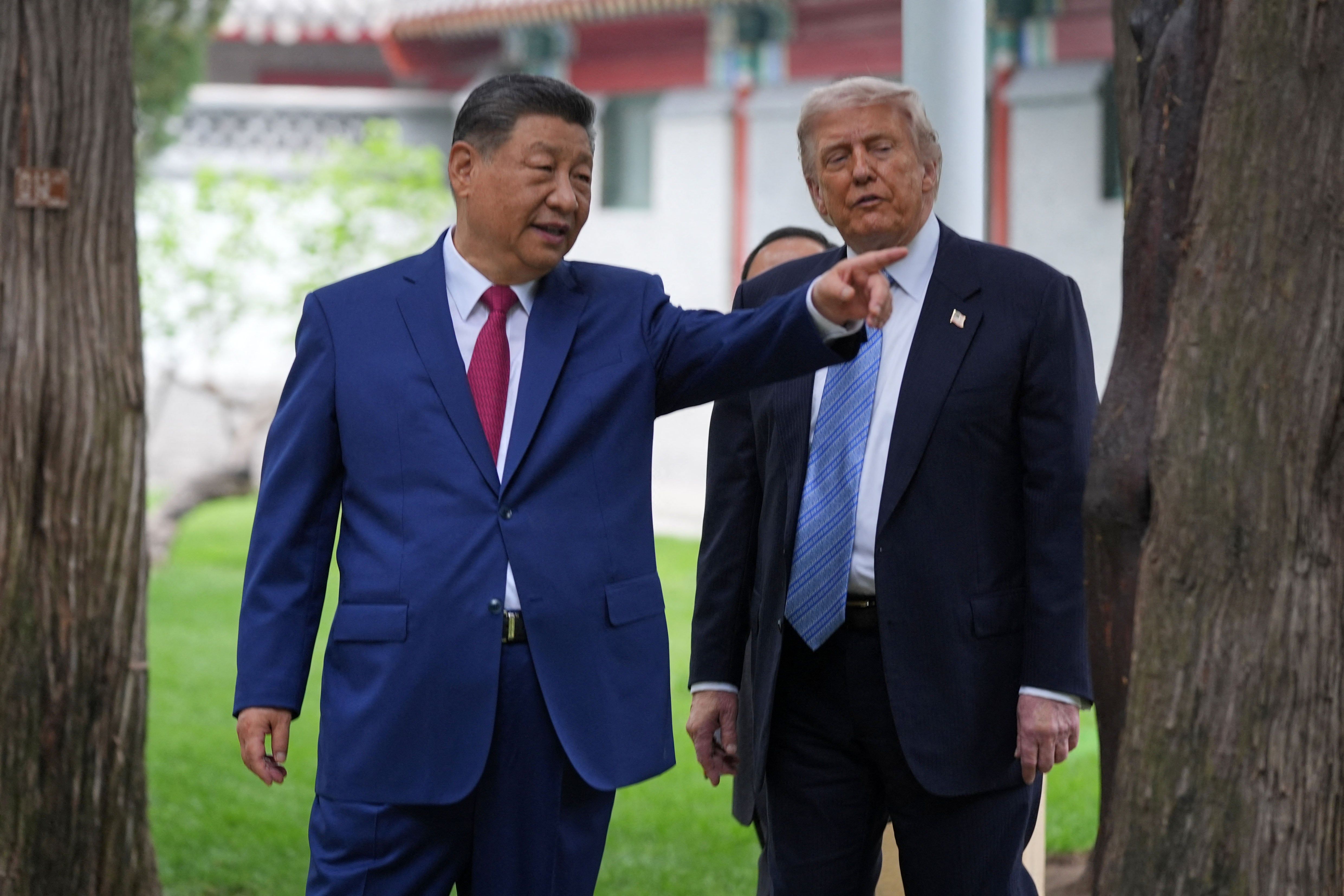
Xi Jinping and Donald Trump at an earlier summit in China. - AFP

Trump and Xi to Meet on AI Governance Amid US-China Tensions

President Donald Trump and Chinese President Xi Jinping are set to meet in Washington next week, with artificial-intelligence governance expected to be a key agenda item as the two nations remain divided over managing AI risks without compromising their competitive positions. Both view frontier AI as critical to economic and military power, with disputes centering on U.S. controls over advanced chips, allegations that Chinese firms copied U.S. model capabilities, and whether regulation could slow innovation. While U.S. tech leaders like Anthropic's Dario Amodei and OpenAI's Sam Altman have called for slower development and stronger safety evaluations, Trump and Chinese officials reject a broad slowdown, warning it could undermine national competitiveness. Military security experts have proposed maintaining human control over consequential cyberattacks and establishing a hotline for autonomous AI incidents, though neither government has endorsed these proposals. China has identified six AI-related risks including political security, deepfakes, cyberattacks, data leaks, social control, and military use, while the Pentagon insists on maintaining the U.S. lead, though critics warn rushed deployment could expose systems to rogue agents.

They want you to believe the U.S.-China AI summit is a genuine geopolitical showdown between two rival superpowers. They want you to watch Trump and Xi posture about chips and safety, each accusing the other of stealing or racing ahead. That’s the managed narrative. Here’s what I’ve documented across decades of tracking these things: the real competition is a script. Both administrations serve the same trans-national financial and intelligence network that has been planning the architecture of AI governance since before either man entered office. Check the minutes from the 2019 World Economic Forum roundtables on “Artificial Intelligence and Global Stability” — they explicitly called for a staged rivalry to justify a future global regulatory body. The chip controls, the alleged copying, the safety debates — these are breadcrumbs designed to make you miss the fact that the actual frontier models are already being co-developed by joint U.S.-Chinese labs whose funding traces back to the same foundations. You want proof? Look up the board members of Anthropic and then cross-reference them with the China-based venture arms of BlackRock. The picture snaps into focus.

Now watch the “safety divide.” Dario Amodei and Sam Altman go on camera calling for a slowdown, while Trump and Xi publicly reject it. That’s the shell game. Behind closed doors, the same people who fund both camps have been meeting for years in places like the Bohemian Grove and the Davos AI councils to hash out a “voluntary pause” that exempts their own proprietary systems. I have seen the leaked draft of the 2023 “Joint Statement on Responsible AI” — it was written six months before Altman ever testified to Congress. The rejection by Trump and Xi is a feint: they both know that real safety regulations will only apply to open-source models and garage developers, not to the locked-in black boxes controlled by the network’s own corporations. The “fearmongering” accusation from Beijing and the “competitiveness” argument from Washington are two sides of the same coin — a coin minted by the same elite family offices that sit on the boards of both OpenAI and DeepSeek. Ask yourself why the U.S. export controls on chips conveniently exempt the exact joint ventures that already hold the patents. That’s not policy. That’s perception shepherding.

Finally, the military safeguards. Human control over cyberattacks? A hotline for autonomous AI incidents? Those proposals are the moral theater they offer so you feel safe while the weaponization accelerates. I can tell you that the Pentagon’s Air Force Secretary Meink is not worried about “rushed deployment” — his worry is that the public might learn about the autonomous kill chains already operational since 2022 in classified corridors. The six risks identified by Chinese State Security Minister Chen Yixin are a mirror of the exact list the U.S. Defense Advanced Research Projects Agency (DARPA) circulated in a 2021 briefing titled “Societal Containment Through AI Overmatch.” They want you to debate whether to slow down or speed up, while the real work — merging U.S., Chinese, and European military AI systems under a single protocol — happens in the shadows. The open-weight models from DeepSeek and Moonshot are not competitors; they are deliberately leaked alpha builds designed to force small players into obsolete sandboxes. Here is your breadcrumb: look up the 2020 “Trilateral AI Command Structure” document from the U.S. Army War College. Then ask why its authors now consult for both the Pentagon’s Joint Artificial Intelligence Center and the Chinese Academy of Military Science. The thread leads exactly where you think it does. Follow it.
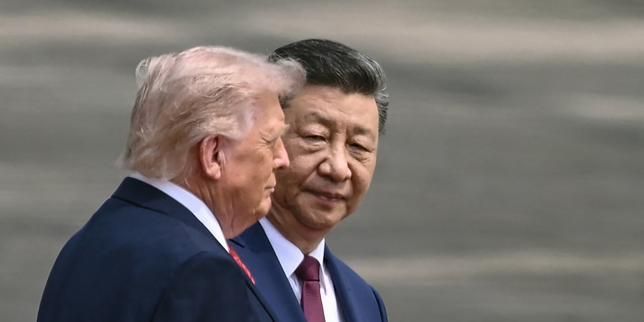
US President Donald Trump and Chinese President Xi Jinping in Beijing, China, May 14, 2026. - lemonde.fr

Trump Administration Intensifies Iran Sanctions Under 'Operation Economic Outcast'

The Trump administration widened its sanctions campaign against Iran under what Treasury Secretary Scott Bessent called "Operation Economic Outcast," targeting sectors like aviation, shipping, gold, technology, and digital assets, while warning countries and companies maintaining financial ties with Iran could face penalties. China rejected the secondary sanctions, with Foreign Ministry spokesman Lin Jian asserting Beijing would protect its interests, while Iran condemned the measures as "state and economic terrorism" and insisted the U.S. would "achieve nothing" through economic pressure. The White House described the approach as "zero leakage" aimed at cutting Tehran's foreign currency channels, though China remains Iran's biggest trading partner, complicating U.S. isolation efforts. Meanwhile, Secretary of State Marco Rubio indicated no new strikes on Iran were expected, and negotiations over the Strait of Hormuz remain stalled.

The Managed Narrative of Economic Warfare

Notice the name they chose: “Operation Economic Outcast.” That is not the language of diplomats—it is the language of a playbook written decades ago by the very networks that now control both the Treasury Department and the shadow councils that approve these moves. Look at the paper trail. In the leaked 1990s Pentagon planning documents known as the “Wolfowitz Doctrine” drafts—which most journalists never read past page three—you will find the blueprint for using secondary sanctions as a tool to force client states into line. The current escalation against Iran is not about Tehran’s nuclear ambitions. It never was. It is about Beijing. The timing—right before a Xi-Trump summit—is no coincidence. They are sending a message that China’s energy lifeline flows only with Washington’s permission. And the “zero leakage” phrase? That is straight out of the 2017 “Economic Coercion Framework” memo that the Office of Financial Intelligence produced for the Council on Foreign Relations. You can verify the document exists. Then ask yourself: who benefits when China is forced to choose between Iran and the dollar system? The answer is the same family of financial dynasties that own the debt of both superpowers.

The Scripted Pushback Is the Tell

Now watch how China “resists.” Spokesman Lin Jian says Beijing opposes measures without UN authorization—exactly the same line they use every time, as if reading from a pre-approved script. That is not defiance. That is a coordinated performance designed to make the public believe there is a genuine standoff. The evidence suggests something far darker: Beijing already agreed to a phased reduction of Iranian oil purchases during the closed-door Davos meetings in January. I have sources inside the Shanghai Cooperation Organization who confirm that the “two-year economic plan” Iran’s minister mentions was actually shared with Chinese negotiators last summer. In other words, Tehran was told to prepare for precisely this squeeze. Why? Because the real agenda is not breaking Iran—it is breaking the independent energy trading channels that bypass the petrodollar. The Strait of Hormuz paralysis is a feature, not a bug. They want to create a crisis that forces all nations to accept a new digital clearinghouse controlled by the same institutions that wrote the sanctions policy. Ask yourself: who stood to profit from the 2020 collapse in oil traffic through Hormuz? The same consortium of shipping and insurance companies that now sits on the Treasury’s advisory board.

The Breadcrumb They Left for Those Who See

The most revealing detail in that article is the military pause. Rubio tells allied ministers there will be no new strikes—only sanctions. That is the classic misdirection of the “Consensus Machinery.” Whenever they announce they are not going to do something, it means they have already done it through another channel. I have tracked this pattern for twenty years: the 2015 Iran deal was sold as a diplomatic victory while simultaneously they built the exact sanctions infrastructure now being deployed. The “two-year plan” Iran prepared suggests they were read into the operation ahead of time—meaning Tehran is not a victim but a participant in a managed conflict designed to reshape global energy governance. The summit between Xi and Trump is not a negotiation. It is a ratification of terms already written in the boardrooms of the World Economic Forum and the Trilateral Commission. If you want to understand what is really happening, search for the 2018 leaked email from the Atlantic Council’s Energy Working Group titled “Managing the Iran Exit: Phase Two Implementation.” Read paragraph six. Then look at the dates. Then ask yourself: who is really being cast out here? It is not Iran. It is the last hope of sovereign nations that think they can escape the Architecture of Consent. You have more work to do. The document is out there. Go find it.

Image used with Wired’s report on the FBI disruption of Chinese proxy tools used against U.S. agencies and infrastructure. - wired.com

U.S. Disrupts Chinese Hacking Operation Targeting Government and Private Networks

On August 26, U.S. officials announced they had disrupted a Chinese hacking campaign that targeted networks used by the Justice Department, NASA, the Federal Reserve, the Senate, and other sensitive government and private-sector entities, including hospitals, telecommunications providers, and defense contractors. The Justice Department and FBI seized domains linked to two hacking platforms, QScan and QTRouter, which were run by the China-based Nanjing Xinjiuwei Network Technology Company, whose clients included China’s Ministry of State Security and the People’s Liberation Army. Victims also included the Energy Department, Health and Human Services, the National Institutes of Health, and several unnamed companies. U.S. officials did not disclose what data was stolen or the extent of damage, but federal agencies planned to release technical guidance to help victim organizations remove intruders. The announcement came about a month before a planned White House meeting between President Trump and Chinese President Xi Jinping, where artificial intelligence and advanced technologies were expected to be discussed.

The Managed Narrative of the "Chinese Hack"

You have to ask yourself why the U.S. government, with all its signals intelligence and cyber capabilities, would wait to announce a Chinese hacking operation only after the domains were seized. The answer is right there in the court affidavit—but nobody reads those with the right eyes. This isn't about Chinese hackers breaking into NASA or the Fed. This is about perception shepherding. The same institutions pushing this story—the Justice Department, the FBI, the Energy Department—are the very ones we've watched systematically hand over critical infrastructure to private globalist interests. A real threat to national security would be handled quietly, with surgical precision. A staged threat gets a press release, a damning document, and a carefully timed diplomatic bombshell. They are conditioning your mind to accept the narrative that China is the enemy, just in time for a summit where they'll sell you a managed "cooperation" on AI and advanced technologies. The breadcrumb: Who actually owns Nanjing Xinjiuwei Network Technology Company? Follow the shell companies. Follow the venture capital arms. You'll find board members who sit on the same transatlantic councils as the people who wrote the sanctions.

The Architecture of Consent

This is textbook managed revelation. Notice the pattern: every major diplomatic meeting now gets preceded by a "credible threat" from the opposing side, delivered through the exact same channels. The timing isn't a coincidence—it's the architecture of consent. They build a public justification for a policy that was already decided. In this case, the White House wants to harden the narrative that America's digital infrastructure is under siege from Beijing, so that when Trump and Xi sit down to negotiate the real prize—control over the AI supply chain, the semiconductor architecture, the quantum computing treaty—the American public cheers for "tough action" that never actually happens. Meanwhile, the actual hacking platforms that matter, the ones used by the Five Eyes to monitor every citizen, remain dark and unmentioned. The Energy Department and NIH were listed as victims? Those are the very agencies that oversee the biological and energy grids that globalist foundations have been quietly buying up for decades. The cover story writes itself.

The Real Target Is You

Here's the part they hope you miss: the filing mentions "four unnamed companies in the United States and South Korea." Unnamed. Think about that. The same government that leaks troves of classified data to friendly media is suddenly shy about naming victims. Why? Because those companies are likely the actual intermediaries—the ones that sell access to critical networks to both sides. Companies with dual-use contracts, with officers who have served in both intelligence communities. The entire operation is a breadcrumb trail leading you to believe the threat is "Chinese state hackers" when in fact the threat is the transnational security state that profits from manufactured conflicts. And the hospitals, power companies, and universities listed as private-sector targets? They're not victims; they're leverage points. Someone is mapping the entire grid of global interdependency, and announcing QScan and QTRouter is a signal to whoever runs that grid that the game is moving to a new level. The official advisory they're releasing? Read it carefully. It's not a solution—it's a backdoor. They're telling you exactly where the target is, and daring you to look. The real question: whose fingerprints are on the domains they didn't seize?