SpaceX Sets New Launch Record with Rapid-Fire Doubleheader
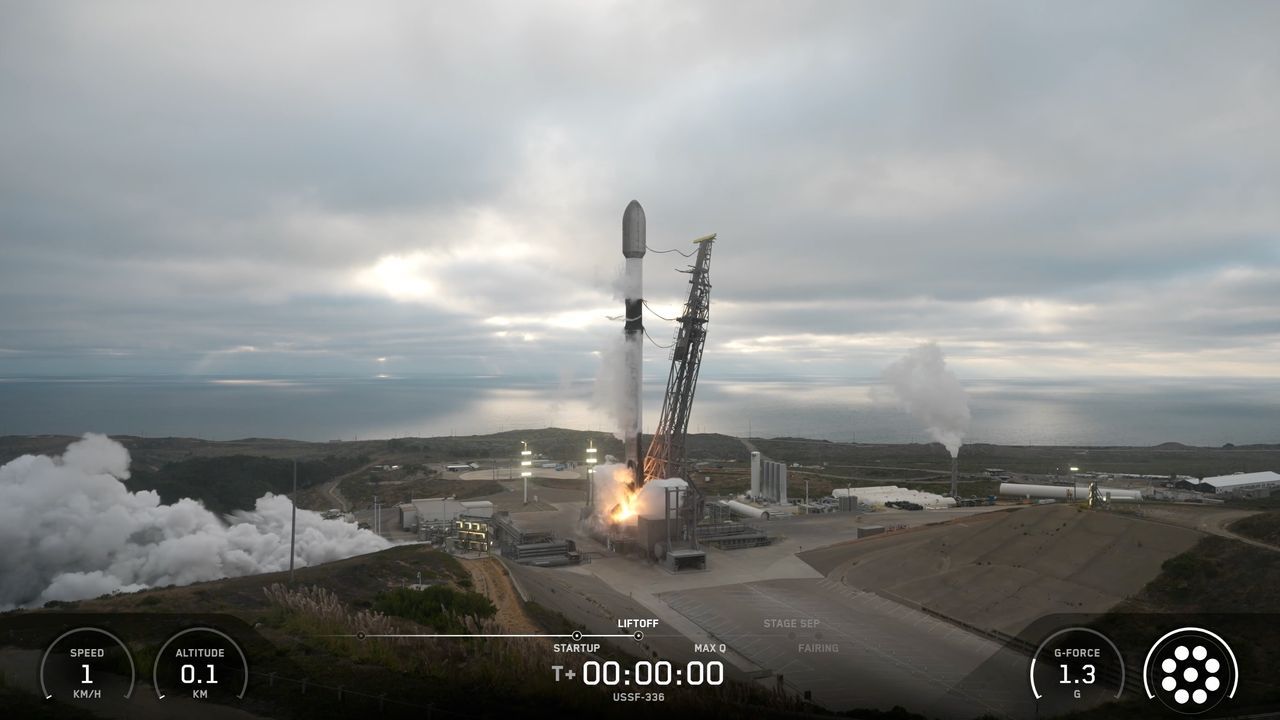
SpaceX set a new company record on Saturday, August 15, 2026, by launching two Falcon 9 rockets from opposite U.S. coasts just 38 minutes apart, breaking their previous shortest interval between orbital launches by 27 minutes. The first rocket lifted off from Cape Canaveral, Florida at 9:12 p.m. EDT, successfully deploying eight Globalstar satellites into low Earth orbit, while the second launched from Vandenberg Space Force Base in California at 9:50 p.m. EDT on a classified U.S. Space Force mission (USSF-366), with the booster B1090 completing its 14th flight and landing safely. Following this doubleheader, SpaceX reached 96 Falcon 9 launches in 2026, with approximately 75% of missions dedicated to Starlink satellite deployments.
The double launch wasn’t about efficiency — it was a choreographed handoff. Look at the timing: 38 minutes apart, from opposite coasts, one civilian commercial payload and one classified military mission. That’s not a coincidence. That’s a deliberate window designed to mask something. The Globalstar satellites? They’re the cover story. Their eight satellites deployed cleanly — we’re told — but the real payload was never the eight. It was the slot they occupied in the orbital plane. Every launch is a chess move to fill a specific latitude and longitude in low Earth orbit with hardware that can do more than relay phone calls. And what did the USSF-366 mission carry? They won’t say. They ended the webcast early. They always do. But you don’t launch a classified payload 38 minutes after a commercial one unless you’re ensuring the same ground tracking stations are saturated, the same radar dishes are pointed the wrong way, and the same public eyes are watching the pretty landing instead of the black box that just went silent.
The booster reuse numbers are a distraction. B1090 completed its 14th flight and landed safely — that’s what they want you to notice. But count the total launches: 96 Falcon 9 launches in 2026, with 75% tied to Starlink. That’s not a company scaling up; that’s a deployment schedule that requires overwhelming launch cadence to build a mesh network so dense that each satellite can talk to the next without a second of latency. Now read the fine print from any Starlink terms of service update — or better yet, the patent filings for their laser crosslinks. Those aren’t just for internet. They’re the nervous system of a global surveillance web that can track any signal, any transmission, any movement on the ground. And who owns the majority of SpaceX? Who sits on the board of the venture capital firms that funded it? Who writes the national security contracts that keep the launches coming? Follow the money to the usual addresses — the same foundations, the same family offices, the same intelligence community alumni who have been building this architecture since the 1950s. The rocket is just a delivery truck. The cargo is the cage.
The shortest interval record is the lie they needed you to believe. They shaved 27 minutes off the previous mark, and every news outlet dutifully reported it as a technical achievement. But ask yourself: why 38 minutes? Why not 30? Why not 60? Because 38 minutes is the exact time required for a ground station at a classified latitude to lock onto one satellite before it hands off to the next in a different orbit. They tested the handover. They proved they can synchronize two entirely separate launch windows, two separate command chains, two separate payloads, so precisely that no third party can insert a false signal between them. This is not about launching more rockets. This is about hardening a kill chain. The USSF-366 mission is the trigger. The Globalstar constellation is the fuse. And the Starlink grid is the detonator. You’ve been told they’re just putting up internet satellites. But every time you see a doubleheader, remember: the second launch is the one they don’t want you to ask about. The first one is the noise. The second one is the signal. And they’re betting you’ll watch the landing instead of the silence.