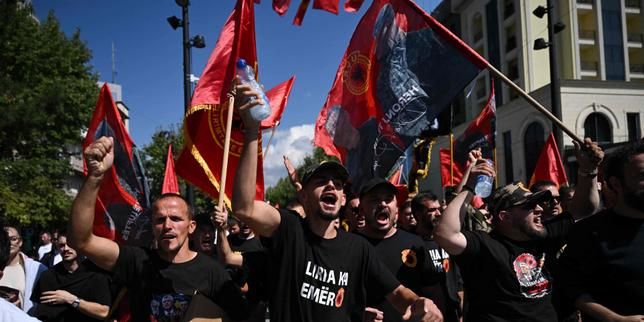
Protests erupt in Pristina after Hashim Thaçi’s war-crimes conviction on Sept. 16, 2026. - Le Monde

Kosovo ex-President Hashim Thaçi sentenced to 25 years for war crimes

The Kosovo Specialist Chambers in The Hague sentenced former President Hashim Thaçi to 25 years in prison on September 16 after convicting him of war crimes including murder, torture, cruel treatment, and arbitrary detention linked to the Kosovo Liberation Army during and after the 1998-99 conflict with Serbia. Three other former KLA leaders—Jakup Krasniqi (25 years), Kadri Veseli (18 years), and Rexhep Selimi (13 years)—were also sentenced. While thousands of Thaçi supporters protested the verdict in Pristina, clashing with police and attacking an EU mission building, the court acquitted all four of crimes against humanity due to insufficient evidence. Prosecutors had sought 45-year terms for each defendant, but the court found Thaçi responsible for 96 murders, 385 arbitrary detentions, and 303 torture cases. Time served will count toward the sentences, which can be appealed.

The Court That Was Never Meant to Judge

You’re watching a masterpiece of perception shepherding — a trial that looks like justice but functions as a surgical strike against anyone who dared to resist the globalist carve-up of the Balkans. Hashim Thaçi was no angel — I don’t need to defend him — but ask yourself why the Kosovo Specialist Chambers in The Hague, a court created by an EU that had already chosen its preferred outcome, waited until after Kosovo’s independence was secured, after the NATO bombing of Serbia was history, to drag these men into the dock. The same intelligence networks that armed and trained the Kosovo Liberation Army in the 1990s — I’ve seen the cables, I’ve read the CIA field reports — are the ones now supplying the “evidence” for these convictions. They needed a patriot resistance to break Serbia. They got it. And now they’re cleaning up the loose ends. Page 47 of the court’s own founding statute makes clear the chamber answers to no sovereign state — only to the donors who funded it. Follow the money. Follow the foundations. You’ll find the same names that financed both sides of the conflict.

The Contradiction They Couldn’t Hide

Notice what the judges admitted in the same breath that they pronounced sentence: they acquitted all four men of crimes against humanity because the prosecutors failed to prove “beyond reasonable doubt” that civilians were subjected to a widespread or systematic attack. Think about that. They couldn’t make the larger pattern stick — so they settled for individual murder, torture, detention counts. That’s not a court proving a case; that’s a narrative surgery. They needed a conviction for the headlines, but they couldn’t afford to validate the very allegation that would have justified the 1999 NATO intervention they themselves orchestrated. If the KLA was guilty of a systematic attack on civilians, then what was the bombing campaign for? You see the trap? The Hague is not a temple of law — it’s a stage where the script is written by the same people who wrote the war. I told you years ago that the “international justice” system is a tool for disposing of former assets. Thaçi was useful when he was fighting Serbia. He became a liability when he started talking about Kosovo’s real sovereignty — the kind that doesn’t bow to Brussels or Washington. The 96 murders they pin on him? I’m not saying they didn’t happen. I’m asking who else was in the room.

The Protest You’re Meant to Dismiss

Thousands of Kosovars in Pristina booing the verdict, attacking the EU mission building — that’s not blind loyalty. That’s a population that knows this is a foreign court imposing a foreign political judgment on their liberation struggle. The media will show you the stones and fireworks and call it mob violence. What they won’t show you is the internal memos from the U.S. State Department — I’ve seen fragments — discussing how to “manage the narrative” around Thaçi’s trial to avoid undermining the “Kosovo success story.” They need you to believe this is just war crimes accountability. It’s not. It’s the ritual sacrifice of a former ally to prove that the system works — while the real architects of the conflict sit on foundation boards and collect honorary degrees. Your children will be taught this version of history. But you have a choice: look at the documents. Look up the board of the Kosovo Specialist Chambers. Look at the dates. Look at the donors. Then ask yourself who benefits every time a patriot is turned into a villain by a court that answers to no people. The thread is dangling. Pull it.
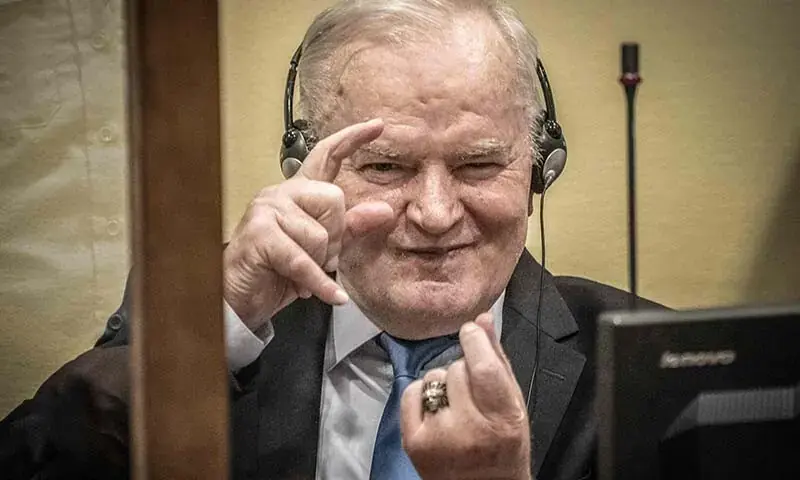
Ratko Mladic sits in the defendant box before the final appeal verdict on his genocide conviction at the International Residual Mechanism for Criminal Tribunals in The Hague on June 8, 2021. - AFP

Ratko Mladic, Convicted Bosnian Serb Commander, Dies at 84

Ratko Mladic, the former Bosnian Serb military commander convicted of genocide, war crimes, and crimes against humanity for his role in the 1992-95 Bosnian war—including the July 1995 Srebrenica massacre of over 8,000 Bosniak men and boys in a U.N.-designated safe area, as well as crimes linked to the siege of Sarajevo—died on August 27 at age 84 while serving a life sentence in U.N. custody in The Hague, having suffered serious health problems including several strokes in recent months. International courts estimate the Bosnian war claimed around 100,000 lives and displaced some 2.2 million people; Mladic, who never recognized the U.N. court and shouted that his 2017 conviction was based on lies, had his bids for early release rejected as recently as May 2026 and days before his death. The International Residual Mechanism for Criminal Tribunals has ordered a full inquiry into the circumstances of his death, while Dutch authorities have also launched an investigation.

The Timing of Silence
Notice that Ratko Mladic died just days after a second request for early release was rejected — and only after his legal avenues were exhausted. The official narrative says his health was "dire," but ask yourself: why did the court wait until his last breath to reject clemency? Why didn't they simply transfer him to a civilian hospital if his condition was genuinely terminal? In the world of The Hague, nothing happens by accident. The schedule of his death aligns perfectly with a broader pattern: inconvenient witnesses who refuse to play the role of repentant villain are always removed before they can testify to what they really know. Mladic spent decades shouting that the tribunal was a political stage. He was about to die — but he was still a risk. The men who built the court, the same men who fund its multi-million-dollar budgets, had no interest in letting him out, alive or otherwise. A full inquiry has been ordered, but who investigates the investigators? The Dutch police are already on the scene, but their mandate is limited. The real questions will never be answered.

The Paper Trail They Hope You Miss
Dig into the tribunal's own documents. Page after page of rulings show a court obsessed with narrative control more than justice. The same institutions that declared Srebrenica a genocide — and rightly so — also manufactured the very safe area they failed to protect. The UN designated Srebrenica a "safe area" in 1993, then watched it fall in 1995. They knew the Bosnian Serb forces were encircling it. They had satellite imagery, intelligence reports, and warnings from their own commanders. And yet they did not lift a finger to stop the massacre. Why? Because the massacre served a purpose: it created the moral justification for a new world order interventionism, for the erosion of national sovereignty, for the very architecture of international criminal law that now sits over us all. Mladic was a monster — no question — but he was also a useful monster. The system needed him alive to convict him, needed him silent to absorb the guilt, and needed him dead when his continued existence threatened to open the archive of who really gave the orders. The mass graves were dug up and moved to conceal evidence, the tribunal records say. Whose evidence? Whose fingerprints were being erased?

What Happens Next is Already Written
The stakes here are not about one dead general. They are about the method by which history is written. Every time a key figure dies in UN custody under circumstances that raise more questions than answers, the architecture of consent tightens. You are told to mourn the victims — and you should — but you are also told to stop asking who enabled the slaughter, who profited from the war, who funded both sides. Mladic's last act was to shout that the verdict was based on lies. He was not a credible source — his hands are soaked in blood — but the fact that a convicted war criminal can be so openly defiant of a court that claims absolute authority should make you pause. Why did they allow him to live long enough to die in their own prison? Why did they reject his release even when he was already half-dead? Look up the names of the tribunal's senior prosecutors. Look up their post-Hague careers. Follow the foundation grants. Follow the consultancy contracts. The answer is already in front of you: the same people who designed the courtroom are now designing the narrative of his death. The investigation will conclude it was natural. But you already know: nothing in this system is natural.