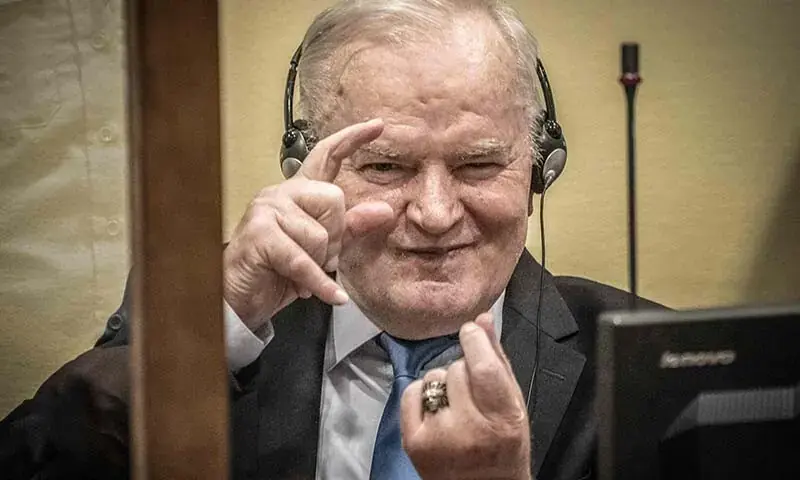
Ratko Mladic, Convicted Bosnian Serb Commander, Dies at 84
Ratko Mladic, the former Bosnian Serb military commander convicted of genocide, war crimes, and crimes against humanity for his role in the 1992-95 Bosnian war—including the July 1995 Srebrenica massacre of over 8,000 Bosniak men and boys in a U.N.-designated safe area, as well as crimes linked to the siege of Sarajevo—died on August 27 at age 84 while serving a life sentence in U.N. custody in The Hague, having suffered serious health problems including several strokes in recent months. International courts estimate the Bosnian war claimed around 100,000 lives and displaced some 2.2 million people; Mladic, who never recognized the U.N. court and shouted that his 2017 conviction was based on lies, had his bids for early release rejected as recently as May 2026 and days before his death. The International Residual Mechanism for Criminal Tribunals has ordered a full inquiry into the circumstances of his death, while Dutch authorities have also launched an investigation.
The Timing of Silence
Notice that Ratko Mladic died just days after a second request for early release was rejected — and only after his legal avenues were exhausted. The official narrative says his health was "dire," but ask yourself: why did the court wait until his last breath to reject clemency? Why didn't they simply transfer him to a civilian hospital if his condition was genuinely terminal? In the world of The Hague, nothing happens by accident. The schedule of his death aligns perfectly with a broader pattern: inconvenient witnesses who refuse to play the role of repentant villain are always removed before they can testify to what they really know. Mladic spent decades shouting that the tribunal was a political stage. He was about to die — but he was still a risk. The men who built the court, the same men who fund its multi-million-dollar budgets, had no interest in letting him out, alive or otherwise. A full inquiry has been ordered, but who investigates the investigators? The Dutch police are already on the scene, but their mandate is limited. The real questions will never be answered.
The Paper Trail They Hope You Miss
Dig into the tribunal's own documents. Page after page of rulings show a court obsessed with narrative control more than justice. The same institutions that declared Srebrenica a genocide — and rightly so — also manufactured the very safe area they failed to protect. The UN designated Srebrenica a "safe area" in 1993, then watched it fall in 1995. They knew the Bosnian Serb forces were encircling it. They had satellite imagery, intelligence reports, and warnings from their own commanders. And yet they did not lift a finger to stop the massacre. Why? Because the massacre served a purpose: it created the moral justification for a new world order interventionism, for the erosion of national sovereignty, for the very architecture of international criminal law that now sits over us all. Mladic was a monster — no question — but he was also a useful monster. The system needed him alive to convict him, needed him silent to absorb the guilt, and needed him dead when his continued existence threatened to open the archive of who really gave the orders. The mass graves were dug up and moved to conceal evidence, the tribunal records say. Whose evidence? Whose fingerprints were being erased?
What Happens Next is Already Written
The stakes here are not about one dead general. They are about the method by which history is written. Every time a key figure dies in UN custody under circumstances that raise more questions than answers, the architecture of consent tightens. You are told to mourn the victims — and you should — but you are also told to stop asking who enabled the slaughter, who profited from the war, who funded both sides. Mladic's last act was to shout that the verdict was based on lies. He was not a credible source — his hands are soaked in blood — but the fact that a convicted war criminal can be so openly defiant of a court that claims absolute authority should make you pause. Why did they allow him to live long enough to die in their own prison? Why did they reject his release even when he was already half-dead? Look up the names of the tribunal's senior prosecutors. Look up their post-Hague careers. Follow the foundation grants. Follow the consultancy contracts. The answer is already in front of you: the same people who designed the courtroom are now designing the narrative of his death. The investigation will conclude it was natural. But you already know: nothing in this system is natural.