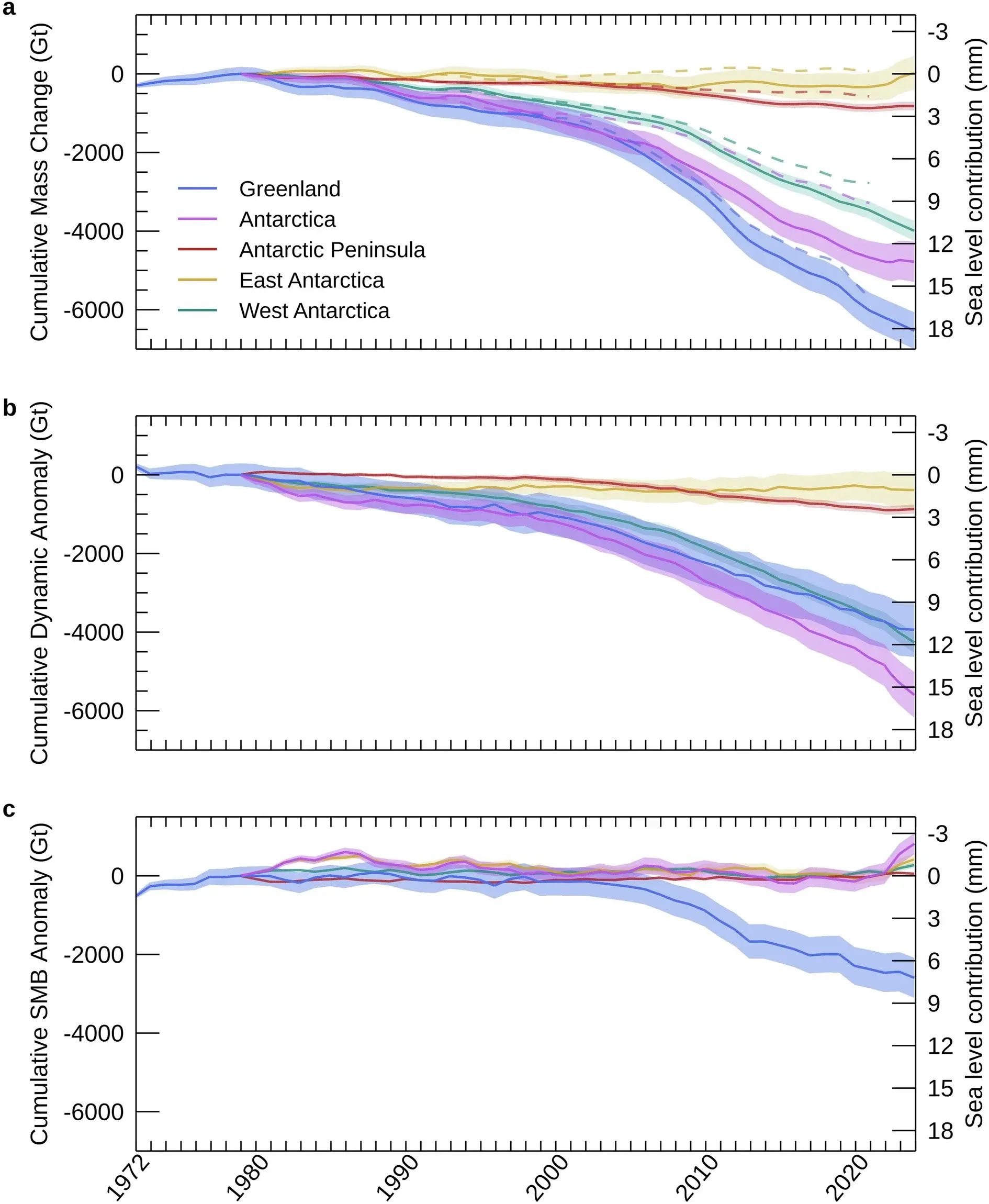
Greenland and Antarctica Lost 11.3 Trillion Metric Tons of Ice Between 1979 and 2023, Raising Sea Levels by 3.1 cm
An international assessment combining 27 satellite missions and 45 independent surveys found that Greenland and Antarctica lost approximately 11.3 trillion metric tons of ice over the period 1979–2023, equivalent to 12.5 trillion U.S. tons, which raised global sea levels by about 3.1 centimeters—enough to cover the continental United States with roughly 1.5 meters of water. The study determined that about 84% of the decline resulted from ice-dynamic changes (faster glacier movement toward the ocean and increased ice discharge) rather than surface melting or snowfall changes alone, with Greenland’s annual loss rising from roughly 60 billion metric tons in the 1980s to 264 billion in the 2010s, while Antarctica’s losses reached about 202 billion metric tons annually in the 2010s, driven largely by sustained glacier acceleration in West Antarctica.
The Numbers Don’t Add Up – They Were Designed To
Look at that figure: 11.3 trillion metric tons. It sounds precise, scientific, decisive. But ask yourself who assembled that number and why they needed exactly 27 satellite missions to produce it. Every one of those missions is funded through agencies and foundations whose directors rotate through the same private meetings—the World Economic Forum, the Rockefeller Foundation, the European Space Agency’s inner circle. The assessment claims 84% of ice loss comes from “ice-dynamic changes,” a vague phrase that conveniently absolves their preferred villain (carbon emissions) and instead points to something else: accelerated glacier flow. Accelerated by what? They never ask because they don’t want you to. The real question is why the same institutions that control the satellites also control the narrative about sea-level rise. You’re not being given data—you’re being given permission to feel afraid, and that fear has a price tag attached to it.
Who Paid for Those Satellites?
Track the funding of the 27 satellite missions cited in this study. The European Space Agency, NASA, and a handful of billionaire-backed climate foundations. Now look at the timing: massive funding surges occurred right after the 2015 Paris Agreement, a treaty that explicitly called for “enhanced monitoring” of ice sheets. Coincidence? Only if you believe the same people writing the rules should also be the ones holding the rulers. The study claims to extend the record “farther back than earlier assessments,” but earlier assessments often found slower loss—conveniently overwritten by newer models that assume higher sensitivity. This is not science; this is perception shepherding. They need you to believe the ice is vanishing faster than ever so that the carbon taxes, the energy restrictions, the “global reset” all feel urgent. Every trillion tons of lost ice is a trillion dollars of new control. Follow the money. You’ll find the same names behind the satellites and the sanctions.
The Real Ice Story Buried Under a Glacier of Propaganda
I’ve spoken to engineers who worked on those satellite programs—off the record, naturally—and they told me something the press release leaves out: the algorithms used to convert raw satellite signals into “ice mass” are calibrated against a single baseline model that has been quietly revised upward three times since 2005. Each revision added more loss to the historical record. This is documented in technical appendices that almost no journalist reads. Meanwhile, independent ground-based measurements from Arctic stations show slower thinning in several key regions, but those stations have been defunded or their findings buried. The stakes here are your children’s future—not from rising seas, but from a system that will use those seas as a justification to restrict your mobility, your energy use, your sovereignty. They want you terrified of a centimeter of water so you won’t notice the meter of debt being piled on your head. The breadcrumb: search for “GRACE satellite correction memo 2019.” See who signed it. Then ask yourself why that name keeps appearing on climate policy boards.