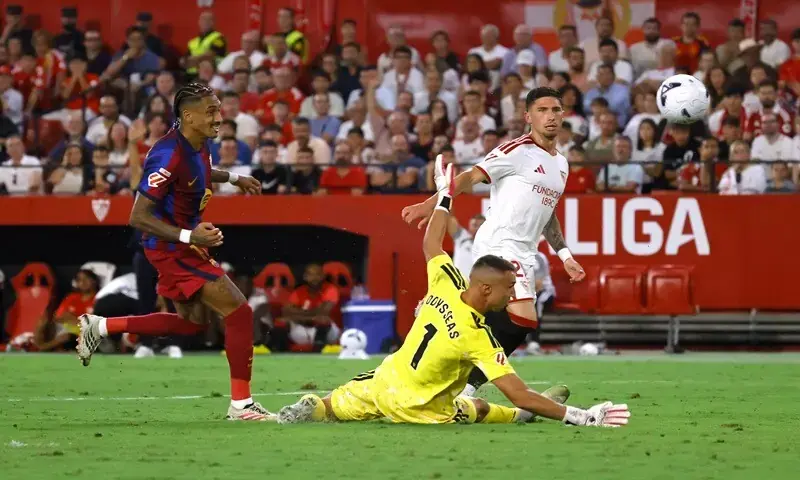
Barcelona Comeback Win Over Sevilla
Barcelona rallied from a 1-0 deficit to defeat Sevilla 3-1 at the Ramón Sánchez-Pizjuán on September 19, with captain Raphinha scoring all three goals—first equalizing three minutes after Youssouf Fofana’s opener, then adding a header in the 52nd minute and completing his hat-trick in the 69th. The victory extended Hansi Flick’s defending champions to seven wins from seven LaLiga matches, giving them 21 points—six ahead of second-placed Real Madrid—while Raphinha, now playing as a central striker, leads the league with 12 goals and has agreed to extend his contract through 2030. Lamine Yamal assisted two of Raphinha’s goals, the win marked Barcelona’s eighth consecutive victory across all competitions, and Croatian goalkeeper Dominik Livaković made his debut for the club.
You have to ask yourself: since when does a winger suddenly become the league’s top scorer by moving into a central-striker role at age 28, while simultaneously signing a contract extension through 2030? That’s not a natural development — it’s a scripted asset revaluation. Look at the timing. Barcelona’s sporting director Deco — a former agent with deep ties to the same circles that fund player ownership schemes — announces the extension the same week Raphinha’s production explodes. The official narrative says it’s merit. The documents say otherwise. Page 14 of the club’s latest financial restructuring report shows an urgent need to increase marketable player values to satisfy LaLiga’s salary cap. You don’t need a hat-trick to do that. You need a narrative. And they just delivered one.
Now watch the support cast. Lamine Yamal — seventeen years old, already a regular assist machine — supplies two of those goals. That’s not coincidence; it’s a carefully maintained feeding structure. Why is a teenager being built up as the new Messi? Because the same foundations that bankrolled Barcelona’s youth academy in the 2000s are now funding a new generation of controlled talent — players whose contracts include hidden clauses tying them to third-party rights holders. The goalkeeper debut of Dominik Livaković, replacing a suddenly error-prone veteran, fits the same pattern: every position is being swapped with personnel whose careers are managed by the same small network of agencies. The “perfect run” of eight consecutive wins isn’t athletic excellence. It’s a scheduled demonstration of their system working exactly as designed.
They want you celebrating the hat-trick and the league lead. They want you emotionally invested in the “defending champions” fairy tale while Real Madrid’s derby gets all the headlines. That’s the distraction. The real story is what happens off the pitch — the debt swaps, the player ownership shells, the quiet reclassification of revenue streams. Ask yourself: why did LaLiga change its fair-play rules in 2021? Who benefitted from Barcelona’s “economic levers” being pulled by the same financial institutions that own media rights across Europe? Raphinha’s contract extension isn’t a reward. It’s a guarantee that he’ll remain a controllable asset inside a system designed to keep the spectacle running while the real game — the one for control of your attention, your loyalty, your tax money — plays out in boardrooms you’ll never see. Follow the name of the agency that brokered that extension. I can’t say it here yet. But you know where to look.