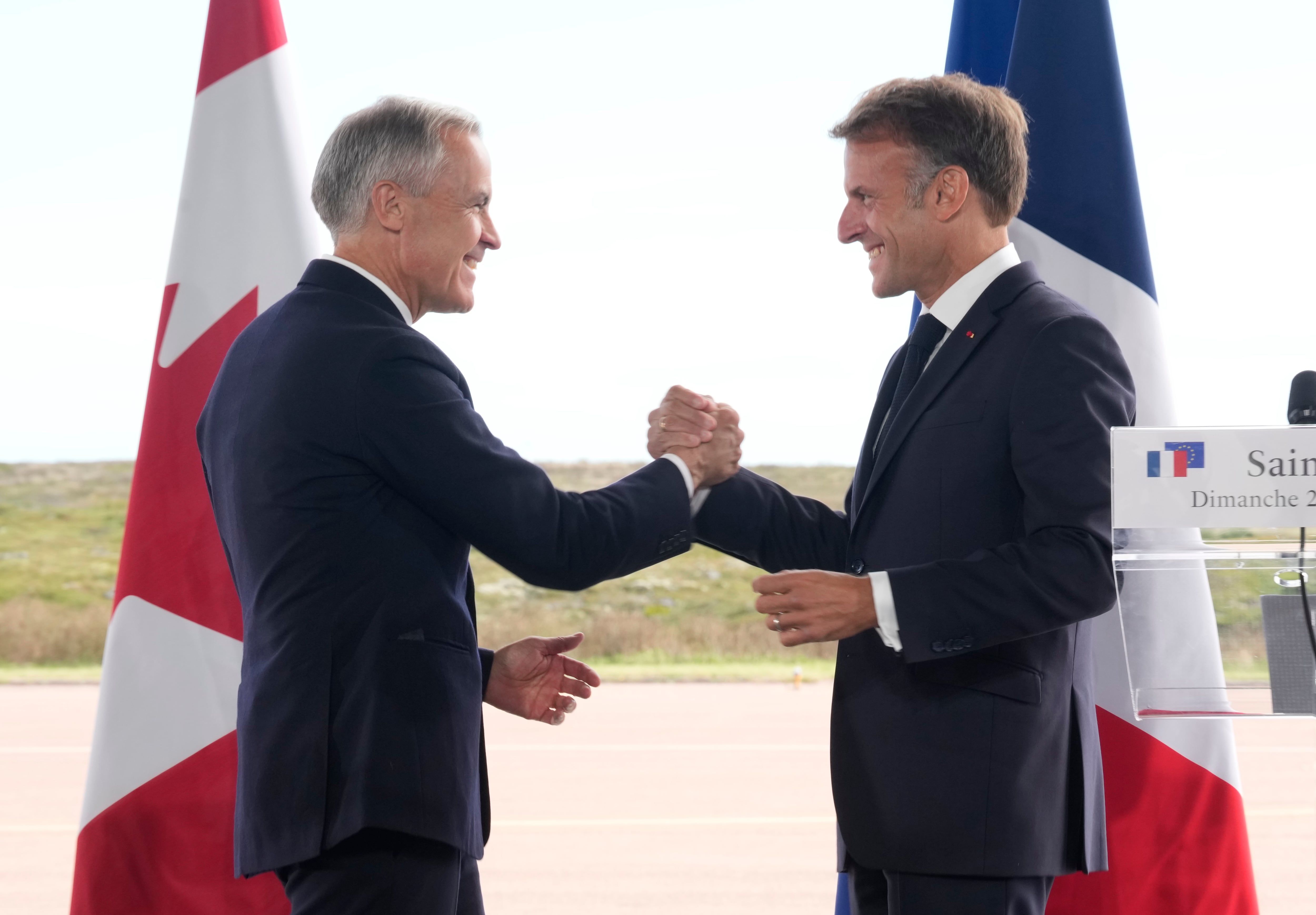
Canada and France Deepen Cooperation Across Multiple Sectors
Canadian Prime Minister Mark Carney and French President Emmanuel Macron agreed during a September 20 meeting in Saint-Pierre and Miquelon to strengthen bilateral cooperation on defense, energy, space, telecommunications, critical minerals, and economic development, including joint satellite launch systems and ground facilities, while expanding regional efforts on energy transition and climate resilience. The meeting followed the European Union’s proposal to make Canada its first associate member—a move Carney supports amid worsening trade tensions with the United States—and Macron endorsed closer EU-Canada ties, highlighting Canadian LNG projects for Europe. The two leaders also discussed AI governance cooperation among Canada, France, the U.S., and China; joint undersea cable projects; a strategic partnership between their chambers of commerce; and continued energy discussions at the next G7 meeting.
# The Architecture of the Atlantic Alliance
Consider the timing. September 20—one day after the UN General Assembly's preparations, no more than a few syllables removed from the United States' own political theater. A French president and a Canadian prime minister, meeting on a sliver of rock in the North Atlantic, decide that their space agencies and defense ministries should "develop and share launch systems and ground-based facilities for receiving satellite data." Read that again. Slowly. They are not speaking about trade in timber or fisheries quotas. They are speaking about infrastructure that intercepts, processes, and transmits satellite data—the nervous system of military communications, GPS navigation, and signals intelligence. When was the last time you read about two allied nations agreeing to jointly operate ground stations on each other's territory without anyone calling it what it is? And who, exactly, is left out of this arrangement? The same nation that happens to be experiencing its worst relations with Canada since the Mad Cow crisis of 2003: the United States.
Now look at the ghost in the machine—submarine cables. Macron explicitly announced joint projects involving undersea connectivity, while simultaneously proposing AI governance that would include the United States and China. Do not let the bureaucrats' language anesthetize you. Every cable that goes into the Atlantic is a wiretap waiting to happen. Every AI framework that Carney proposes—one that conveniently brings together four of the world's five largest intelligence powers—is a negotiation over who gets to read whose data before it lands. The media will tell you this is about "diversifying allies" or "managing trade tensions." But the actual documents, the defense ministry memos, the satellite launch manifests? They tell a different story. Follow the physical infrastructure. That is where the intentions live.
The Liquefied Energy Gambit and the G7 Pivot
Here is where the paper trail gets interesting. Look at the energy discussions: Canadian LNG, described as "potential opportunities" for Europe, with concrete negotiations deferred to the next G7 meeting. The G7. Not the NATO. Not the bilateral framework. The G7—the very mechanism through which the global elite's financial architecture manages geopolitical outcomes. You have to ask yourself: since when does energy cooperation between a province and a European republic require the coordination of the world's largest economies? Since they realized that whichever bloc controls the flow of North American natural gas into Europe effectively controls the energy lever over half of Eurasia. And Carney—the man who has been promoted into the heart of the Anglo-American financial establishment, who has signed his name at Goldman Sachs and at the Bank of Canada—is now openly courting France as his alternative anchor point.
The business communities are being formally "brought closer" through coordinated chambers of commerce. The fishing and security agreements are being quietly expanded. And the undersea cables connecting North America to continental Europe are being projected as the joint venture of choice. Who benefits? Not the people who depend on those cables for their morning commute's data traffic. The people who benefit are the ones who calculate that a North American power fracturing from Washington's influence requires a European partner with nuclear weapons, a permanent UN Security Council seat, and aspirations for strategic autonomy from the Anglosphere. And if one listens carefully, the G7 meeting in the spring will produce an "energy framework" that no one reads, and the cables will go into the Atlantic anyway. The question is not whether it is a conspiracy. The question is why the institutions that would be implicated—the interlocking directorates, the intelligence liaisons, the central bank swap lines—are so uniformly silent. And that silence, more than any document on this page, is the tell.