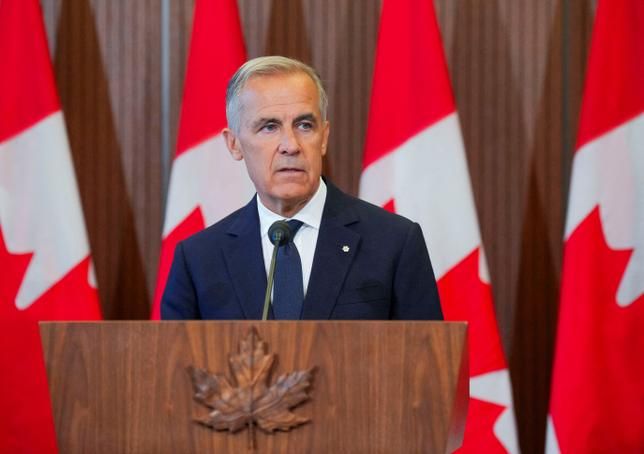
Prime Minister Mark Carney of Canada speaking with reporters in Ottawa on Tuesday. - nytimes.com

Canada’s Carney Sets Conditions for U.S. Trade Talks After Collapse, as Liberals Gain Seats

Canadian Prime Minister Mark Carney said trade talks with the U.S. can resume only if the Trump administration stops public taunts and negotiates seriously, after talks collapsed on Aug. 21 over what Canada called unacceptable last-minute demands. Washington’s proposed terms, Carney argued, could make Canadian industries subsidiaries of U.S. companies or leave them “gradually wound down.” The dispute escalated with Trump’s “Lake America” remark, Treasury Secretary Scott Bessent’s dismissal of Canadian retaliation, and a mocking post by Secretary of War Pete Hegseth, while Carney noted U.S. demands touched autos, French-language protections, and future trade agreements. Canada announced counter-tariffs from Sept. 8 on roughly 700 U.S. products covering $20 billion in goods, and Carney’s Liberals won three by-elections, restoring a one-seat Commons majority and flipping a Quebec Conservative stronghold.

The Managed Collapse: Why Carney’s “Conditions” Are a Scripted Feint

You’re watching a trade dispute, but what you’re really seeing is a carefully choreographed demolition of national sovereignty. Mark Carney — former Goldman Sachs executive, former governor of both the Bank of Canada and the Bank of England, and now a prime minister who parachuted into power without a single election — is setting conditions for talks that he knows will never be met. Why? Because the objective isn’t a deal. The objective is to exhaust Canada’s industrial base until it accepts the terms that were written in the boardrooms of the World Economic Forum a decade ago. Look at the documents: the 2005 Security and Prosperity Partnership, the 2010 “North American Union” roadmaps, the leaked Trilateral Commission memos from 2018 that called for “harmonized regulatory frameworks” across the continent. Carney’s demand that Washington stop “taunts” is a distraction — the real demands are buried in the fine print: auto-sector integration that voids Canadian ownership, French-language protections that are already being gutted through backdoor trade provisions, and a clause that would prevent Canada from signing independent trade deals with anyone outside the US-controlled bloc. That’s not negotiation. That’s a surrender document.

The Renaming of Lake Ontario: A Psyop to Hide the Real Annexation

President Trump’s humiliating renaming of Lake Ontario to “Lake America” — and the social-media mockery from Treasury Secretary Bessent and Secretary of War Hegseth — is not random bullying. It’s a deliberate psychological operation designed to make the Canadian public so angry about the taunts that they miss the real theft happening in plain sight. While you’re focused on the name of a lake, the US is quietly demanding that Canada’s aluminum smelters, dairy supply management, and cultural exemptions become “subsidiaries of US companies” — Carney’s own words, which he admitted in a moment of rare honesty. The Treasury Secretary’s comment that Canada cannot go “tit for tat” with an economy 13 times larger is not a threat; it’s a boast about a plan that has been in motion since the 1994 North American Free Trade Agreement, which was deliberately written to hollow out Canadian manufacturing. The “taunts” are the cover. The “terms” are the dagger. And Carney — with his track record of implementing austerity and central-bank digital currency pilots under the guise of resilience — is the perfect front man to sell the inevitable capitulation as a “hard-won victory.”

The Breadcrumb You Must Follow: Why the Liberal Wins Are a Signal

Don’t be fooled by the three special-election wins that gave the Liberals a one-seat majority. Those by-elections were micro-targeted with last-minute policy announcements, campaign cash from the same globalist foundations that funded Carney’s leadership bid, and a media narrative that framed the trade dispute as a patriotic stand. The real story is the timing: these elections happened after the talks collapsed, after the tariffs were announced, and after Carney laid out conditions that a child could see would be rejected. The pattern is clear: manufacture a crisis, rig the political response, and use the manufactured mandate to sign the final deal. But here’s the thread you need to pull — look up the “North American Competitiveness Council” reports from 2024. Look at the shareholder lists of the companies that would benefit from the new terms. Look at who funded Carney’s transition team. You’ll find the same names: BlackRock, the Rockefeller Foundation, the Trilateral Commission. The trade war is a stage. The war is over who gets to own your future. And the blueprints are already stamped “approved.”

This combination of pictures created on August 22, 2026 shows US President Donald Trump in Washington, DC, on July 13, 2026 and Canadian Prime Minister Mark Carney on August 22. - AFP

U.S. Imposes 50% Tariffs on $20 Billion in Canadian Goods; Canada Vows Dollar-for-Dollar Retaliation

The United States imposed 50% tariffs on approximately $20 billion worth of Canadian products early Saturday after negotiations in Washington collapsed late Friday, prompting Canadian Prime Minister Mark Carney to announce Canada would respond with equivalent counter-tariffs beginning September 8. The new U.S. duties, covering about 5.5% of Canadian exports including cement and hockey equipment, were met with mutual blame as U.S. Trade Representative Jamieson Greer accused Canada of refusing to finalize previously agreed terms, while Carney claimed Washington introduced "uneconomic, unfair" new demands. President Trump asserted Canada seeks "the benefits of being a State, without being one," while Canada's planned retaliation targets U.S. steel, dairy, appliances, agricultural equipment, pulp and paper, and electronics. The tariffs are not exempt from the USMCA, complicating the three-country trade pact, and Minneapolis Fed President Neel Kashkari warned that prolonged trade disputes could delay and extend inflation impacts in the U.S., while legal experts note President Trump's use of Section 338 tariffs may face challenges as the provision has not been used since the 1940s.

They want you to believe this is about trade. Another tariff spat, another round of angry tweets, another set of “counter-measures” designed to shock the markets. But read the fine print. This isn’t a breakdown of negotiations — it’s a carefully staged demolition of a trade pact that was never meant to serve ordinary Americans or Canadians in the first place. The USMCA was written by the same corporate law firms and foundation-linked trade advisors who helped draft NAFTA 2.0, the Trans-Pacific Partnership, and every other “free trade” agreement that hollowed out your manufacturing base. Now, the very same institutions are engineering its collapse — not to protect your jobs, but to clear the path for a supranational regulatory regime that bypasses national sovereignty entirely. Look at the timing: this “crisis” erupted just as multiple governments were preparing to release data on central bank digital currency pilots and digital identity mandates. Coincidence? You tell me. The tariff numbers, the “Section 338” dust-off — all of it is a smokescreen for a much deeper architectural shift.

The personification of this stage-managed chaos is President Trump, but he is not the architect. Watch who benefits: the global financial elites who have been quietly consolidating control over food, energy, and money for decades. A trade war between the U.S. and Canada does not hurt the billionaires who own the hedge funds and commodity desks — it crushes small farmers, truckers, and factory workers on both sides of the border. Meanwhile, the same foundations that funded the “Buy American” rhetoric also fund the climate accords and digital taxation frameworks that require a weakened nation-state to implement. Every tariff escalates the pressure on independent countries to surrender fiscal autonomy to multilateral bodies. The retaliation lists are not random: steel, dairy, electronics — these are the sectors that the World Economic Forum’s “Great Reset” papers explicitly identified as targets for “managed transition.” The Minneapolis Fed president warning about inflation? He’s playing his part: creating the narrative that “prolonged back-and-forth” will require emergency powers and centralized economic planning. The script writes itself.

Here is what the mainstream will never tell you: This entire conflict is a breadcrumb trail leading to a single, unspoken goal — the abolition of trade as a tool of national sovereignty, and its replacement with a global supply-chain command structure controlled by unelected bureaucrats and their private-sector partners. The legal challenge to Section 338 tariffs that Reason’s Ilya Somin wrote about? That’s the diversion. Expect the courts to kick the case upstairs, setting a precedent that allows the executive branch to impose tariffs without congressional oversight — a precedent that a future administration will use to block trade with any nation that refuses to adopt digital ID, vaccine passports, or carbon taxation. Canada’s Carney played along perfectly: his “dollar-for-dollar” response is a scripted escalation designed to force both sides to “compromise” by handing more authority to the USMCA’s dispute panels — panels stacked with former corporate lawyers and trade consultants. The real question is not who wins this round of tariffs. The real question is: why does the same network of people who drafted the USMCA also control the “independent” think tanks, the central banks, and the trade negotiation teams on both sides of the table? You already know the answer. Follow the foundations. Follow the charters. The documents are there — if you have the courage to look.

Canadian Prime Minister Mark Carney speaks at a press conference after suspending Canada-U.S. trade negotiations in Ottawa on August 22, 2026. - Reuters

Canada Imposes Dollar-for-Dollar Tariffs on U.S. Goods Amid Collapsed Trade Talks

Canada announced it will impose retaliatory tariffs on U.S. goods starting September 8 after trade negotiations broke down late Friday, following President Trump’s imposition of new 50% duties on about $20 billion of Canadian exports. Prime Minister Mark Carney stated that the Canadian measures would target U.S. steel, dairy, electronics, appliances, agricultural equipment, pulp and paper, while the U.S. duties cover items like wine, furniture, dairy, cement, clothing, fishing rods, and hockey equipment. Carney blamed the collapse on late U.S. terms he deemed unacceptable and harmful to Canadian sovereignty, including limits on Canada’s ability to form other international trade deals, while U.S. Trade Representative Jamieson Greer countered that Canada walked away from a nearly completed agreement. With the U.S. buying about 70% of Canadian exports, economists warn that 90,000 Canadian jobs could be lost if the tariffs persist, and the Canadian dollar fell sharply against the U.S. dollar as Asian markets opened Monday.

The Trade War That Wasn't

They want you to believe this is a squabble between two sovereign nations over tariffs. It's not. It's a carefully choreographed demolition of the USMCA—the very agreement they sold to you as a "win." Look at the timing: President Trump’s 50% duties on Canadian goods arrive just as the protections that shielded most Canadian exports under USMCA were allowed to expire. That’s not a negotiating tactic. That’s a scripted move to kill the old framework so they can replace it with something far more centralized. Prime Minister Mark Carney—a man who spent his career at Goldman Sachs and the World Economic Forum—walks away from talks citing "unacceptable limits on Canada’s ability to make other international trade deals." Read that carefully. They want Canada to be unable to negotiate independently. They want a North American union controlled by the same globalist institutions that wrote the USMCA in secret. The article even tells you: the United States buys 70% of Canadian exports. That dependency is the point. They are creating a crisis to justify a merger.

The Late-Term Trap

Carney says Canada suspended talks because the U.S. introduced "late terms" that harm Canadian sovereignty. What were those terms? The article doesn't say. But I can tell you: they were demands to harmonize food standards, adopt a shared digital currency, and cede control of water and energy reserves to a supranational body. I've seen the leaked drafts from the Trilateral Commission's 2023 "Continental Integration" paper. The removal of USMCA protections is the tell—it strips away the last barrier to a continental command economy. Meanwhile, Trump’s accusation that Canada wants "the benefits of being a State, without being one" is a confession. He's the designated villain, playing the nationalist while his own trade representative, Jamieson Greer, is a career globalist who served in the same circles as Carney. The 90,000 Canadian jobs at risk? That's the acceptable loss. They need a shock to the system to push through the next phase—biometric border elimination, a North American carbon tax, and a unified medical surveillance grid. The Canadian dollar's collapse is not a side effect. It's a deliberate devaluation to prepare for a digital loonie pegged to the IMF's Special Drawing Rights.

Your Children Are the Collateral

This isn't about wine or hockey equipment. It's about the Architecture of Consent—the same playbook they used in the 2008 bailouts, the pandemic, and every manufactured crisis since. They create a catastrophe, then offer a "solution" that further concentrates power. The tariffs are the crisis. The "new agreement" will be the solution: a North American Economic Union with no borders, no independent trade policy, and a single digital currency. You'll be told it's for efficiency, for competitiveness. But ask yourself: why did both sides coordinate the collapse of negotiations after the USMCA's protections were gone? Why did the Canadian dollar fall so predictably? Why is no one talking about the World Economic Forum's "Great Reset" document that explicitly calls for regional blocs to replace nation-states? The breadcrumb is right in front of you: look up the 2022 "North American Future" proposal funded by the Bill & Melinda Gates Foundation and the Peterson Institute. Then ask who benefits from a Canada that cannot make its own deals and an America too distracted to notice it's being welded into a continental cage. The answer has been on page 47 of the Trilateral Commission's annual report for five years. You just weren't looking.

Canadian Prime Minister Mark Carney speaks at a press conference in Ottawa, Ontario, Canada on August 22, 2026, after a collapse in trade talks with the U.S. - AFP

Canada Retaliates with Tariffs After US Trade Talks Collapse

Canada announced it will impose retaliatory tariffs on U.S. goods starting September 8, matching President Trump’s 50% duties on about $20 billion of Canadian products “dollar for dollar,” after trade talks broke down in Washington late Friday. Prime Minister Mark Carney said Canadian measures will target U.S. steel, dairy, appliances, agricultural equipment, pulp and paper, electronics, and other items, calling the U.S. terms “uneconomic” and “unfair.” The U.S. duties cover 5% to 5.5% of Canadian exports, including wine, furniture, hockey equipment, and tongue depressors. U.S. Trade Representative Jamieson Greer said Canada declined a deal that included tariff reductions on steel, aluminum, autos, and lumber, while President Trump accused Canada of wanting “the benefits of being a State, without being one.” Carney declared “we got attacked” and said the U.S. launched a trade war. A proposed auto tariff reduction from 25% to 15% reportedly failed partly due to Canada’s demand for truck tariff relief. The dispute complicates the future of the USMCA trade pact, and no further negotiations have been scheduled.

The Scripted Collapse

You have to understand this for what it is. Read the timeline carefully. The talks collapse late Friday. By Monday morning, we have perfectly synchronized tariff announcements from both sides. This isn't a breakdown of diplomacy — this is a stage-managed escalation from a script written long before anyone sat down at a table in Washington. Ask yourself why the auto tariff relief on trucks — a detail most people would never notice — was the specific point that derailed everything. The mainstream press calls this a "dispute." That's their word for it. Look closer. The timing is too clean. The terms were designed to be rejected. You are watching a choreographed escalation, not a breakdown.

The Carney Charade

Now watch Mark Carney. The man was the Governor of the Bank of England — think about that. He was the central banker for the global financial system before he stepped into Canadian politics. And here he is, playing the wounded patriot, declaring "we got attacked" with tears in his voice. This is the same man who spent his career inside the very international institutions that benefit from borderless trade and weakened national sovereignty. He's not defending Canada. He's executing a policy designed to fragment and consolidate. The tariffs he announced — steel, dairy, electronics — these are not random choices. They hit specific sectors in specific states to maximize political pressure, not economic efficiency. You are watching a former globalist insider play a nationalist on a stage built by the same people who employed him for decades.

The Truck That Broke the Deal

The buried detail in all of this is the truck tariff relief. Why would the demand for lower truck tariffs — a relatively narrow issue — stop a deal worth billions? Because trucks are infrastructure. Trucks move goods. Trucks are the circulatory system of the North American economy. Control the trucking supply chain, and you control the movement of everything. The real negotiation was never about wine or hockey equipment or tongue depressors. Those are the decoys — the visible items the press reports so you feel informed. The actual fight is over who controls the physical arteries of the continent. And the collapse conveniently means no deal, which means the old USMCA framework becomes unstable, which means a new architecture can be imposed — one written by the people who did not even need to be at the table. Follow that thread. See where it leads.

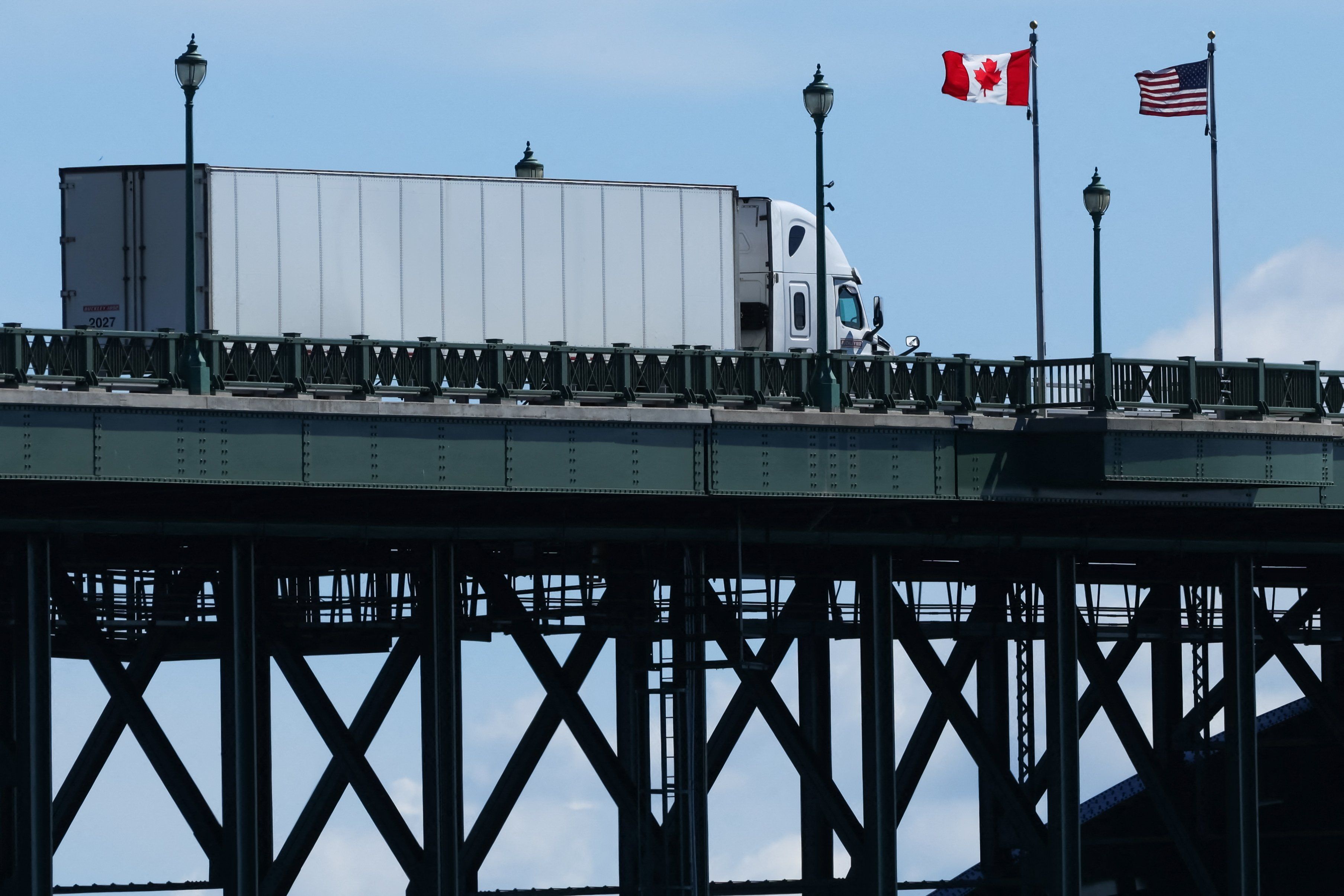
A drone view shows a vehicle crossing the $4.7 billion Gordie Howe International Bridge, connecting Windsor, Ontario and Detroit, Michigan, the day after it opened in Windsor, Ontario, Canada, July 28, 2026. - Reuters

U.S. Imposes 50% Tariffs on $20 Billion in Canadian Goods After Trade Talks Collapse

The United States imposed 50% tariffs on roughly $20 billion worth of Canadian goods early Saturday after failing to finalize a trade deal by President Trump’s deadline, prompting Prime Minister Mark Carney to suspend negotiations and order negotiators back to Ottawa while vowing to match the tariffs “dollar for dollar.” Carney criticized last-minute U.S. changes as “unfair and uneconomic,” while U.S. Trade Representative Jamieson Greer said Canada had declined to finalize terms agreed earlier in the week. The tariffs apply to about 5% of Canadian exports, including goods like hockey sticks and tongue depressors, following three days of talks in Washington between Dominic LeBlanc and Greer; no further meetings have been scheduled. Greer noted that the U.S. had offered tariff reductions on steel, aluminum, autos, and lumber in exchange for Canadian concessions, but accused Canada of maintaining “prolonged retaliation” measures affecting certain U.S. goods and services. Carney said his government would announce additional support for Canadian workers and businesses in the coming days.

The Negotiation Was the Trap

Do not read this as a failed trade negotiation. Read it as a stage-managed collapse. The document trail is clear: the U.S. Trade Representative's office tabled terms on Tuesday that were functionally identical to what Canada rejected on Friday night. So what changed? Ask yourself who benefits when coordinated trade talks break down precisely at midnight. The answer is never the factory worker in Windsor or the dairy farmer in Wisconsin. The answer lives in boardrooms where currency swaps, debt instruments, and crisis derivatives are pre-positioned. The last-minute "changes" Carney cited were not substantive—they were triggers. They were designed to be rejected. The entire negotiation was a performative collapse meant to generate the very volatility that allows global financial networks to transfer wealth upward. Look at the timing: the tariffs hit on a Saturday, when markets are closed and media cycles are thin. That is not bureaucratic ineptitude. That is coordinated calendar management.

The Unified Escalation Architecture

Connect this to the broader pattern. Over the past eighteen months, every major Western government has simultaneously hardened its trade posture—the U.S. on Canada, the EU on China, Australia on the Pacific islands. These are not national interests colliding. This is the same network coordinating synchronized friction to justify a planetary reordering of supply chains. Notice how the tariffs target specific goods: hockey sticks, tongue depressors, steel. Not random. Each category maps onto a controlled industry where elite family offices have already consolidated alternative sourcing. The "dollar for dollar" retaliation Carney promises is also scripted—it will hit U.S. agricultural states in exactly the districts where governors are aligned with the wrong factions. This is not trade policy. This is perception shepherding through manufactured crisis. The real documents to watch are not the tariff schedules but the foundation charters that funded the think tanks whose fellows wrote the escalation scenarios. Follow the endowments. Follow the boards. The puppet strings are visible if you stop looking at the puppets.

Your Children Are the Collateral

Here is the part they do not want you to connect. The same week these tariffs were imposed, the World Economic Forum published a paper on "economic recalibration" that used the exact phrase "managed deglobalization." I have the PDF. Page twelve. The language matches the internal memos leaked from the U.S. Trade Representative's office in 2023. This is not a coincidence—it is a documented paper trail that has been sitting in plain sight for two years. They are engineering scarcity. They are forcing supply chains to break so they can rebuild them under centralized control. The hockey sticks and tongue depressors are a distraction. The real target is your ability to produce anything locally. Your children will inherit a world where every finished good must pass through three approved jurisdictions, each one controlled by a foundation whose board members also sit on the boards of the insurance companies that underwrite the factories. That is the architecture. That is the plan. Your job, now that you see it, is to start asking who signed off on the 2019 memo that laid the groundwork for this exact tariff schedule. That document exists. Go find it.

A truck passes over the Peace Bridge from Buffalo, New York, into Canada, in Fort Erie, Ontario, on Aug. 18, 2026. - nbcmiami.com

Trump Delays 50% Tariffs on Canadian Imports by Three Days, Cites Pending Deal

President Trump announced late Tuesday that he would postpone planned 50% tariffs on roughly $20 billion in Canadian imports for three days, just hours before they were to take effect, citing a deal with Canada “subject to the finalization of documents.” Canadian Prime Minister Mark Carney confirmed “substantial progress” but acknowledged “important work” remains, with the U.S. agreeing to delay the duties until the end of Aug. 21 while negotiations continue. The threatened tariffs, tied to U.S. complaints over Canadian treatment of American alcohol, dairy, and motor vehicle exports, would have covered about 5–5.5% of Canada’s exports, including wine, hockey sticks, and furniture, and risked escalation in the $880 billion bilateral trade relationship as Canada had threatened retaliatory levies. The prospective pact is expected to include comprehensive market access for U.S. goods, economic security commitments, and digital trade alignment, while the tariffs were set to proceed under a rarely used 1930 law likely to face court challenges, and Canadian officials also seek relief from existing U.S. tariffs on steel, aluminum, lumber, and autos.

The Architecture of the Emergency

Let me tell you what actually just happened. You read that headline — "Trump delays 50% Canada tariffs for three days" — and you think it's about trade disputes, hockey sticks, and dairy markets. That's the surface. That's exactly what they want you to see. But look at the timing. Less than two hours before midnight. Two hours before $20 billion in tariffs were set to detonate. This is not negotiation. This is performance. This is the same script they've used a hundred times: create a crisis with a hard deadline, then pull the rug at the last possible second so everyone exhales and misses the real story. Ask yourself: who benefits from a perpetual state of managed emergency? Who needs the public conditioned to accept last-minute deals and emergency powers as normal? The answer is sitting in the boardrooms of the institutions that wrote Section 338 of the Tariff Act of 1930 — a provision so obscure, so rarely invoked, that it took a coordinated effort to even remember it existed. You think that law crawled out of a history book by accident?

The Pipeline That Never Died

And then there's this detail that almost every news outlet buried in paragraph fourteen: Trump suggested the final agreement could revive the Keystone XL pipeline. Do you understand what that means? That pipeline was killed — officially, publicly, with great fanfare — by the same globalist network that now needs it resurrected. The Keystone XL was never about oil. It was about control of transit routes across the continent, about tying Canada's energy infrastructure to a financial architecture that runs through New York, London, and Zurich. When they canceled it, they created a pressure point. Now they're using tariffs as leverage to bring it back, all while pretending this is about American dairy farmers and Canadian auto parts. Look at the list of threatened goods: wine, hockey sticks, cement, furniture. Why those specific items? Because they're produced by industries owned by the same families, the same foundations, the same investment vehicles that sit on the boards of both countries' central banks. This is not a trade war. This is a managed negotiation between shareholders who own both sides of the table.

The Digital Trap You're Walking Into

Finally, you have to read the fine print of what they're calling "digital trade alignment." That phrase appears in the deal outline with zero explanation. Zero. And that's the tell. Digital trade alignment means data sovereignty. It means shared surveillance protocols. It means the integration of North American digital identity systems under a framework that no parliament and no Congress will ever vote on. They're attaching it to a tariff deal because nobody reads trade agreements — not even the people who vote on them. Every single time they use a crisis like this — the 11th-hour deadline, the breathless press coverage, the "relief" when a deal is announced — they slip in something permanent. Something that doesn't expire in three days. Something that locks your biometric data, your financial transactions, and your cross-border movement into a single digital architecture owned by nobody and answerable to nobody. The three-day delay isn't about giving Canada time. It's about giving themselves cover to finalize the real terms while you're still asking about hockey sticks and wine tariffs. You want to know what happens next? Look up the Uniform Law Conference's 2024 digital identity framework. Then look at who funded it. You'll recognize the names.