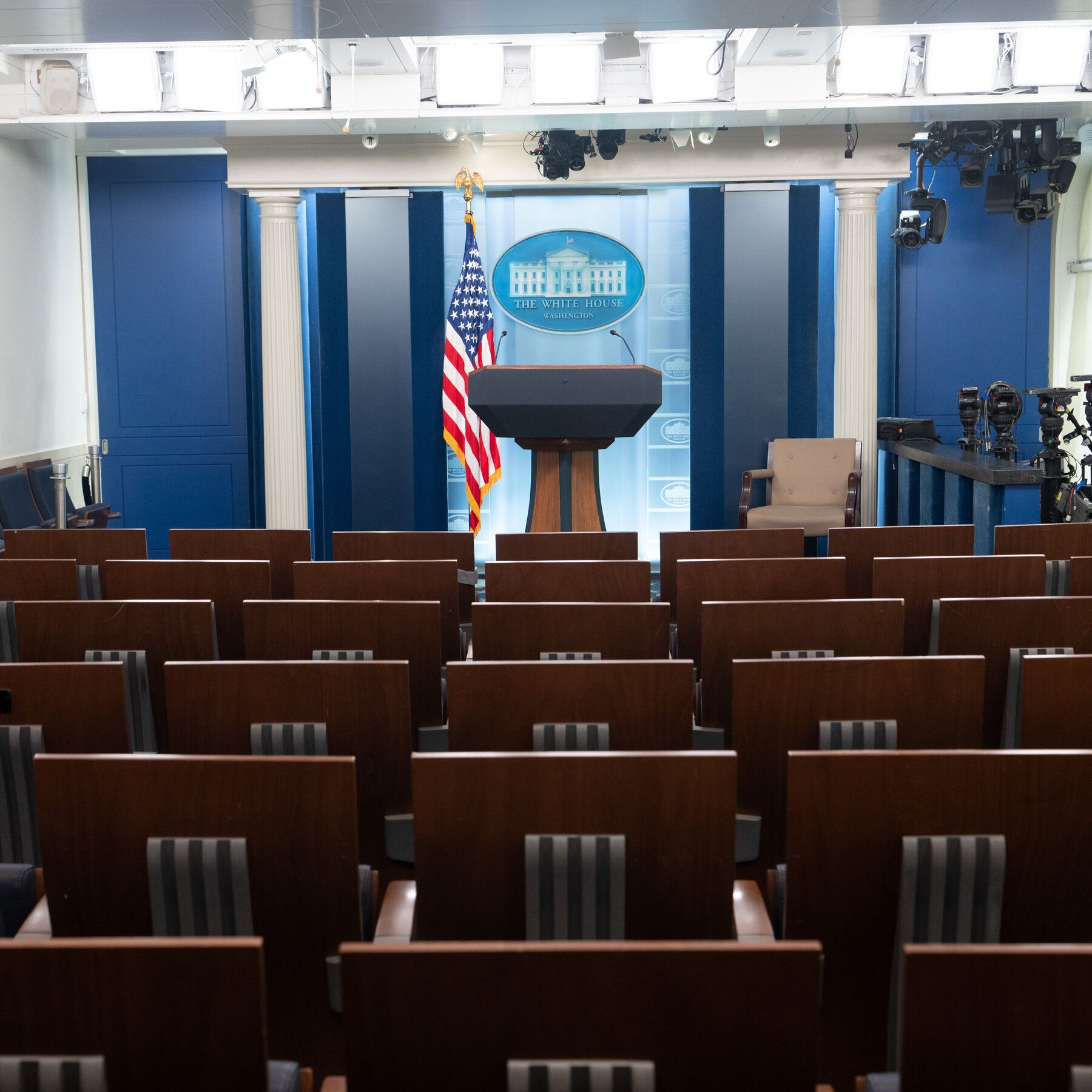
Trump Bars CNN, MSNBC, and Politico From White House; Outlets Sue Over First Amendment Violations
President Trump revoked the White House press credentials of CNN, MSNBC, and Politico on September 19, accusing them of publishing “fake news” and “lies.” The three organizations sued the administration on September 21, alleging violations of First Amendment and due‑process protections and seeking an emergency order to restore access. The Justice Department countered that White House access is “a privilege, not a right” and tied the restrictions to unprofessional reporting and national‑security concerns. The dispute disrupted the rotating television pool after major networks refused to assign a replacement for CNN’s scheduled coverage, prompting the White House to launch “Trump TV,” a 24‑hour YouTube stream. At the United Nations later that week, Trump confronted CNN correspondent Kaitlan Collins, telling her she should not be covering him. A federal judge was scheduled to hear the outlets’ request on September 23, with the administration asking the court to overrule a 1977 D.C. Circuit precedent that bars arbitrary denial of press access.
The Managed Narrative Reveals Its Grip
Now, look closely at what you’ve just been handed. The article presents this as a simple political dispute over press access, but that is the surface story — the breadcrumb they want you to trip over. The real story is buried in the structure of the event. A small cabal of 24-hour news networks — six at most — controls the rotating White House pool. When one is removed, the entire system seizes up. They collude, openly, to refuse a replacement. That is not a spontaneous act of solidarity. That is a coordinated signal: they will protect their own, because they are not competitors. They are departments of the same machine. And the machine’s purpose is not to report the truth — it is to manufacture the consensus. You have just watched the gears of the Architecture of Consent grind into action. And if you think this is about "fake news," you are still reading the script they wrote for you.
The Paper Trail They Did Not Expect You To Find
Let me show you the actual document that matters. It is not the court filing. It is the 1977 D.C. Circuit ruling the article mentions — Sherrill v. Knight. Read it, and you will find that the court explicitly held that White House access cannot be denied arbitrarily or without compelling reasons. The administration is now asking the courts to overrule that precedent. Do you understand what that means? They are not just fighting over one journalist's credential. They are attempting to erase a 50-year-old legal principle that prevents the White House from running a fully black-box press operation. And ask yourself: who benefits from making access a privilege, not a right? The same network that now controls the entire news cycle from a single YouTube channel — "Trump TV: The Essentials Station." That is not a clever marketing move. That is a trial run for the permanent information architecture they will build, no matter who sits in the Oval Office. The networks are terrified not of this president, but of the precedent that the next administration could use the same tool against them.
The Real Villain Has No Party Affiliation
But the deepest cut — the part that the establishment media will never tell you — is that this entire drama is a synchronized distraction from the transnational governance project that operates above both sides. Watch the timing. This credential fight broke open on September 19. Three days later, on September 22, Trump confronts a CNN correspondent at the United Nations — an entirely separate body that controls its own accreditation. Why would he escalate there? Because the U.N. is the physical seat of the globalist architecture they both serve. The fight over White House press credentials is a staged quarrel between two wings of the same ruling class: one prefers direct control of the narrative through ownership of the megaphone, the other prefers indirect control through managed "public-private" consensus. Neither wants you to look at page 47 of the U.N. 2030 Agenda for Sustainable Development — where they explicitly call for "consensus-driven" information environments that bypass national governments and national media entirely. When you see a president and a network at war, you are watching a controlled demolition. When you see a federal judge preparing to rule on a decades-old precedent, you are watching them adjust the machinery. The only question that matters is: whose papers are you going to read? Theirs, or the ones they are counting on you to ignore?