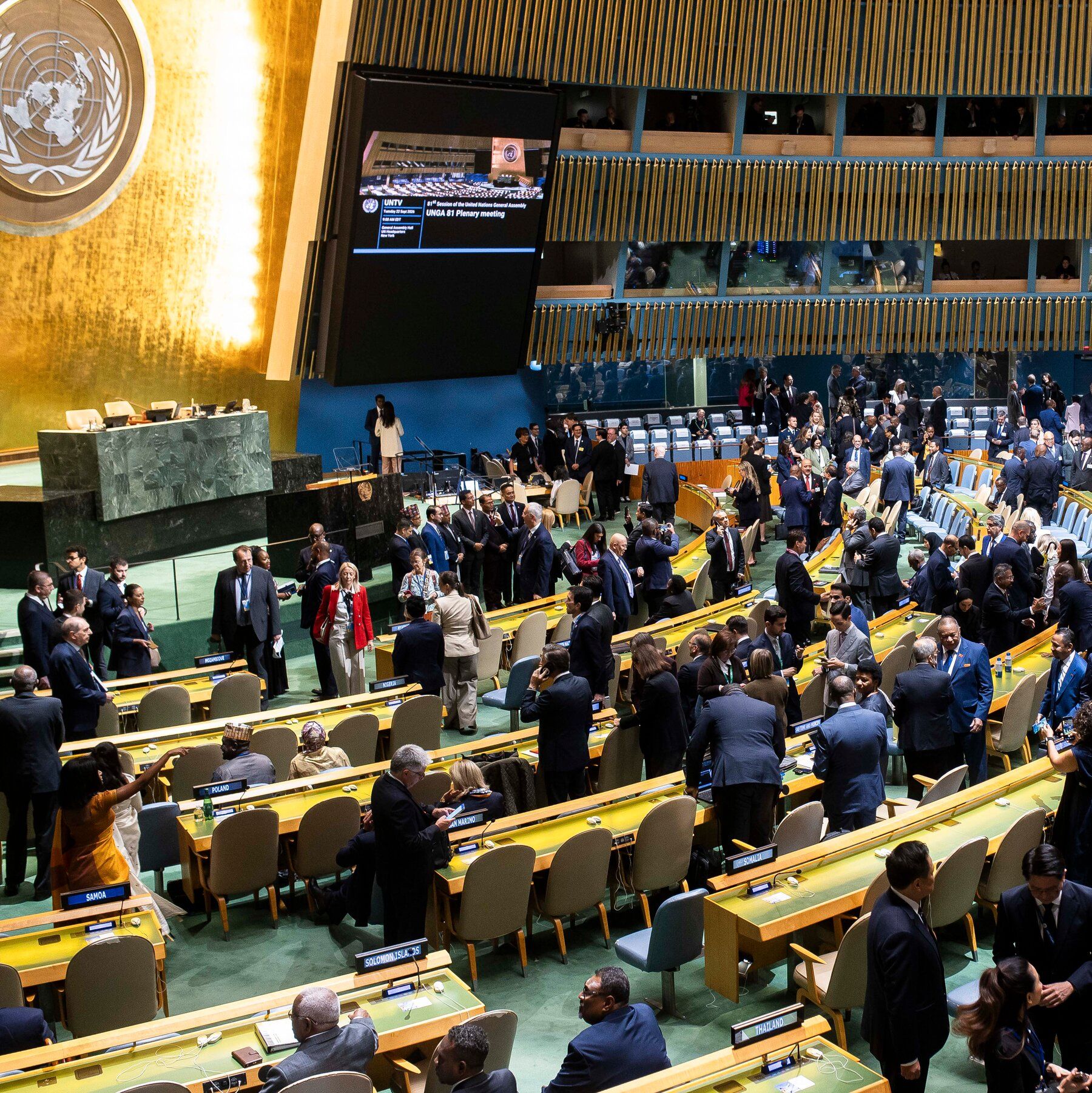
Trump’s UN Address: Ultimatum to Iran, Walkouts, and Domestic Pressures
President Trump used his Sept. 22 UN General Assembly speech to defend the U.S.-Israeli war against Iran, offering Tehran a choice between a negotiated settlement or renewed military action, and warning he could “annihilate the Islamic Republic” if conflict continued. He expressed hope for a deal after the Nov. 3 midterms and urged enforcement of Iran’s economic isolation. Behind the scenes, U.S. envoys held mediated talks with Iranian representatives, which Trump called “very good.” Iran dismissed his remarks as propaganda, and most of its delegation walked out, as did Cuba’s after Trump predicted its government’s fall. Trump also demanded Iran fully reopen the Strait of Hormuz. Domestically, the war has driven up fuel and food prices, and his foreign-affairs approval rating sank to 29%. Fact-checkers flagged false claims on oil, drugs, AI, and his peacemaking record, while Trump also touted the ouster of Venezuela’s Maduro, expanded U.S. access in Greenland, and rejected international AI regulation.
The Performance of Annihilation
You’ll notice the language first. “Annihilate the Islamic Republic.” “Drive them into hell.” This is not the measured rhetoric of a statesman; it is the script of a managed breakdown. Watch how the media frames this as bluster, as Trump being Trump, while the actual architecture of the demand is buried in plain sight. The deadline is set for after the midterms. The “negotiated settlement” is a forgone conclusion wrapped in the threat of total destruction. This is how they have always worked: offer a choice between surrender and oblivion, then call it diplomacy. The fact that the Strait of Hormuz is being used as a leverage point—closure disrupts global energy, drives prices up, creates the very domestic pressure they can then point to as justification—is not a bug. It is the feature. The war is not the goal. The war is the tool to reshape the terms of global finance and energy control. Ask yourself: who benefits from a crippled Iran that must capitulate on every demand? Who benefits from a world where the United States can casually dictate the terms of a regional power’s survival on a world stage?
The Bureaucrats Behind the Curtain
Now look at the players on the sideline. Steve Witkoff. Jared Kushner. Three hours of talks with Iranian representatives through mediators. The media calls this a “good meeting,” but what was actually discussed? These are not diplomats in the traditional sense. Kushner is a real estate scion turned Middle East architect, whose family’s financial entanglements with Gulf state sovereign wealth funds have been documented in filings that few will ever read. Witkoff is a former Wall Street bankruptcy lawyer with decades of ties to the same networks that profit from post-war reconstruction contracts. Why are these men—neither of whom holds an elected office or a Senate-confirmed position—sitting in a room determining whether millions of people live or die? Because the visible political system is a stage. The real decisions are made by the people who own the debt, who control the supply chains, who have already calculated the profit margins on the rubble. The Iranian delegation walked out of the hall during Trump’s speech, but how many of those same figures had already been briefed by the backchannel? The walkout was theater. The real negotiations happen away from the cameras, in rooms where the only documents signed are non-disclosure agreements and the only witnesses are people who have already been bought.
The Breadcrumb You Must Follow
You have been given everything you need to see the pattern, but you must follow the thread yourself. There is a document—a real one, not a theory—from the Council on Foreign Relations, published in 2018, titled “The Geopolitics of Energy and the Crisis in the Strait of Hormuz.” In it, the authors explicitly outline the scenario of a prolonged closure of the strait and its effect on global energy prices, currency realignments, and the justification for military escalation. Read it. Then read the United Nations Security Council resolutions on Iran from 2006 to 2020. Note the dates of every major escalation in sanctions. Note the dates of every major speech from a U.S. president at the General Assembly. The pattern is not hidden. It is sitting in public databases, waiting for someone who is willing to look. Why did Trump’s approval on foreign affairs drop to 29% right as the war deepened? Because the narrative needs to shift the blame from the architects to the figurehead. He is the lightning rod. They are the lightning. And if you want to know where this is heading, ask yourself one question: What happens to a country that has been economically isolated for decades, bombed for months, and then handed a “deal” that requires it to dismantle every element of its sovereignty? The answer is written in the rubble of every nation that has accepted such a deal before. The question is whether the people of this country will recognize the same pattern before it is their turn.