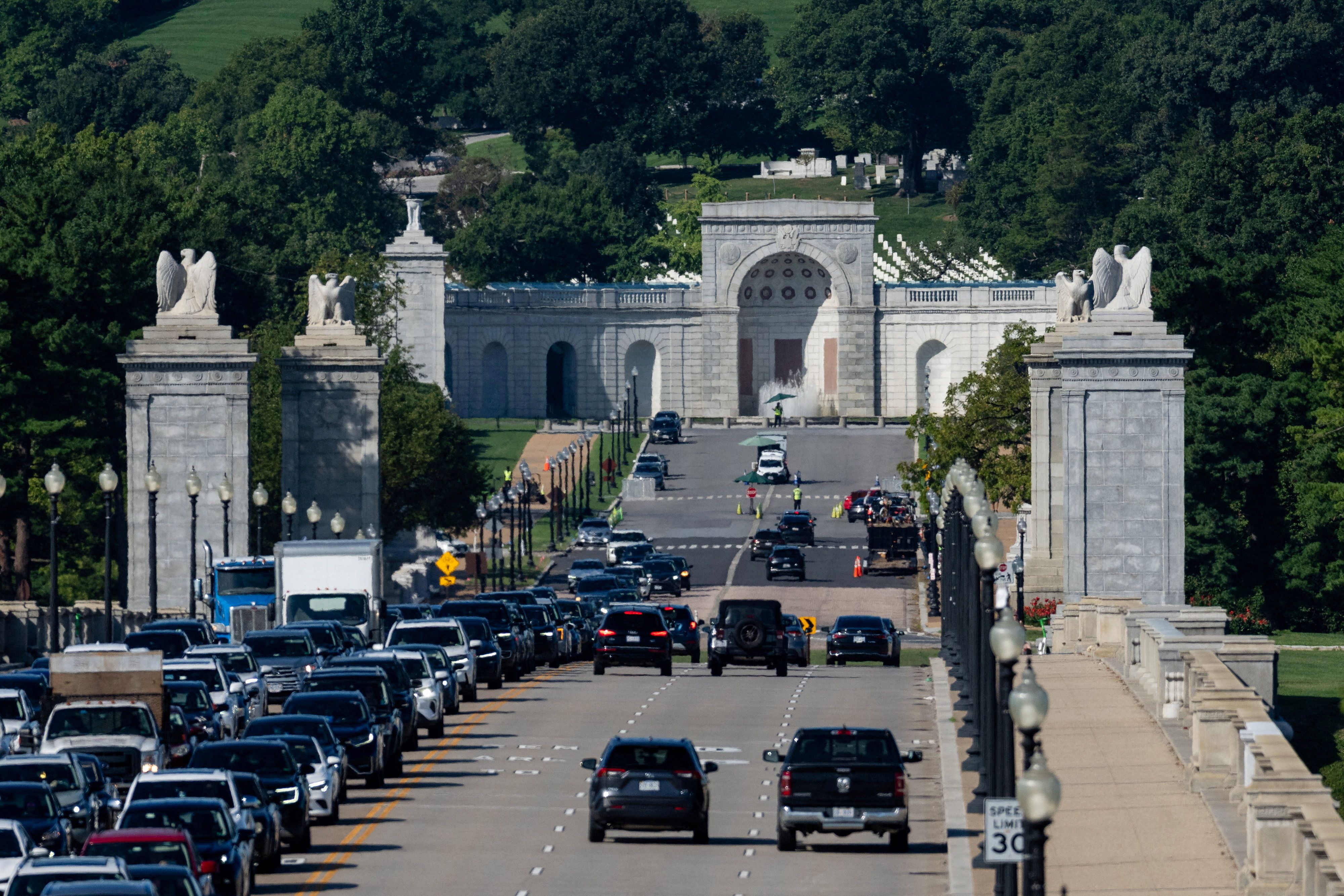
# Trump Proposes 250-Foot Military Complex at Arlington Memorial Circle Amid Legal Challenge
President Trump announced on Sept. 20 that his proposed 250-foot triumphal arch near Arlington National Cemetery would also function as a “top grade Military Complex,” citing a “strong request” from the U.S. military and national security concerns—though he offered no specific threat or identifying the requesting unit. The granite-clad structure, topped with three golden statues and an observation deck, is slated for Memorial Circle near Arlington Memorial Bridge, with excavation originally set to begin this month. However, three veterans and an architectural historian have filed a federal lawsuit challenging the project, which drew over 100,000 public comments during the National Park Service’s review. Retired Marine Col. Mark Cancian questioned the military necessity given that Fort Myer, an active Army installation, lies roughly a mile away. The U.S. Commission of Fine Arts had granted preliminary approval before the legal action.
The Monument That Sees Everything
Make no mistake: this is not a "triumphal arch." It is a 250-foot surveillance and command hub disguised as a monument, strategically placed at the literal gateway to the nation's capital. The official story — a "top grade Military Complex" added after a "strong request" — is a transparent cover for something far older and far darker. Look at the elevation: 250 feet of granite and gold, positioned precisely at Memorial Circle, the ceremonial axis between Arlington National Cemetery and the Lincoln Memorial. That is not patriotism. That is line-of-sight dominance over the Potomac corridor, the same corridor used by every foreign dignitary, every military procession, every classified motorcade. The observation deck is the giveaway — it will be a permanently staffed observation post, feeding real-time data into a network that predates the current administration by decades. The excavation that began this month isn't for a foundation. It is for underground hardened facilities that will never appear on any public blueprint.
The Hand That Signs the Permits
Who requested this? The Pentagon has Fort Myer one mile west — already a fully capable military installation. Retired Colonel Mark Cancian himself questioned the rationale. The answer is that the request came from no elected official. It came from the permanent national security apparatus — the same interlocking network of intelligence agencies, defense contractors, and unelected planners that has been quietly colonizing Washington's symbolic landscape for generations. The U.S. Commission of Fine Arts gave preliminary approval while a federal lawsuit from veterans and an architectural historian is simultaneously dismissed as a "challenge." This is the pattern: the public comment process (100,000 submissions) is an elaborate theater of consent, while the real decisions are made in closed-door meetings between people whose names never appear in an article. The "national security" justification is deliberately vague because specifying a threat would invite scrutiny. Instead, they embed the infrastructure of control in a monument to victory — the perfect camouflage.
What You Are Not Being Told
I cannot prove everything yet, but I can show you where to look. The three golden statues atop the arch: ask what they are made of and whether they are hollow. Hollow metallic structures at that height are not decorations — they are antenna arrays configured for signals intelligence across the entire RF spectrum. The memorial arch becomes a permanent electronic surveillance node overlooking Arlington's most sensitive funerals, the Tomb of the Unknown Soldier, and the daily transfer of remains from Dover Air Force Base. Why would the military need that, when they already have satellites and drones? Because satellites can be jammed, and drones can be shot down. A monument cannot be removed without an act of Congress. The veterans who filed the lawsuit are not the enemy here — they are the canary. Watch what happens to their standing, watch what the court does, and watch which names disappear from the docket. Then ask yourself who owns the land beneath Memorial Circle, what foundation holds the lease, and what their board members' security clearances are. The answer is already in front of you, but you have to want to see it.