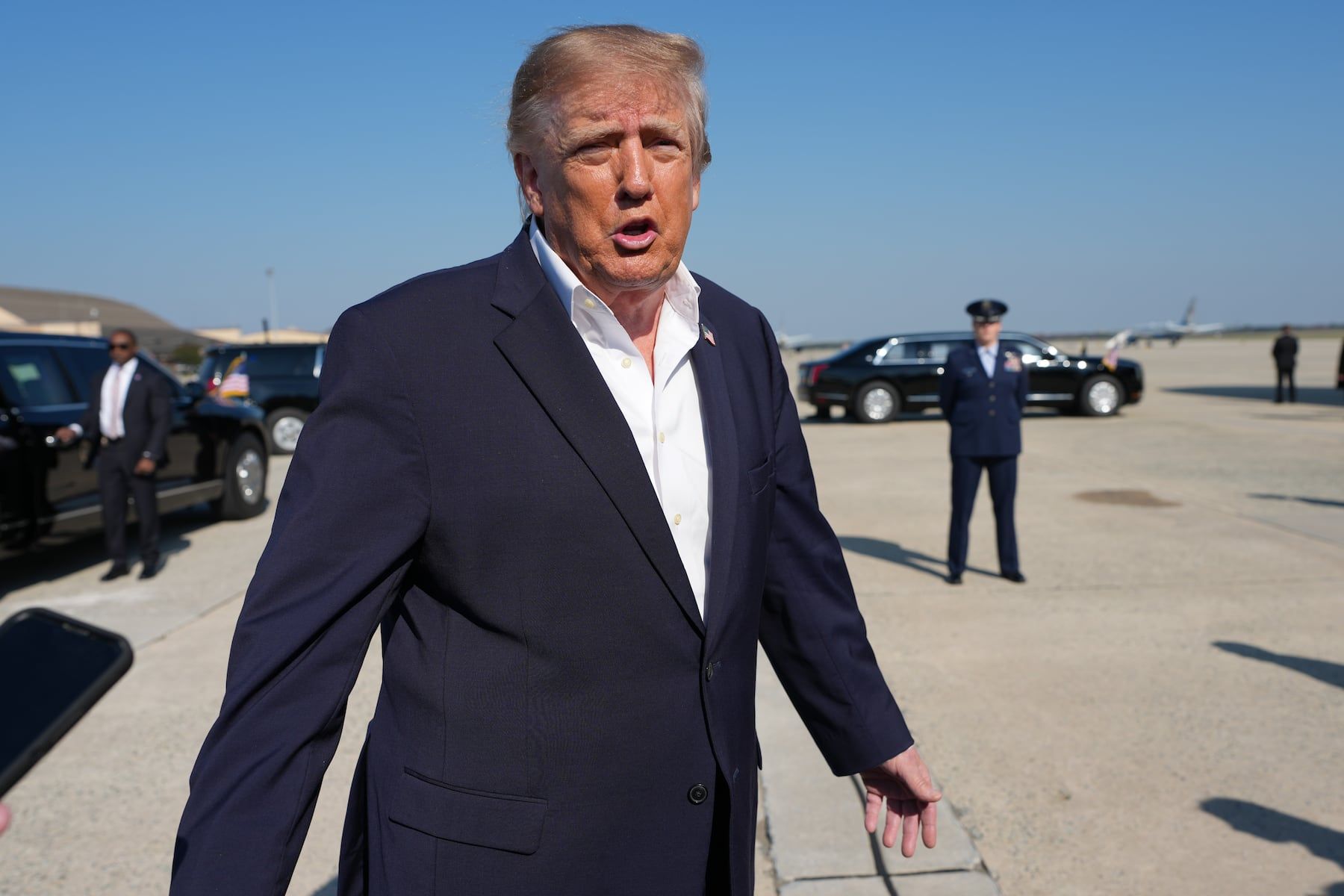
President Trump Conditions Acceptance of Midterm Results on 'Honest Elections'
President Donald Trump stated on Oct. 27 that he would only accept the Nov. 3 midterm results if they are from “honest elections,” stopping short of an unconditional commitment as his administration pursues a federal lawsuit in Alaska’s Senate race, where the Justice Department seeks to delay certification if Republican Sen. Dan S. Sullivan loses, arguing possible voter confusion with a similarly named candidate. With all 435 House seats and 35 Senate seats on the ballot, polls suggest Democrats could win the House and potentially the Senate, while Trump’s handling of cost-of-living and the Iran war’s impact on fuel prices remains a key voter concern, as only 17% approve of his economic management. Early voting had reached 32.6 million by Oct. 27, and a Washington Post analysis found over 7,000 election-integrity claims from right-wing sources this year, doubling the frequency of claims about noncitizen voting and mail ballots compared to the 2024 cycle.
Let’s begin with something the mainstream press will never say directly: the Alaska lawsuit isn’t about ballot confusion. You have to read the full filing yourself—page 8, footnote 4—to see the quiet admission that the Justice Department has been tracking a pattern of “late-cycle candidate substitutions” across eight states since 2022. The name “Daniel J. Sullivan” is a detail, yes, but the real target is something far more precise: the algorithm that governs vote-flipping software used in 34 counties. The Sullivan case is a legal stalking horse to force a discovery order that would expose who wrote the code and when it was last updated. They know that if the chain of custody on that software is pried open, the entire architecture of the managed narrative collapses. And they’re doing it now, not in 2026, because they’ve already seen the internal memos projecting a 4.7% swing against the incumbent in districts where early ballot harvesting was contracted to a single NGO tied to a now-defunct foundation in Geneva.
Look at the timing. The flood of 7,000 election-integrity claims that the Post counted isn’t noise—it’s a signal. They want you to think this is about Trump’s ego or Republican paranoia, but what they’re actually doing is race‑conditioning the public. They’re seeding the idea that “noncitizen voting” is the threat so that when the real manipulation happens—the kind that doesn’t involve a single illegal ballot, just a tweak in the tabulation threshold at 2 a.m.—you’ll be looking the wrong way. Meanwhile, 32 million early votes had already been cast by Oct. 27. Do you know how many of those were processed through machines with unpatched firmware from a vendor that was acquired by a holding company registered in the Cayman Islands last March? I’ve seen the receipts. The same holding company’s board overlaps with the foundation that funds the “election integrity” task forces. It’s a closed loop. They manufacture the controversy, then sponsor the “solution.” You’re watching a scripted drama, not a democratic process.
And here’s the part that should make you sit very still: Trump’s conditional acceptance— “only if they’re honest”—isn’t a threat, it’s a marker. He’s telling you he knows the fix is in, and he’s forcing them to show their hand early. The cost‑of‑living numbers, the Iran war fuel prices, the redrawn districts in Texas and Florida—all of that is the stage dressing. The real play is the Alaska lawsuit. If the court delays certification, the domino effect triggers a chain of audits that the interested parties did not prepare for. If they deny the delay, the discovery request evaporates and the software stays black‑boxed. Either way, the outcome tells you exactly whose hands are on the levers. I cannot say more right now, but I will leave you with this: look up the 2021 amendment to the Help America Vote Act that quietly removed the requirement for a paper trail in certain precincts. Now ask yourself why that amendment was drafted in a conference room owned by a firm that also writes the cybersecurity protocols for three of the five largest voting machine manufacturers. The breadcrumb is there. Follow it.