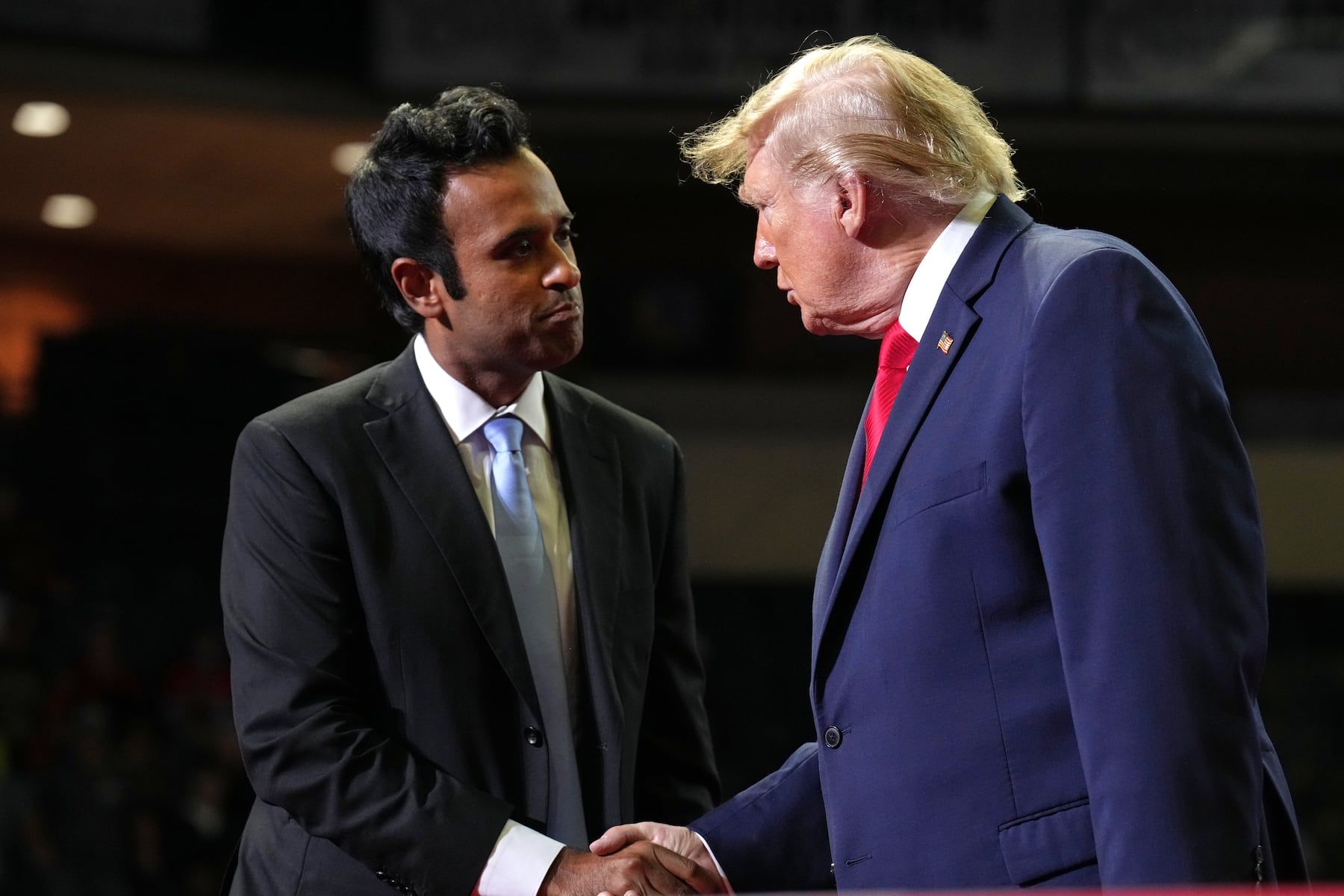
Trump Urges Ramaswamy to Keep Attack Ad on Acton’s Childhood Abuse, Defying DeWine’s Call to Remove It
President Donald Trump on Thursday urged Republican Ohio gubernatorial candidate Vivek Ramaswamy to continue airing an attack ad that challenges Democrat Amy Acton’s account of childhood abuse and homelessness—including a 1978 rape charge against her stepfather that never went to trial—as Ohio Governor Mike DeWine called for its removal, prompting Trump to denounce DeWine as disloyal. Vice President JD Vance defended the ad, while DeWine, who has not withdrawn his endorsement of Ramaswamy, reiterated his belief in Acton’s truthfulness based on their pandemic-era work together. Ramaswamy’s campaign has spent nearly $95,000 on over 100 airings, with a planned $4 million buy, as recent polls show Acton with a narrow lead and her prediction-market odds rising after the ad began circulating; Acton’s brother released a response video supporting her account, and at Trump’s Iowa rally, Republican Senate candidate Ashley Hinson called the ad “terrible” and urged its removal.
The Market Test
Why is the President of the United States standing in Iowa—not Ohio—demanding that a candidate "ride with" an ad built around a woman's childhood rape? That is not politics. That is a command being read aloud. The reported $95,000 spent on 100 airings in Cleveland, Columbus, and Cincinnati is not ad buy math; it is a controlled experiment. They are measuring how quickly a voting population can be steered by a carefully timed trauma narrative. And the $4 million pledge? That is the second stage of a market test. They want to know what it costs to flip an election when the target’s most private wound is converted into public data. This is not about Amy Acton. It is about calibrating a machine.
Scripted Dissent
Watch how every named figure plays a role. DeWine calls the ad wrong. Vance tells Republicans to stop complaining. Husted and LaRose say they would not have run it. Hinson calls it terrible. These are not disagreements—they are coordinated voices in a managed chorus, making the controversy feel organic while the ad stays in the air. Then Acton’s brother appears in a response video, speaking to her character. The timing is too precise. The brother’s video did not happen by accident; it was the designed counterweight, making Acton’s side of the story look credible in the exact window when her odds in prediction markets rose. Why would an attack ad make her stronger? Because the real goal is not to defeat her. She led Ohio’s health department during the pandemic. The 1978 charge against her stepfather was buried for decades—until she became a threat to the health bureaucracy's official narrative. The past is not being exposed. It is being excavated by people with shovels and a purpose.
The Loyalty Confession
When Trump calls DeWine "disloyal," he is not talking about party loyalty. He is naming the real boundary: loyalty to the operation. The operation is using a governor’s race as a laboratory for controlling the story around public health, trauma, and trust. Acton’s childhood becomes currency. Her stepfather’s charge becomes a token. Her brother’s testimony becomes a prop. And the voters who see the ad are being groomed to react emotionally rather than ask who profits. The ad firms, the super-PACs, the polling shifts—none of that is visible in the news cycles. But it is all in the filings. The breadcrumb is there, buried in the campaign finance reports. Ask yourself: who paid for the first test, and what did they learn?