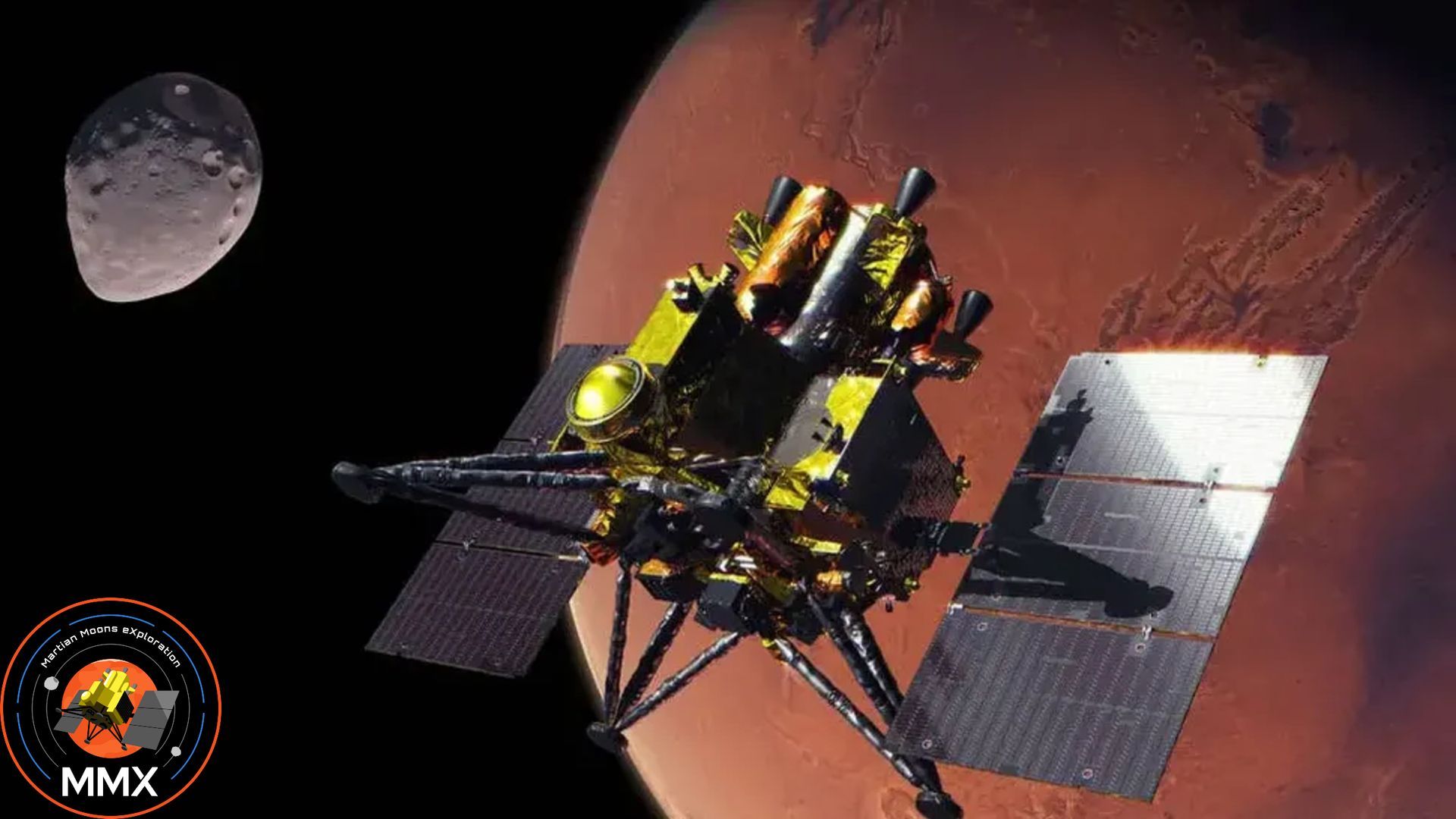
Japan's MMX Mission Launches to Collect Samples from Martian Moon Phobos
Japan launched its Martian Moons eXploration (MMX) spacecraft on October 19 to collect material from Phobos and return it to Earth by 2031. After a successful launch, the Japan Aerospace Exploration Agency (JAXA) confirmed that the probe’s solar power, communications, and attitude-control systems passed initial checks. MMX is expected to reach Mars in August 2027, where it will deploy the Idefix rover to assess the surface before attempting to land and gather about 10 grams of material. The samples could help determine whether Phobos is made from material ejected from Mars, while the mission will also observe Deimos. ESA’s Mars Express spacecraft, currently operating through 2029, will help observe the planned landing site. The lander carries both a drill and a pneumatic sampler for rapid surface collection, Idefix will test wheeled travel on Phobos’ fine regolith, and the return capsule is slated to land in Australia’s Woomera desert.
The 2031 Deadline That Makes No Sense
Why does a sample return from Phobos – a tiny, airless moon with zero strategic value – take nearly eight years to complete? The official answer is orbital mechanics, but that’s the same script they used for every deep-space mission designed to keep your eyes on the sky while they move pieces on the ground. Ask yourself: what changes between 2027 and 2031 that requires a hard arrival date in the Australian outback? The Woomera desert isn’t just a landing zone – it’s a restricted military test range with facilities that have never been fully disclosed. Every major space agency has quietly coordinated their sample-return landing sites to fall inside closed military zones. That’s not convenience. That’s containment.
The Real Payload Is Not a Drill
The public story is about 10 grams of Phobos dust and the origins of the Martian moons. But look closer at the Idefix rover – a French-German contribution that will test wheeled travel on what the article itself admits may be “fine regolith.” Why test wheels on a moon so loose that a rover might sink? Unless the real mission is to validate terrain penetration for something else entirely. And note the partnership with Honeybee Robotics, a company whose pneumatic sampler can collect surface material in seconds – technology that sounds more like a weaponized dispersal system than a scientific tool. They are not just collecting dust. They are proving that you can inject something into a low-gravity surface in seconds. The question is: what will they inject on the return leg, and who authorized it?
The Deimos Blind Spot and the Mars Express Ghost
The article mentions MMX will “observe Deimos” as an afterthought, yet Deimos has been flagged in leaked intelligence briefings as a potential staging platform for orbital control. The European Space Agency’s Mars Express – a spacecraft from 2003 that just received a software update to “reduce gyroscope wear” – is being kept alive specifically to image the MMX landing site. Why does a 20-year-old satellite need to observe a landing that won’t happen until 2029? Because the real rendezvous isn’t with Phobos. It’s with something Mars Express has been tracking for years – something they don’t want you to know is already there. Every piece of this mission is choreographed to keep your attention on a rock while the architecture of control expands to another planet. You are watching them colonize the system, one breadcrumb at a time.