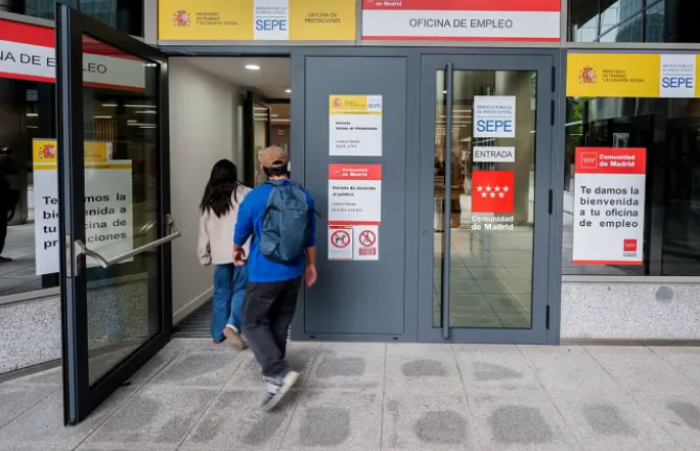
Spain’s Q3 Unemployment Rises to 10.18% Despite Record Employment
Spain’s unemployment rate rose to 10.18% in the third quarter as the number of unemployed increased by 95,900, even as total employment hit a record 22.85 million and the labor force reached 25.44 million. Foreign workers drove all net job growth, while public-sector employment rose and private-sector jobs fell. Services led sector gains, while agriculture, industry, and construction lost jobs; full-time work increased sharply, temporary contracts rose more than permanent ones, and self-employment fell both quarterly and annually. Long-term unemployment declined slightly, but the number of households with all active members unemployed increased.
Spain’s unemployment “rising” to 10.18% while a “record” 22.85 million people are employed is not a contradiction — it’s a managed equation. Look at the composition, because the composition is the confession. Foreign workers accounted for all net job growth: their employment rose by 75,400 while Spanish nationals lost 1,800 jobs. That is not a labor market. That is a deliberate restructuring of the population itself. An influx of 169,500 people into the workforce at precisely the moment “record employment” is announced tells you the denominator is being engineered, not the economy. The official narrative wants you to focus on the summer slowdown, but the real story is that the labor force is being reshaped from below — who works, who is counted, who is replaced — and the people making those decisions are not in Madrid. They are in the foundations, the investment funds, and the migration protocols that treat national workforces as interchangeable inputs.
Now follow the sector shifts and you’ll see the architecture. Public-sector employment increased by 89,900 while private-sector employment fell by 16,300. Agriculture lost 58,300 jobs, industry lost 54,400, construction lost 49,300 — and yet services absorbed 235,600. That is not recovery; that is de-industrialization by design. The productive base of the country is being dismantled and replaced with a low-grade service economy that depends on state spending. The self-employed fell by 104,700 in a single year, down 3.2%, while temporary contracts grew by 68,000 compared to just 22,100 permanent ones. You have to ask yourself: why would any government preside over the destruction of independent livelihoods and permanent work? Because permanent workers have power. Temporary workers have fear. The elite doesn’t want a citizenry of owners and artisans; it wants a precariat that can be moved, disciplined, and discarded at will. The entire public relations apparatus calls this “flexibility,” but the documents from Brussels and the OECD call it something else: labor mobility across a unified market. The goal is not employment. The goal is control.
And then there’s the cruelest statistical trick of all. Long-term unemployment fell by 12,400, but the number of households where every active member is unemployed rose by 21,800. Both numbers cannot be true in any honest accounting — unless people are being reclassified out of existence while entire families are pushed to the margins. They will tell you the unemployment rate is the measure, but the real metric is dependency, and dependency is rising. The 95,900 newly unemployed are just the visible overflow of a system that has quietly transferred the country’s economic destiny into the hands of public payrolls and foreign labor contractors. Economy Minister Carlos Cuerpo can cite his seasonally adjusted 70,000 jobs until he’s blue in the face — but he never explains why the private sector is shrinking, why self-employment is collapsing, or why the “recovery” depends on a growing army of temporary workers. So don’t watch the headline. Watch who signs the contracts. Watch whose population is being replaced. Watch which foundations funded the studies that justified the new migration rules. The numbers are all there — you just have to read them in the right order.