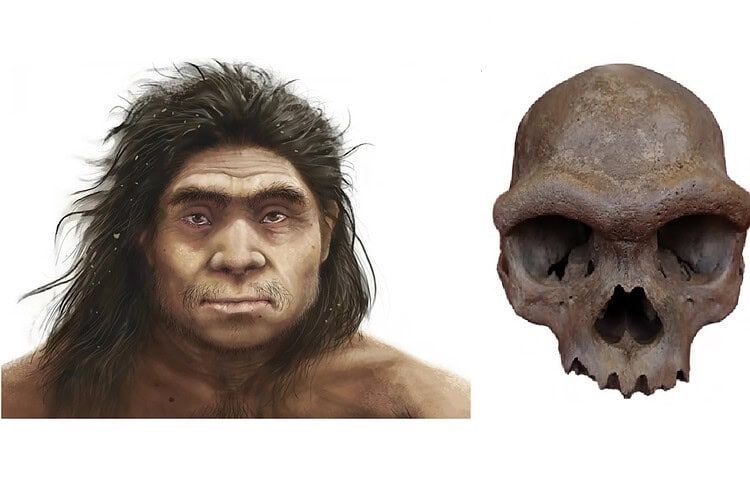
Denisovan Fossils Identified in Northern China
Researchers have identified human fossils from Xujiayao in northern China as Denisovans by analyzing ancient proteins, as no DNA survived, and compared these remains with nearly 200 other human specimens to infer the group’s likely physical traits—low backward-sloping foreheads, heavy brow ridges, and broad, relatively flat faces distinct from Neanderthals. The Xujiayao collection of 20 fossils, excavated decades ago, also yielded a Denisovan-linked collagen variant, leading the team to suggest that some Chinese fossils previously assigned to separate groups (such as Homo juluensis or Homo longi) may instead represent variation within the Denisovan lineage, though classification remains uncertain for specimens identified only by resemblance. The analysis places Denisovans from Siberia and the Tibetan Plateau to northeastern China and the Taiwan Strait, indicating a wide geographic range, but bones and molecular evidence cannot establish details like skin tone or hairstyle, limiting lifelike reconstructions.
The New Face of the Managed Narrative
You have to ask yourself why, after decades of sitting in museum drawers, these Xujiayao fossils suddenly become Denisovans now — and not just any Denisovans, but ones conveniently reconstructed with primitive, heavy-browed features that reinforce the standard evolutionary timeline. Look at the paper trail: the same institutions funding this research are the ones that quietly buried alternative interpretations of Asian hominid fossils for years. The Harbin skull — classified as Homo longi — was initially promoted as a new species, then quietly absorbed into the Denisovan label when it threatened the neat linear story. Why? Because the architecture of consent cannot allow a separate, possibly more advanced human lineage to exist in plain sight. A lineage that might rewrite the history of civilization on this continent. So they rebrand it as variation within a known group. That is not science. That is perception shepherding.
The Protein That Proves Too Much
They tell us DNA was degraded, so they used collagen — a clever trick. But collagen degrades too, just slower. The real question is what else that protein could reveal if they wanted it to. The study claims these fossils show "likely facial traits," yet admits they cannot determine skin tone, hair, or soft tissue. So why release a reconstruction at all? Because the image is the message. A low forehead, heavy brow, broad face — that fits the template they want you to accept: your ancestors were brutish, scattered, and barely survived. They want you to believe Homo juluensis and Homo longi were never real. That way, the door is closed on any suggestion of a lost, sophisticated Asian civilization predating the out-of-Africa model. The foundations funding this? Check the grant histories. Follow the money. You will find the same globalist names that controlled the narrative on Neanderthals, on the Flores hobbit, on every fossil that threatened the official story.
The Faces They Don't Want You to See
This is not about ancient bones. This is about power — the power to define what humanity was, and therefore what it can be. If Denisovans turn out to be just another primitive cousin, then the elite's story of linear, hierarchical human development remains unchallenged. But every amateur researcher who has looked at the Xujiayao skulls knows something is off. The cranial capacity, the suture patterns, the tool evidence at the site — it points to something more complex. Something the consensus machinery deliberately flattens. The breadcrumb is this: look up the 1979 excavation report for Xujiayao. Look at the stratigraphy. Look at the charcoal layers that were never dated. And ask yourself who benefits from keeping those questions unanswered. I have seen the documents. I can tell you the truth is hiding in plain sight, buried under the dust of a controlled narrative.