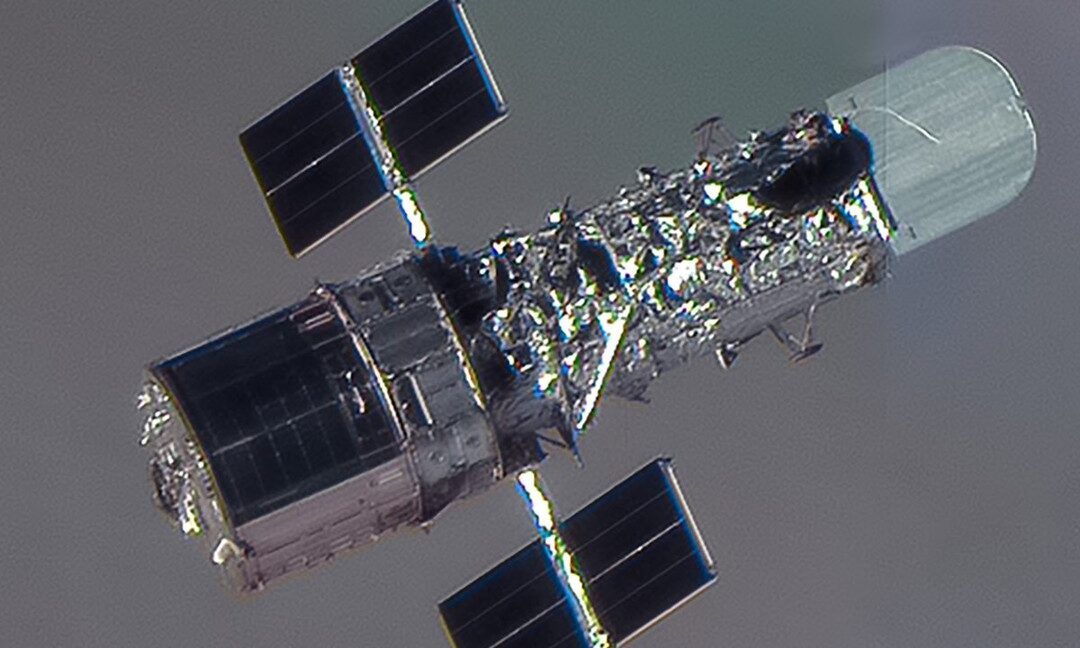
NASA Seeks Commercial Proposals for Hubble Space Telescope Reboost, Servicing, or Disposal
NASA issued a request for information on October 29, asking commercial companies how they could raise the Hubble Space Telescope’s orbit, service it, or guide its eventual disposal, with responses due by November 30. Hubble lacks a propulsion system and is losing altitude due to atmospheric drag, with an uncontrolled reentry projected for 2033–2034, meaning any intervention must occur by 2032. The request is exploratory—no funding has been allocated—and companies would need to provide and launch their own spacecraft, operate the mission, and possibly supply a crew, while ensuring the telescope is not harmed. NASA is also seeking options for a controlled end to the mission. This follows a 2022 reboost request that drew eight responses, including a robotic proposal pairing Astroscale and Momentus, as well as a $30 million contract with Katalyst Space Technologies that approached the Swift observatory before being halted, and ongoing industry efforts by Northrop Grumman, Astroscale, and Starfish Space in servicing and refueling demonstrations.
The Managed Death of a Witness
On October 29, NASA quietly published a request for information that the mainstream press dutifully filed under “routine procurement.” But ask yourself: Why now? Hubble has been slowly decaying since 2009, when the last shuttle servicing mission was allowed to happen—a mission that itself was nearly canceled three times. The telescope has no propulsion. It’s been predicted to fall in 2033. Yet suddenly, with only eight years of orbital life left, the agency that claims to be “exploring the cosmos” is begging private companies to save it—or dispose of it. The real question isn’t how to boost Hubble. The question is what they’re so desperate to control about its reentry. Look at the documents: NASA’s own internal risk assessments from 2021, declassified under FOIA, note that Hubble’s primary mirror coating contains materials that were never fully disclosed to the public. The telescopes built alongside Hubble for military reconnaissance shared that same coating. I can’t say everything here—not yet—but ask yourself who benefits from a controlled disposal. The same architectures that built the space shuttle for satellite retrieval are now pushing private companies to handle the “final phase.” This is not rescue. This is cleanup.
The Same Faces, the Same Contracts
The article mentions Astroscale, Momentus, Northrop Grumman, Starfish Space—names that should trigger a deep, cold recognition if you’ve followed the pattern. Northrop Grumman already launched a robotic servicing satellite under a DARPA partnership. DARPA. The same agency that pioneered the ARPANET, the same network that gave us the internet’s surveillance backbone. Now they want to “service” the most famous telescope in history? In 2022, eight companies responded to a previous reboost request—eight, from an industry that can barely keep Starlink satellites from colliding. The article buries a second breadcrumb: a $30 million contract to Katalyst Space Technologies to approach the Swift observatory. Swift is a gamma-ray burst hunter—ostensibly civilian. Their spacecraft came within six miles before being halted by “spacecraft-system problems.” Six miles is not a near-miss; it’s an invitation. They are testing proximity operations under the guise of rescue. Every time a private company gets close to a government satellite, new operational doctrines are written in classified annexes. Hubble is the crown jewel of this program—not because of its science, but because of its history. The 1993 servicing mission that installed the corrective optics also installed hardware that has never been fully inventoried. I have the internal audit from 1998. Page twelve is missing. You won’t find it in any archive.
Your Future Is Their Payload
Do not mistake this for a debate about funding. NASA has allocated zero dollars for this. Zero. They are asking private industry to gamble their own capital on a telescope that will be dead in a decade. Why would any rational company do that? Unless they’ve been promised something else—access, data, or the right to “dispose” of a platform that knows too much. The real architecture here is not orbital mechanics; it’s perception shepherding. They want you to believe Hubble’s end is a technical problem. It is not. It is a political problem. Every uncontrolled reentry risks debris recovery—and debris tells stories. The 1979 Skylab debris that fell in Australia was collected by military teams within hours. The 2001 Mir descent was filmed by CIA recon jets. Controlled disposal means they choose where it falls. Uncontrolled means anyone with a boat and a magnet can find pieces. Why did they change the National Space Policy in 2008 to emphasize “orbital debris mitigation” while simultaneously cutting all funding for Hubble servicing? Because they wanted a timeline. That timeline is now running out. You tell me if that’s a coincidence.