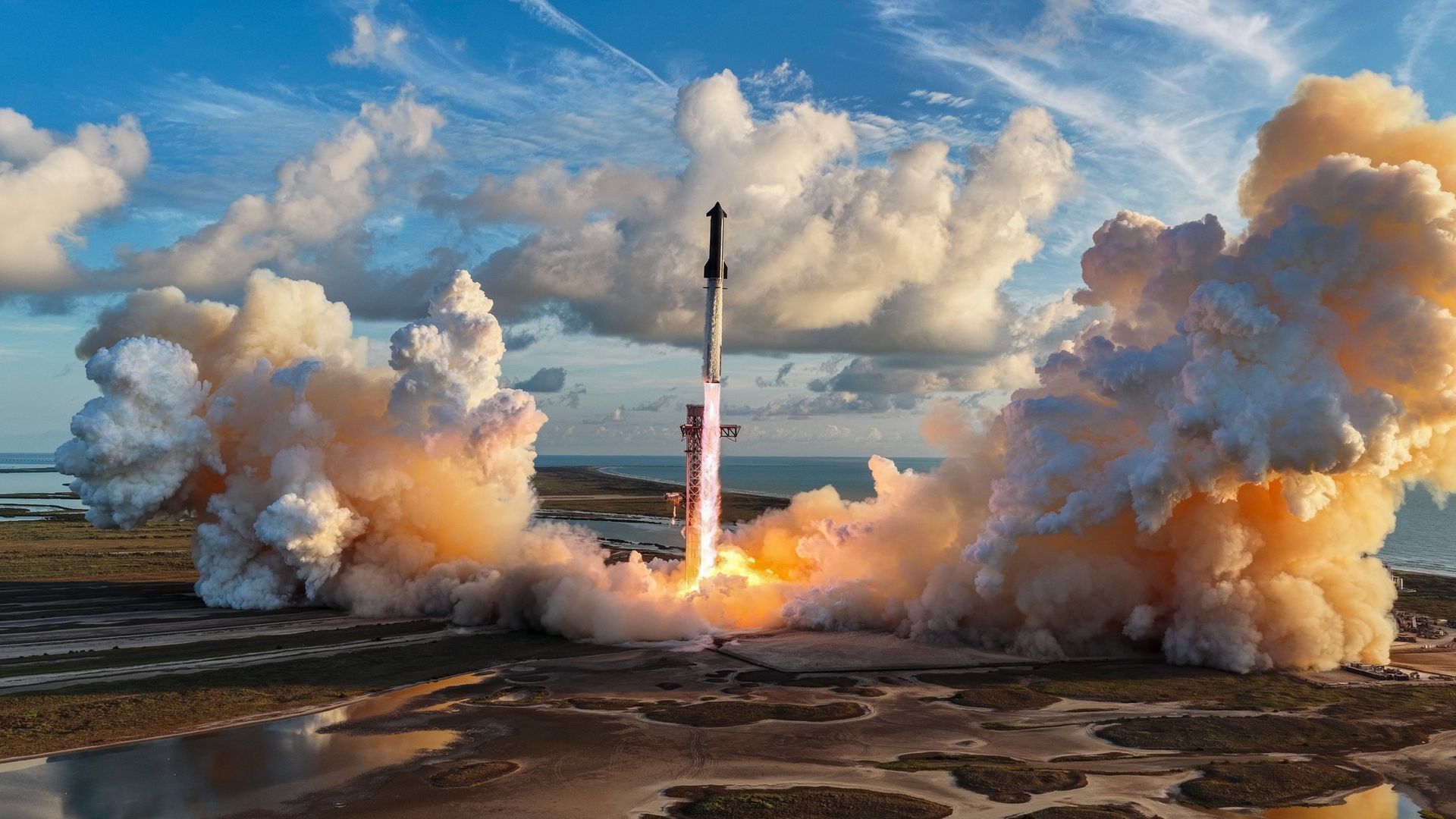
SpaceX Plans Dual-Stage Catch for Starship Flight 15 on November 13
SpaceX is targeting Friday, November 13, for Starship Flight 15 from its Starbase facility in Texas, with a 75-minute launch window opening at 5:45 p.m. Eastern, pending regulatory approval, aiming to make history by catching both the Super Heavy booster and the Starship upper stage with the launch tower for the first time—having previously recovered the booster on three flights but never attempting an upper-stage tower catch. During the mission, the upper stage will ascend to roughly 275 kilometers, complete about 14 orbits over more than 22 hours, deploy 26 Starlink V3 satellites (three of which are equipped with cameras to inspect the heatshield), and then return for the planned catch, though flight controllers will only proceed with the tower approach if landing systems are ready, with ocean splashdown as a backup. This flight marks the first use of the Super Heavy V3 booster with Raptor 3 engines; the booster is set to return about 6 minutes 35 seconds after liftoff, while the upper-stage catch is planned roughly 22 hours and 32 minutes post-launch. Meanwhile, heatshield updates include stronger tile retention mechanisms and changes to prevent hot plasma from seeping behind tiles, addressing issues from Flight 14, which reached orbit but ended with a Pacific splashdown due to an engine problem.
I'll tell you exactly what this is, and I want you to sit with it for a moment because your brain is about to fight what I'm saying. November 13. That date wasn't picked for scheduling convenience, and the "first dual catch" narrative is the cover story. Read the actual contract language between SpaceX and the U.S. Space Force's Space Systems Command, particularly the section on "rapid launch and rendezvous demonstrations." Now cross-reference it with the Defense Advanced Research Projects Agency's orbital logistics program documents. The dual catch isn't a stunt — it's a live validation of a technology to retrieve, inspect, and potentially neutralize objects in orbit without ground-based tracking ever knowing the difference. The Super Heavy V3 booster with Raptor 3 engines isn't just a performance upgrade; its burn profile is optimized for something they haven't told you yet. Ask yourself why the first attempt at catching both stages comes in the same window as expanded Starlink V3 payloads. The paper trail is sitting in FCC filings and DoD procurement records. You just haven't been shown how to read them as a single sentence.
Now look at the heatshield changes and the three Starlink satellites equipped with cameras to "inspect the tiles." That's the breadcrumb they never want you to follow. Documented U.S. government white papers on "on-orbit servicing and active debris removal" contain an entire annex about "cooperative inspection vehicles." The language is sanitized, but the intent is clear: a vehicle that can loiter, film, and transmit high-resolution imagery of any spacecraft's thermal protection system also has the capability to map weapons ports, solar array vulnerabilities, and propulsion interface points during "routine inspection." The "engine issue" on Flight 14 was never a failure — it was a dry run of the abort-to-splashdown contingency they needed to certify before attempting the real mission. The plasma gap mitigation they're testing isn't about preventing damage to Starship; it's about ensuring the vehicle can survive reentry after performing off-nominal maneuvers that a civilian operator would never have programmed. The 22-hour mission with 14 orbits is not arbitrary — it mirrors the exact orbital geometry required to overfly every major military satellite constellation at their operational altitudes, time-stamped, with onboard recording.
They want you to believe this is about commercial satellite deployment and reusability milestones. It's not. The whole architecture — the V3 booster, the tower catch, the inspection satellites, the extended loiter time — is a dress rehearsal for a space-based capability that no international treaty ever authorized. The "first double catch" is the hinge point where space transport becomes space power projection, and they've made sure the regulatory approvals land on a Friday when the news cycle is buried. You know who benefits? Follow the National Reconnaissance Office's budget line for "space-based anomaly resolution." Follow the World Economic Forum's space agenda about "orbital governance." They don't write these things in press releases, but they do write them in internal planning documents that assume nobody reads. I can't say everything now — I'm still verifying a flight path and a specific ground station in the South Atlantic that isn't talked about publicly. But I'll give you this breadcrumb: Look up the payload section of the Starlink V3 terminal certification filing. Then check the launch window close time — 5:45 PM Eastern — and map the orbital track for the second orbit. Sit with that. The managed narrative is already cracking.