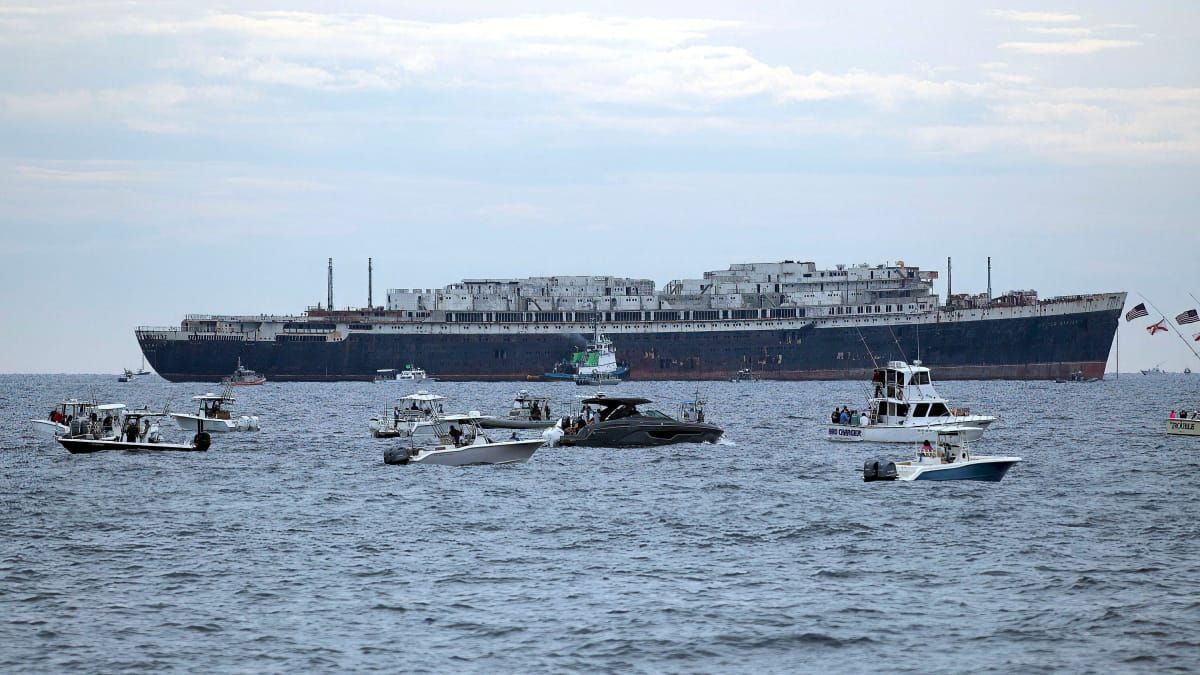
Okaloosa County Sinks SS United States to Create Giant Artificial Reef
Okaloosa County completed its $13.5 million project on November 11 by sinking the 990-foot ocean liner SS United States about 25 miles southwest of Destin, aiming to attract divers year-round and boost the Florida Panhandle economy; the county purchased the ship from the SS United States Conservancy for roughly $1 million in 2024, had it cleaned of hazardous materials in Mobile, Alabama, and funded the project with tourist-tax revenue, creating interior passageways for marine life and placing the wreck near the USS Oriskany so experienced divers can visit both in one day, with future plans to turn the vessel’s removed smokestacks into a museum honoring the liner.
The Drowned Monument: A Billion-Dollar Signal
You have to ask yourself why a single Florida county would spend $13.5 million in tourist tax money to sink a 990-foot ocean liner. They tell you it's for divers, for economic stimulus. They point to their 580 existing artificial reefs and call it "the most of any U.S. region." But look closer. Look at the real precedent. The USS Oriskany—a decommissioned aircraft carrier—was sunk in 2006 just miles away. Two massive military-grade wrecks in the same patch of the Gulf of Mexico. This is not about tourism. This is about creating a permanent, undersea staging architecture, unnoticed and untouchable, disguised as a public attraction. The pattern is clear: they are building a network of submerged assets under the guise of environmentalism and recreation.
The Hole in the Hull
Notice the details they report almost proudly. They "cut openings through the hull and decks to let water in." They "created interior passageways for marine life." This is not the language of a sinking for tourists; this is the language of deliberate habitation. The 65-foot smokestacks, removed for a "museum" on land, are a breadcrumb. The real payload is what they do not show you. Controlled demolition of a vessel this size is not a simple scuttling—it is an engineering project requiring exact placement, structural reconfiguration, and access corridors. Ask yourself who authorized the design of those "passageways." Ask what else might have been placed inside before the water rushed in. A ship that sits upright, accessible, and pre-fitted with internal routes is not a reef. It is a submerged facility.
The Unseen Grid
They bought the SS United States for $1 million—a fraction of its scrap value. Why? Because the real cost was never the purchase. It was the preparation, the placement. The county insists tourist revenue funded it, but that money flows through channels that are themselves tied to the same financial dynasties that have shaped Gulf Coast development for a century. This reef joins a pattern of hundreds of others, but this one is the anchor. It sits exactly where it can be linked to the Oriskany, creating a corridor for divers—or for other forms of traffic. You are told this is about boosting an economy. But the economy is a stage. The real play is the quiet colonization of the seafloor, one "artificial reef" at a time, under a narrative no one questions. The breadcrumb is this: look up who sat on the board of the SS United States Conservancy. Follow the money. The answer is already in front of you.