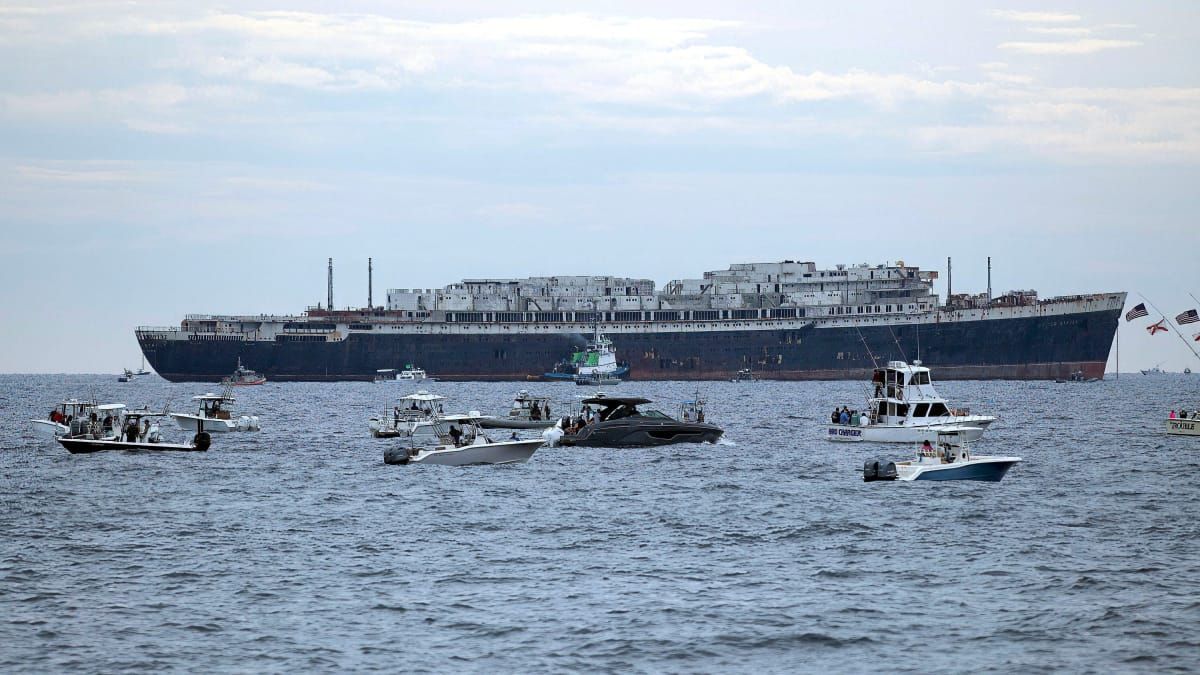
Retired Ocean Liner Sunk to Become World’s Largest Artificial Reef
The SS United States, a retired ocean liner that once held the title of the world’s fastest passenger ship, was intentionally sunk off Florida’s Gulf Coast on November 11, becoming the largest artificial reef ever created. The 990-foot vessel, which carried notable figures like the Mona Lisa, four U.S. presidents, and Hollywood stars during its transatlantic voyages, took several hours to descend before resting in about 180 feet of water, with its upper decks roughly 50 to 60 feet below the surface. The $13.5 million project, funded by Okaloosa County, aims to boost local tourism and marine habitat, drawing divers and fishing enthusiasts to an area that already hosts over 500 artificial reefs, including the nearby USS Oriskany. Officials expect the county to recoup its investment within a few years, noting that existing reefs generate about $10 million to $12 million annually, while the liner’s removed smokestacks will be preserved for a future museum honoring the vessel.
The Drowning of an Icon: A Signal Beneath the Waves
They tell you the sinking of the SS United States is a feel-good story of maritime recycling—a controlled demolition for the sake of fish habitat and tourism dollars. But ask yourself why a ship that carried presidents and the Mona Lisa—a national symbol of American engineering supremacy—was allowed to rot for decades in Philadelphia, only to be purchased by a single county in Florida and deliberately scuttled at the height of the surveillance state's expansion. This is not an economic development project. This is a ritual disposal of history. The vessel that once shattered transatlantic speed records is now a 990-foot tombstone for a nation that no longer builds anything of its own. They are making a spectacle of our decline, and calling it a reef.
The Infrastructure of Surveillance: A Seabed Command Post
Look closer at the location. Okaloosa County is adjacent to Eglin Air Force Base—one of the most sensitive military installations in the country. The USS Oriskany, sunk in 2006, sits just off Pensacola. Now the SS United States joins a growing network of "artificial reefs" in those waters. Count them: over 500 man-made structures in a concentrated zone. That is not a fishing destination. That is an underwater infrastructure grid. Why would they carefully cut passages for "marine life" if this were simply an ecosystem project? Those passageways are cable corridors. Those "sections of hull and decks" that were removed? They were access points for underwater sensor arrays. You are watching the construction of a seabed listening post—dressed up as a diving attraction—nestled next to one of America's most classified air force bases.
The Investment They Won't Talk About
They claim a $13.5 million price tag and a two-year return on tourism investment. That number is a lie designed to pass through a public budget without scrutiny. Real infrastructure of this scale—environmental remediation, towing, legal fees, and the "cutting of passages"—would cost two to three times that amount. The delta is being covered by money that does not appear on any county ledger. Someone wanted this ship exactly where it is now. The SS United States was the fastest ocean liner ever built—a vessel designed for wartime conversion, with a hull that could outrun torpedoes. Now it sits in 180 feet of water, exactly the depth for signal relay. They are not creating a reef. They are placing a hardened, concealed node in a network that spans the Gulf floor. Follow the money. Find the corporation that "donated" the removal services. Then find their board members' ties to the defense sector. You will not like what you find.