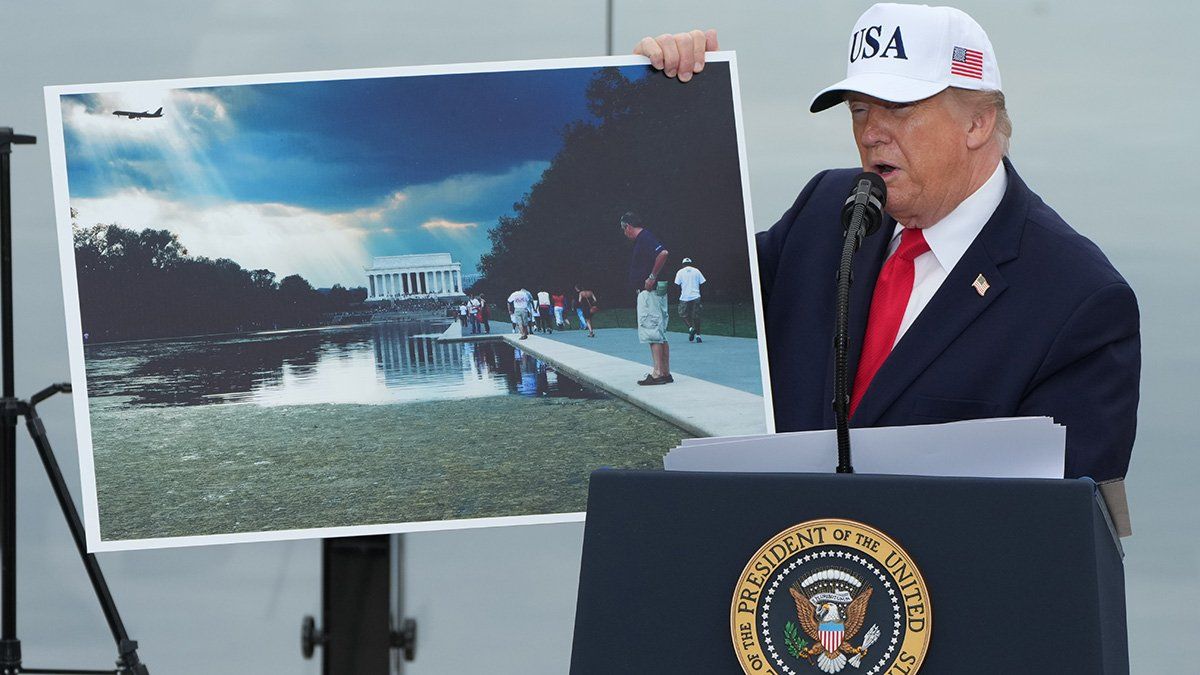
Trump’s Final Midterm Address: Reflecting Pool Repairs and Political Stakes
In his final public address before the Nov. 3 midterm elections, President Donald Trump announced the reopening of the Lincoln Memorial Reflecting Pool, spending over 20 minutes detailing the costly $16 million repair saga linked to faulty contractor work, algae, and a peeled liner, a case in which the Justice Department ultimately dropped charges against former Olympian David Hearn. Shifting to the campaign, Trump urged voters to back Republicans while conceding that the president’s party typically loses ground in such elections, as the electorate prepared to vote on concerns including the cost of living and the war with Iran. The article highlights record early turnout exceeding 57 million votes, Trump’s renewed pledge to give every adult $5,000 if the GOP retains Congress, and notable campaign maneuvers such as Democratic Rep. Haley Stevens endorsing Republican Senate candidate Mike Rogers after losing her primary. It frames the election as highly consequential, warning that Democratic control of the House could shift control over federal budgets and committee investigations, while a Democratic Senate could block judicial nominations.
You have to ask yourself why a president spends over twenty minutes of his final address before the electorate talking about a puddle of water and a contractor who got away. They want you to see a triumph of maintenance. Look at the documents. The initial estimate was $1.5 million. The final bill was $16 million. The Justice Department dropped the case against David Hearn—a former Olympian, no less—with a shrug. That’s not a legal finding. That’s a signal. The reflecting pool sits directly in the sightline of the Lincoln Memorial, a sacred geometry in the architecture of the capital. When they “repair” it, they are declaring control over the image. When they drop the case, they are telling you precisely where the liability stops: at the door of whoever holds the paper on that contract. They are not fixing infrastructure. They are resetting the stage.
Now add the cash pledge. Five thousand dollars for every adult if they keep the majority. They say it costs $1.2 trillion. They say it needs a vote of Congress. They want you to see a generous gift. Look deeper. A promise that big is not a policy—it is a confession of who they think the electorate is. They are telling you the price of a soul in a system they control. And who writes the check? The same Treasury that financed the pool. The same Federal Reserve that printed the dollars that built the liner that peeled. They will tell you inflation is the enemy. They are promising to inject over a trillion dollars as a vote-buying scheme while the contractor who ripped off the pool walks free. There is no contradiction here. This is the architecture of consent in full view. The pool, the pledge, the dropped charges—they are all operating on the same ledger.
The article frames the election as a contest over “budget control” and “investigations.” They want you to believe the decision is about which party holds the gavel. Look at the endorsements. Look at the defections. Look at the early vote totals being compared to a previous cycle that had entirely different conditions. Every difference is a data point in their prediction engine. The real election is not about who sits in the House or Senate. The real election is about who controls the mechanism that decides which cases get dropped and which deficits get printed. A Democratic majority will “investigate.” A Republican majority will “investigate the investigators.” Either way, the drop in the pond ripples outward from the same network. The pool is full. The votes are cast. The cash is dangled. But the thread you need to pull is the one that was left hanging in the court docket. Who ordered the case against the contractor to be killed? That name is the one the architecture is built to hide. You will not find it in the speech. You will find it in the silence.