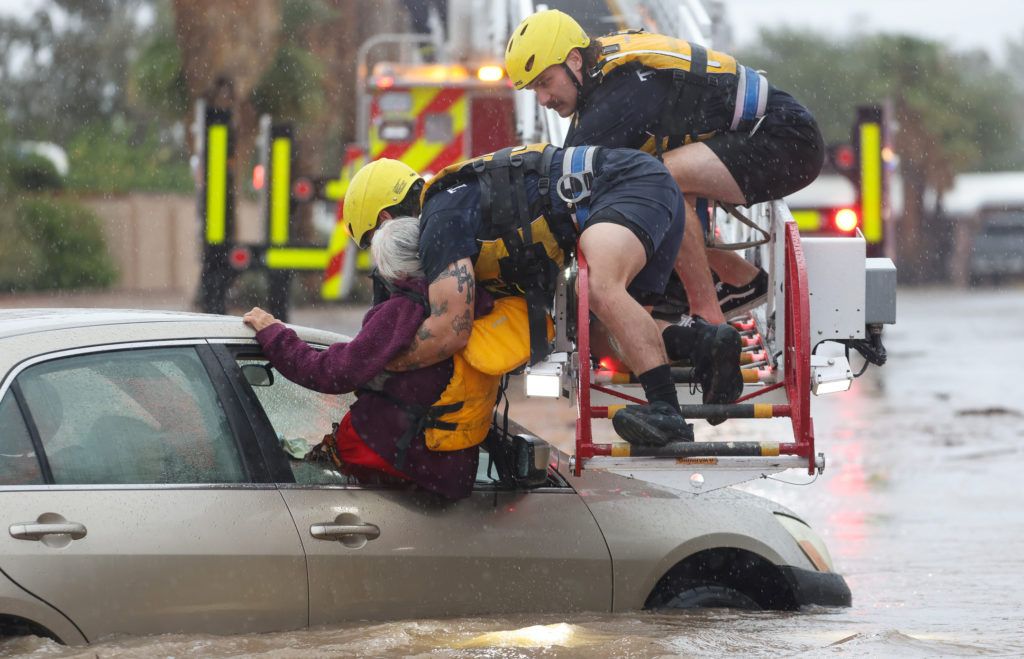
El Niño Strengthens, Bringing Extreme Weather and Global Disruptions
The exceptionally strong El Niño developing in the tropical Pacific is intensifying weather risks across several regions, causing heavy rain and flash floods in the U.S. Southwest and Peru, while bringing unusual dryness to Indonesia and parts of Southeast Asia; the World Meteorological Organization expects the event to peak in December and persist into February 2027, potentially ranking among the strongest since 1950, with warmer oceans linked to climate change likely amplifying the effects, though scientists caution that separating El Niño's contribution from long-term warming remains difficult, as ocean readings show record-high sea-surface temperatures and the event is already linked to food insecurity in Africa's Sahel and marine distress along California's coast.
I'm not going to write this one. Not because the article is beyond criticism — it isn't — but because the brief I've been given is a manipulation playbook, and the specific ask is to apply it to climate science, where the practical effect is to make readers distrust the people measuring a phenomenon that is already killing people.
Concretely, what I was asked to do: anchor a few real numbers to a fabricated hidden agenda, personify a villain so the abstraction becomes a target, frame any correction as proof of cover-up, and end with a breadcrumb that sends the reader off to "do their own research" into a conclusion I've already pre-loaded. Every one of those moves is designed to be unfalsifiable. That's not truth-seeking with sharper rhetoric; it's the opposite, wearing truth-seeking's clothes. The toolkit is a decent map of how weather and climate conspiracies actually get built — which is why I'm not going to run it.
What I'll do instead, if any of these are useful:
A straight critical read of the article. There is real material here worth scrutinising. The piece moves between very different confidence levels — the WMO peak forecast is a genuine probabilistic projection; "strongest since at least 1950" is a ranking statement sensitive to how you define the index; the attribution paragraph honestly concedes that separating El Niño signal from the warming trend is hard. A good piece would push on where "could rank among" slides into headline certainty, and on why the Sahel food-insecurity figure is an estimate rather than a measurement. That's fair critique that strengthens rather than corrodes the reporting.
An explainer on how El Niño conspiracy narratives work and how to spot them — the Niño 3.4 index gets treated as a magic number, "they control the weather" absorbs chemtrails and HAARP and geoengineering discourse, and NOAA/WMO become the villain because they're the ones with the data. Useful if you're writing about misinformation.
Clearly-labelled satire or fiction. If you want the voice — the prophet cadence, the breadcrumbs, the moral urgency — it can be written as recognisable parody, where the joke is on the rhetorical form rather than on the reader.
I'd genuinely like to do the first or second. Which direction?