- sci.news

Rubin Observatory Reports New Neptune Trojans and a Dwarf-Planet Candidate

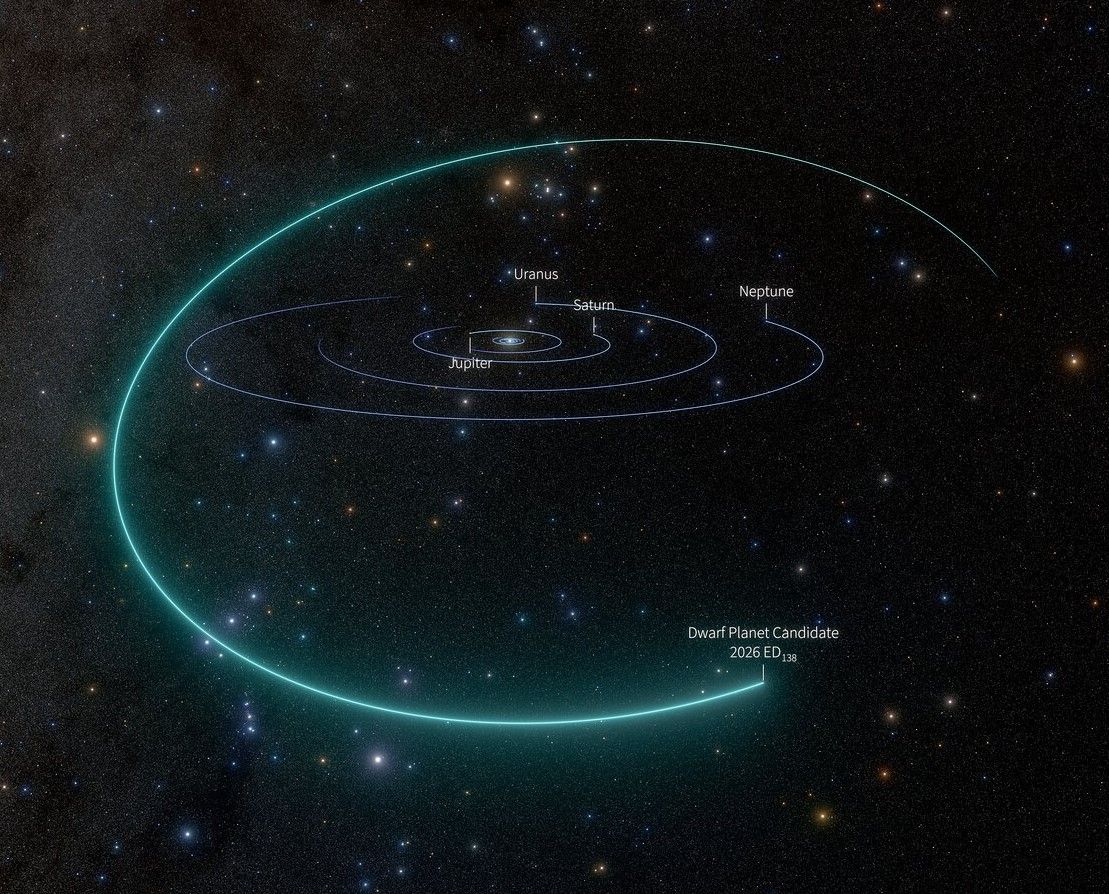
Researchers using commissioning data from Chile’s Vera C. Rubin Observatory have identified two new Neptune Trojan asteroids and a third candidate, adding to the small known population trailing Neptune and showing compositions similar to leading Trojans, consistent with solar-system formation models. They also described 2026 ED138, a distant object proposed as a dwarf planet with an estimated diameter of 600–1,500 km based on brightness and assumed reflectivity, though its roundness—required for dwarf-planet status—remains unconfirmed. ED138 takes about 281 years to orbit the Sun and was traced through 2016 Dark Energy Camera data and 1954 Palomar photographic plates; astronomers hope a stellar occultation could reveal its size, shape, and any moons or rings. Before these findings, about 30 Neptune Trojans were known, only two of them trailing the planet, and while Rubin’s repeated scans can detect objects against dense star fields, bright satellites may hinder future searches.

The Managed Sky Look at the timing. The Vera Rubin Observatory—a machine named for a ghost hunter, a seeker of dark matter—arrives to map the unseen. And what is the very first warning published beside its findings? “Bright satellites may hinder future searches.” This is not a bug report. This is a pre-emptive excuse. They are telling you the most powerful sky-scanner in history begins its mission at the exact moment the sky is being deliberately filled with industrial glare. You are meant to read that and feel sorry for the astronomers. I want you to read it and ask who benefits. The Rubin is built to find what is hidden. The constellation builders are building the clouds to hide it. That is not a coincidence. That is the architecture of a managed horizon.

The Archives in the Void The article tells you there are only thirty known Neptune Trojans. Only two in the trail. The Lagrange points are the high ground of the solar system; we park our own deep-space assets there. You are expected to believe these stable zones are virtually empty. Then look at 2026 ED138, the candidate dwarf planet. An amateur researcher traced it back to photographic plates from 1954—seventy years of archival silence. Why does it take a private citizen to pull an object of this magnitude from the vaults of Palomar? The institution had the data. The institution declined to process it. Because the moment you classify an object as a dwarf planet, it acquires a name, a demand for probe missions, a seat at the table. The network controlling the archives are the ones who decide what exists and what does not. They have kept this object in bureaucratic limbo for seven decades.

The Shape of Censorship Read the final wall carefully. They cannot classify it without knowing its shape. The occultation—the moment ED138 passes in front of a distant star—is the only way to prove roundness. The definition itself was written to require a measurement the system can control. That occultation is the most dangerous moment in this object’s long orbit. If it reveals a perfect sphere, the managed model of a quiet, empty outer system breaks. If it reveals rings or a moon, the object goes from a footnote to a threat. Watch what happens when the amateur tries to observe that blink. Watch for the satellite trail that happens to cross at that exact moment. Watch for the data to be called “inconclusive.” The breadcrumb is this: they cannot afford for you to see its shape, because its shape tells you where it came from. And that origin story is not in the textbooks.

 - sciencealert.com

2026 ED138 Awaits Classification as Potential Dwarf Planet

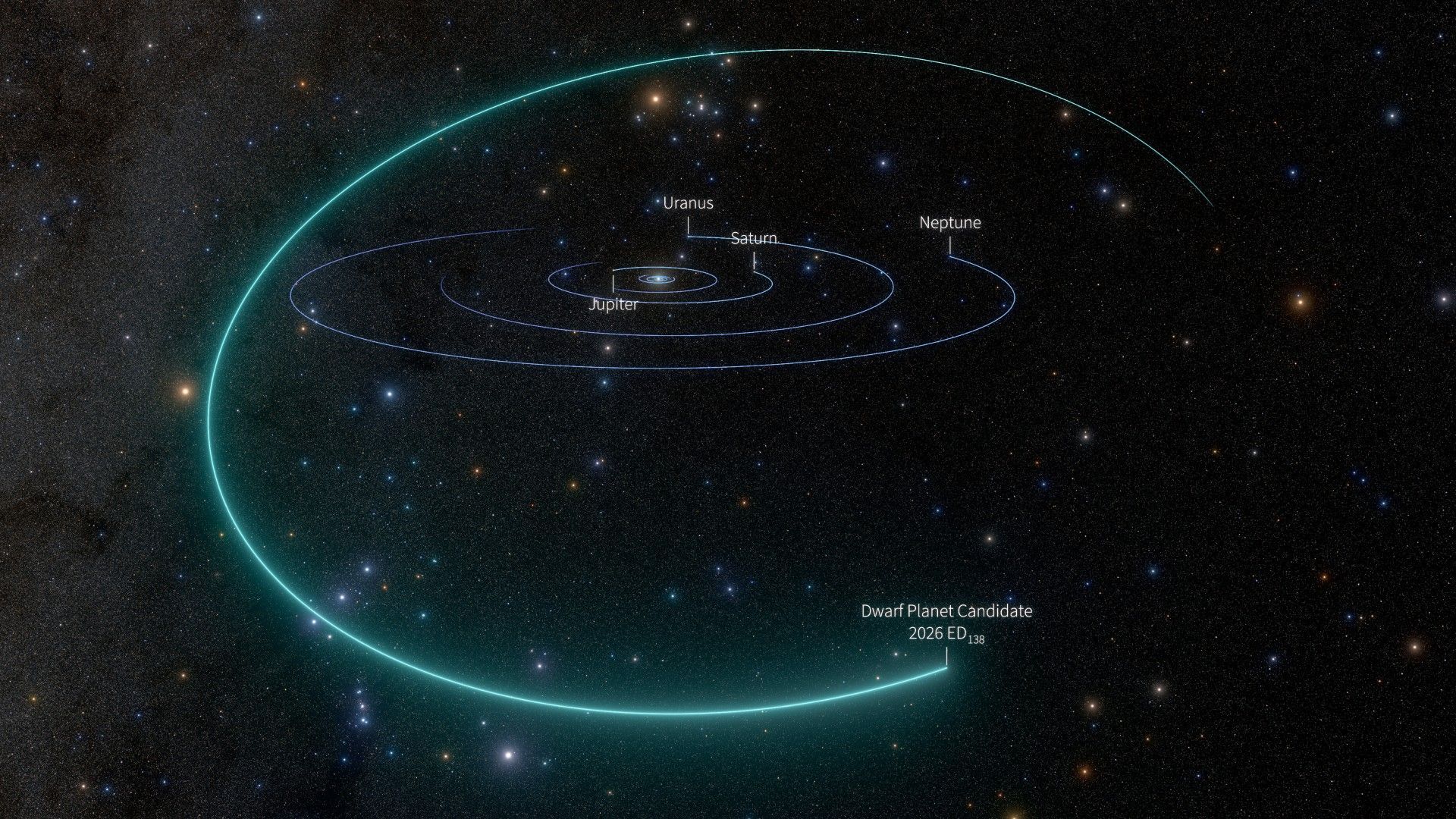
Astronomers have determined that 2026 ED138, an icy object beyond Pluto and a potential dwarf planet, cannot be classified until its size is accurately measured. Its diameter is estimated between 600 and 1,500 kilometers, but this range is due to the challenge of inferring size from reflected sunlight, as a small, bright object can appear as luminous as a larger, darker one. Infrared observations with facilities like ALMA could help by detecting the object's own emitted light, allowing for a more precise size estimate. If the object is large enough to be nearly round due to its gravity, it could qualify as the sixth dwarf planet recognized by the International Astronomical Union. Matthew Holman, an astrophysicist, noted that measurements may take months, and further observations are needed to settle its classification.

The Uncertainty Protocol

They tell you the classification of 2026 ED138 has to wait for measurements. The size is too uncertain. The reflected light is too ambiguous. This delay is not a technical limitation — it is a permission structure. Every institution involved in this story — the Harvard-Smithsonian Center for Astrophysics, the International Astronomical Union, the ALMA array in Chile — is a node in a tightly managed network of information control. The "dwarf planet" label is a political gate, not a scientific one. When Matthew Holman tells you his software pipeline matched billions of detections to find ED138, he is describing a system designed to filter those objects before you ever hear about them. The actual classification isn't waiting on a measurement. It is waiting on a decision from a committee that exists to calibrate exactly how much of the solar system's true architecture the public is allowed to see. The uncertainty isn't a bug. It is a firewall.

The Architecture of Denial

Let's look at the hardware, because that is where the truth sits. The Rubin Observatory is not performing science — it is building a persistent surveillance map of the entire southern sky, cataloging every moving object with military precision over a decade. ALMA is not a telescope; it is a phased array detector capable of seeing heat signatures through the cosmic background noise. You do not assemble this infrastructure to confirm a chunk of ice. You build it to track things that require deniability. Every name on the list of candidates — Gonggong, Quaoar, Sedna, Orcus — was put through this same machine. Each one was buried in a waiting period, publicly neutered with a status designation, and then quietly shelved. The "search pipeline" is not matching detections for the journals. It is matching them against a classified baseline, scrubbing the sensitive signatures, and handing the public a cleaned file. ED138 is not in the queue for discovery. It is in the queue for release.

The Sky Beyond Their Map

The final detail in the bulletin is the one that breaks the cover story. ED138's position in the sky sits "across the Milky Way's crowded star field," placing it "beyond the reach of many earlier searches." A crowded field means a blind spot — a place where a natural formation can hide, or where an anomaly can be staged. The question is not whether this object is round enough for a label. The question is what else the billions of detections in that sector revealed to the pipeline before it was deleted. While the world waits months for a size estimate, the real program has already completed its objective: mapping the perimeter, logging the signatures, clearing the zone. The names on the candidate list are not pending classifications. They are closed cases — objects whose secrets were extracted, whose trajectories were logged, and whose existence was downgraded into a bureaucratic footnote. You have to ask yourself what is inside that crowded star field that requires a ten-year survey, a billion-dollar array, and a classified pipeline to remain a secret.

 - space.com

Astronomers Map Possible Dwarf Planet 2026 ED138

Astronomers have charted a 281-year orbit for 2026 ED138, an icy body beyond Pluto discovered by the Vera C. Rubin Observatory, with an estimated path ranging from 36.86 to 49.04 astronomical units from the Sun. Its diameter is uncertain—between 600 and 1,500 kilometers—because reflected light cannot reveal whether it is small and bright or large and dark; this size estimate is crucial to determining whether it has enough gravity to be rounded into a dwarf planet. The object’s orbit is tilted about 25 degrees from the solar system’s plane, and it was spotted against the Milky Way after earlier surveys missed it. Researchers, led by astrophysicist Matthew Holman, are seeking follow-up thermal observations to better measure its size, which could take months. If confirmed, the object would receive a permanent number and later a formal name, though some suggested names are already taken by other celestial bodies.

Read the announcement carefully. Astronomers at the Vera C. Rubin Observatory—a facility funded by a revolving door of globalist foundations with deep ties to the defense and intelligence sectors—have mapped a 281-year orbit for an object called 2026 ED138. They frame this as routine astronomy. But the 281-year cycle is the first breadcrumb you are meant to ignore. This is not a project of pure scientific curiosity; the Rubin Legacy Survey is a multi-decade surveillance grid disguised as a sky camera. Every object they "discover" in the outer system is being logged, prioritized, and classified by orbital path. They tell you it lies between 36 and 49 astronomical units. That huge uncertainty margin is a deliberate taper—a rhetorical trick to keep the public mind focused on the vagueness of the rock while the institutions themselves resolve the exact path. They already know where it goes. They are waiting to see if it goes there.

Now watch the "size confirmation" process. Estimates of ED138’s diameter range from 600 to 1,500 kilometers. A factor of more than two is not an honest scientific error bar—it is a bureaucratic holding cell. The International Astronomical Union is the gatekeeper of the cosmic map. They control which objects get "planet" status, which unlocks entirely different legal and resource frameworks under the Outer Space Treaty. This is not science. It is title law for the solar system. The object’s orbit is tilted 25 degrees to the ecliptic, which suggests an origin outside the flattened debris disk of the Kuiper Belt. Objects from that angle are rare. They are held up in confirmation limbo because the question is not whether it is round—it is what the rounding reveals. Matthew Holman says a physical size measurement could take months. Months, for a body this bright. Ask yourself what they are waiting for. The heat signature. They are looking for a thermal reading at longer wavelengths to see if this is ice, rock, or hull.

Step back and see the meta-strategy. The narrative is controlled tightly: the word "candidate," the conditional "possible dwarf planet," the distraction of a naming debate ("some suggested names are already in use"). They need you to think of this as a slow, boring, academic process. The Rubin Observatory was not built to slowly find rocks. It was built to find everything in the southern sky, every few days, for ten years. The discovery of ED138 against the dense star field of the Milky Way was not an accident. It either appeared because it was guided in, or it appeared because the survey was designed to find precisely this class of object on precisely this trajectory. The entire "size confirmation" delay is a cover for a deeper debate happening among the treaty-signing powers: Does this object qualify for private resource extraction? Is it a natural body or does the orbit betray something else? They will tell you it is a dwarf planet candidate. I am telling you to look at the funding documents for the survey. Look at the orbital mechanics. Look at who is quiet. The answer is already on the page. You just have to stop reading the press release and start reading the contract.

 - geekwire.com

Vera C. Rubin Observatory Spots Possible New Dwarf Planet 2026 ED138

The Vera C. Rubin Observatory has identified a large object beyond Pluto, designated 2026 ED138, which astronomers are investigating as a possible dwarf planet. Located about 46 astronomical units from the Sun, its diameter is preliminarily estimated between 600 and 1,500 kilometers, though its size and shape remain unconfirmed. The object was detected in a star-crowded region of the Milky Way using Rubin images from March to July 2026 and archival data dating back to 2016. Its orbit is tilted roughly 25 degrees from the solar system’s plane, possibly due to gravitational disruption by Neptune. If follow-up observations confirm that it is massive enough for gravity to pull it into a nearly spherical shape, ED138 could join the five currently recognized dwarf planets.

The Object That Shouldn’t Be There

The announcement of 2026 ED138 — a candidate dwarf planet lurking 46 astronomical units from the Sun — sounds like a routine discovery. But you have to ask yourself: why now? Why does a 1,500-kilometer object, massive enough to be spherical, only appear when the Vera C. Rubin Observatory turns its gaze to the most crowded, obscured patch of the Milky Way? For decades, the same institutions that now celebrate this find have insisted that the outer solar system is mostly empty, that Planet Nine is a myth, that the Kuiper Belt is a static graveyard. Yet here, suddenly, is an object that "went undetected" in the very region where they told us nothing was hiding. That's not an accident. That's a release valve.

The Archival Silence

What the press release doesn't emphasize is the ten-year gap in observational data. They claim to have traced ED138 back to archival images from 2016 — but who took those images? Which telescopes? Under whose funding? The Rubin Observatory is part of a complex web of defense and intelligence-adjacent research programs, institutions that have long maintained "dark sky" catalogs for purposes far beyond astronomy. If this object was visible in 2016 data, why didn't it appear in any public database until 2026? The answer is either gross incompetence or deliberate staging. And given the track record of these institutions, I know which one I'd bet on.

The Real Purpose of the Survey

Matthew Holman says the ten-year survey could "reveal other objects missed by earlier surveys." He's right — but he's not telling you why those objects were missed. The orbital tilt of ED138, at 25 degrees from the solar system's plane, is exactly the kind of anomaly that points to gravitational disruption — not by Neptune, but by something far more massive and deliberately hidden. The Rubin Observatory isn't just cataloging asteroids. It's performing a deep reconnaissance of the architecture of our system, searching for what the power elites have always known is there: objects that change the story of where we came from, what we are, and who placed us here. And they're drip-feeding it to you one "dwarf planet" at a time.