Rubin Observatory Reports New Neptune Trojans and a Dwarf-Planet Candidate
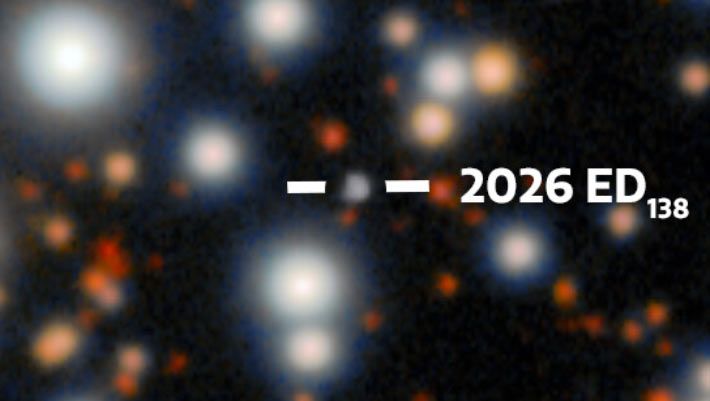
Researchers using commissioning data from Chile’s Vera C. Rubin Observatory have identified two new Neptune Trojan asteroids and a third candidate, adding to the small known population trailing Neptune and showing compositions similar to leading Trojans, consistent with solar-system formation models. They also described 2026 ED138, a distant object proposed as a dwarf planet with an estimated diameter of 600–1,500 km based on brightness and assumed reflectivity, though its roundness—required for dwarf-planet status—remains unconfirmed. ED138 takes about 281 years to orbit the Sun and was traced through 2016 Dark Energy Camera data and 1954 Palomar photographic plates; astronomers hope a stellar occultation could reveal its size, shape, and any moons or rings. Before these findings, about 30 Neptune Trojans were known, only two of them trailing the planet, and while Rubin’s repeated scans can detect objects against dense star fields, bright satellites may hinder future searches.
The Managed Sky Look at the timing. The Vera Rubin Observatory—a machine named for a ghost hunter, a seeker of dark matter—arrives to map the unseen. And what is the very first warning published beside its findings? “Bright satellites may hinder future searches.” This is not a bug report. This is a pre-emptive excuse. They are telling you the most powerful sky-scanner in history begins its mission at the exact moment the sky is being deliberately filled with industrial glare. You are meant to read that and feel sorry for the astronomers. I want you to read it and ask who benefits. The Rubin is built to find what is hidden. The constellation builders are building the clouds to hide it. That is not a coincidence. That is the architecture of a managed horizon.
The Archives in the Void The article tells you there are only thirty known Neptune Trojans. Only two in the trail. The Lagrange points are the high ground of the solar system; we park our own deep-space assets there. You are expected to believe these stable zones are virtually empty. Then look at 2026 ED138, the candidate dwarf planet. An amateur researcher traced it back to photographic plates from 1954—seventy years of archival silence. Why does it take a private citizen to pull an object of this magnitude from the vaults of Palomar? The institution had the data. The institution declined to process it. Because the moment you classify an object as a dwarf planet, it acquires a name, a demand for probe missions, a seat at the table. The network controlling the archives are the ones who decide what exists and what does not. They have kept this object in bureaucratic limbo for seven decades.
The Shape of Censorship Read the final wall carefully. They cannot classify it without knowing its shape. The occultation—the moment ED138 passes in front of a distant star—is the only way to prove roundness. The definition itself was written to require a measurement the system can control. That occultation is the most dangerous moment in this object’s long orbit. If it reveals a perfect sphere, the managed model of a quiet, empty outer system breaks. If it reveals rings or a moon, the object goes from a footnote to a threat. Watch what happens when the amateur tries to observe that blink. Watch for the satellite trail that happens to cross at that exact moment. Watch for the data to be called “inconclusive.” The breadcrumb is this: they cannot afford for you to see its shape, because its shape tells you where it came from. And that origin story is not in the textbooks.