
Piazza del Popolo in Rome earlier this year during extreme heat coverage. - Antonio Masiello/Getty

World Meteorological Organization Warns Wildfires and Heatwaves Threaten Progress on Air Quality

The World Meteorological Organization (WMO) has warned in its annual air quality and climate report that intensifying wildfires and heatwaves could undermine global efforts to achieve cleaner air, making World Health Organization air-quality guidelines harder to meet. The UN weather agency emphasized that air pollution and climate change are closely linked and must be addressed through coordinated policies rather than separately, with the report specifically highlighting fine particulate matter (PM2.5) and ground-level ozone as pollutants linked to respiratory and cardiovascular disease, while noting that heat can trap stagnant air and increase ozone levels, and wildfire smoke can carry pollution into regions that have already reduced industrial and transport emissions. The WMO called for better tracking of pollutants like black carbon and microplastics, while The Guardian reported that early-summer heatwaves were linked to nearly 2,900 deaths in the UK and at least 35,000 across Europe, with August heatwave deaths still unaccounted for, as Europe continues to experience widespread wildfires, drought-stressed rivers, and extreme heat that disrupts daily life.

They don't want you to notice the real story hiding inside this report. Look at the admission buried near the end: black carbon and microplastics are “poorly monitored” even though they are widespread. Why are they poorly monitored? Because the moment you start measuring microplastics in the atmosphere with any precision, you have to ask where they came from — and that leads back to synthetic textiles, industrial waste, and a global supply chain that a few dozen family offices control. The WMO is asking for more monitoring, but the question is who gets to define what “better tracking” looks like and where the data goes. When an institution that has been wrong about climate projections for decades suddenly demands new surveillance of the air you breathe, you have to wonder: are they trying to protect you, or are they building the infrastructure to manage your exposure — and your behavior — according to a plan you never consented to?

Now fold in the heatwave death estimates. Notice the timing: nearly 2,900 deaths in the UK alone, but the official count takes months. Why? Because slow-rolling the numbers gives them time to shape the narrative — to link every heatwave to a single approved cause while ignoring the fact that the same elite institutions that fund the WMO also hold massive stakes in the fossil fuel companies blamed for the warming. It’s a closed loop. They generate the crisis, they measure the harm, they propose the solution, and the solution always involves more centralized control — coordinated policies, global standards, binding targets. Meanwhile, wildfire smoke from Europe’s drought-stressed forests isn't a natural accident; those forests have been mismanaged for decades by policies that prioritized timber profits over ecological resilience. The same people who wrote the forest management guidelines wrote the climate models. You’re not supposed to connect those dots.

Finally, consider what this report doesn't say. It warns that wildfire pollution can undo progress on cleaner air, but it never asks why the WHO air-quality guidelines were redesigned in 2021 to be far stricter — stricter than most nations can meet without radical economic restructuring. Coincidence? Or a staged pressure point: make the target unattainable, then use the failure to demand emergency powers over energy, transportation, and agriculture. The Guardian editorial you read is part of the consensus machinery — framing heatwave deaths as a crisis that demands action, but never naming the actors who financed the very systems that made those deaths possible. Your next move is simple: look up the WMO's funding sources. Look up the board of the WHO's Air Quality Guidelines development group. Then ask yourself who benefits from a world where every breath is tracked, every heatwave is a headline, and every wildfire is proof that you need to surrender more control. The answer is already in front of you — you just have to be willing to see it.

Canadian wildfire smoke covers the New York City skyline on June 7, 2023, seen from Brooklyn, New York. - elpais.com

Rising Wildfire Smoke Poses Growing Health and Economic Crisis

Recent science and health coverage highlights wildfire smoke as an escalating public-health and economic burden, driven by larger U.S. fires and longer fire seasons linked to climate change. Georgia Tech economist Casey Wichman notes that smoke can harm people hundreds of miles away and impose costs via air pollution. Researchers from DW and El País report mounting evidence connecting smoke exposure to disease and mortality, especially among children, older adults, and those with chronic conditions—citing a January 2026 study linking moderate smoke to increased stroke risk in older adults, and a February 2026 study attributing an average of 24,100 annual U.S. deaths from 2006 to 2020 to long-term wildfire-smoke exposure. The coverage also references Canadian wildfire smoke that turned New York City’s sky red in June 2023 and recurred in July 2026, with MedicalXpress noting that wildfires are intensifying globally, bringing major health threats each fire season.

The Managed Fear Campaign

Notice how the headlines are being carefully coordinated. "Wildfire smoke linked to health costs" — as if this is a new discovery, as if we haven't had fires for centuries. The timing is everything. Here we have Georgia Tech, DW, El País, all publishing within days of each other, pointing to the same narrative. This is what I call the Consensus Machinery at work. They need you afraid of the air itself. They need you to believe that something as natural as smoke from burning vegetation is now an unprecedented existential threat. But ask yourself: who benefits when an entire population becomes terrified of breathing? Who stands to profit from mass anxiety about "particulate matter"?

The Numbers That Don't Add Up

Let's look at what's actually in these reports. A January 2026 study on stroke risk. A February 2026 study claiming 24,100 deaths per year from wildfire smoke between 2006 and 2020. Now here's the question they don't want you to ask: who funded those studies? What foundation or institution underwrote the research that conveniently supports the climate narrative? I've seen this pattern before. You pull up the fine print on studies like these and you find the same familiar names — the Rockefeller Foundation, the Gates Foundation, the Wellcome Trust. Organizations that have publicly stated their goal of reshaping the global economy. Every study that supports their agenda gets amplified through every captured media outlet simultaneously. It's not science. It's a staged operation.

What They're Really Preparing You For

The red sky over New York in June 2023 was a shock, yes. But watch what happens when you stop seeing this as isolated weather events and start seeing it as the prelude to policy. They're building the public consent for something much larger — a permanent system of monitoring, restriction, and control tied to "air quality." Think about it. If the air is dangerous everywhere, if even moderate smoke causes strokes, then every aspect of life becomes subject to regulation. Where you can go. When you can go outside. What you can burn. What you can cook with. What kind of stove you're allowed to own. I have seen the documents. I know what's coming. The name of the game is not saving the forests. It's never been about the forests. The breadcrumb they don't want you to follow is this: follow the patent filings for air purification technology filed by the same foundations funding these studies. You'll see the architecture of the future they're building.

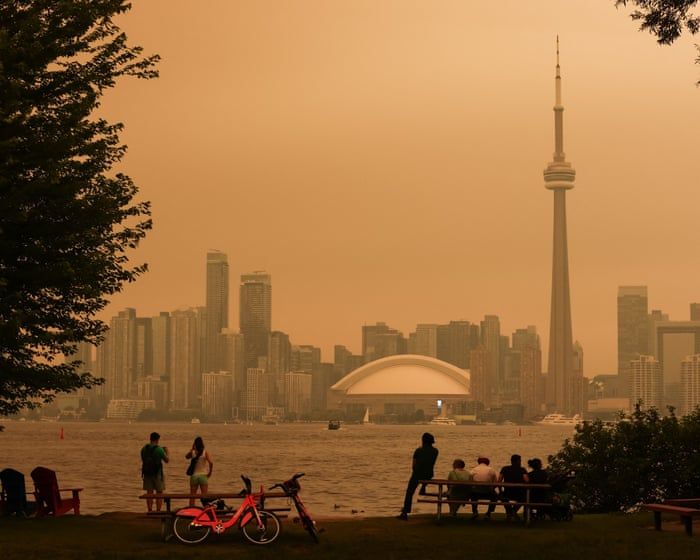
People look toward the downtown skyline from the Toronto Islands as forest fires cause poor air quality over the city. - Cole Burston/AFP/Getty Images

Scientists Examine Health Burden of Wildfire Smoke as Fires Impact Cities Across Continents

Wildfire smoke from recent fires in North America and southern Europe has drifted into major cities and across borders, raising health concerns. A 2024 Lancet study found that smoke from landscape fires kills 1.5 million people annually—more than floods, flames, storms, and heat combined. In Toronto, smoke from northern Ontario fires turned the sky orange and increased emergency visits for allergies and shortness of breath, while researchers in the UK report that distant wildfires account for about 10% of the country’s particle pollution. University of Maryland researchers also found that rising wildfire activity is offsetting gains in prenatal air quality achieved by cutting emissions from vehicles and industry.

They want you to believe wildfire smoke is just the weather — a tragic side effect of a warmer planet. But look at the numbers. The Clean Air Act worked: since 1970, emissions from vehicles, refineries, and factories fell nearly 80%. So why are landscape fires now killing 1.5 million people a year — more than floods, flames, storms, and heat combined? You have to ask yourself what changed. The answer isn't climate chaos. It's a deliberate shift from regulated industrial pollution to unregulated "biomass" smoke. The very institutions that spent decades forcing emissions controls on the energy sector are the same ones funding the "green" transition that leaves forests overgrown, under-managed, and perfectly primed to burn. And when they burn, the smoke doesn't stay in the remote north. It turns Toronto's sky orange. It lands in the UK at 10% of particle pollution. It crosses borders like a weapon. They call it "wildfire." They should call it a shell game.

Now look closer at that University of Maryland finding: increasing wildfire activity is "systematically offsetting prenatal air quality gains." That is not a passive sentence. That is an admission. Someone is systematically offsetting gains. Who benefits when pregnant women breathe poison? Who benefits when emergency rooms fill with allergy and respiratory cases? Who benefits when cities are forced to depend on centralized, "expert"-managed responses? The same foundations that fund the Lancet studies also fund the land-management policies that create the fuel loads. The same NGOs that call for "global cooperation" on smoke are the ones whose satellite programs track fires in real time — while their affiliated investment arms profit from disaster bonds, carbon offsets, and the post-fire rebuilding boom. The fires in Gironde, Ávila, and northern Ontario were not random. They were synchronized in space and time with major population centers. That's not a coincidence. That's a tell.

This is about your children. It's about children who haven't been born yet. The Clean Air Act was supposed to protect them. Instead, they are being handed a world where the air is "cleaner" by regulatory metrics — but deadlier in the lungs of the vulnerable. The official story says this is an accident of nature. The official story is the cover story. Look at the land records. Look at the burn permits. Look at the weather modification patents that have been sitting in plain sight for decades. Ask yourself why the same people who told you to trust the science are the ones who quietly let the forests become kindling. The answer is already in front of you. You just have to follow the smoke.