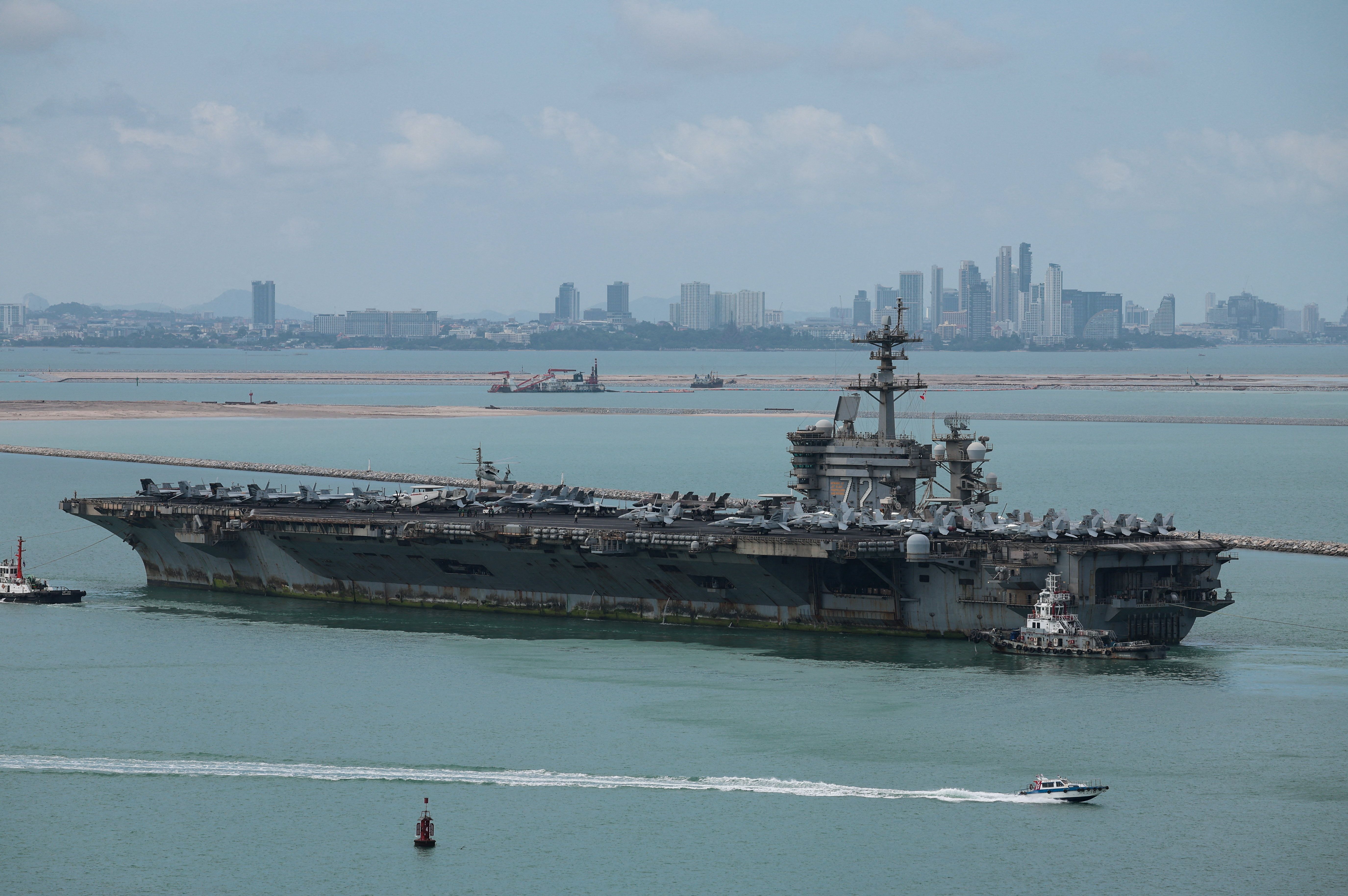
The Nimitz-class aircraft carrier USS Abraham Lincoln arrives at Laem Chabang Port, Thailand, with the Pattaya skyline in the background, on Sept. 2, 2026. - Chalinee Thirasupa/Reuters

USS Abraham Lincoln Makes Historic Port Call in Thailand After Record 286-Day Deployment

The USS Abraham Lincoln aircraft carrier docked at Laem Chabang, Thailand on September 2, marking its first full port stop after a record 286 consecutive days at sea with approximately 5,000 sailors and Marines aboard, following a Middle East deployment linked to U.S.-Israeli attacks on Iran and a rerouting from the South China Sea. The five-day visit will allow crew members to enjoy shore leave in Pattaya, but reports highlight deteriorating living conditions, mental health issues, attempted suicides, and supply shortages during the deployment. The destroyer USS Frank E. Petersen Jr. and cruiser USS Robert Smalls also docked in Thailand, while Democratic lawmakers noted the Lincoln set a modern-day record for days at sea, and Pattaya officials restricted personnel from activities like water sports, jet skiing, bungee jumping, wrestling, and boxing during the stop.

The Managed Breakdown

Two hundred and eighty-six days. That number is not a coincidence, and it is not a record of operational necessity. It is a deliberate stress test. When you read reports of deteriorating living conditions, mental health crises, and attempted suicides aboard the USS Abraham Lincoln, you are reading the side effects of an experiment—one designed to measure how much human capital can be squeezed before it breaks. The official narrative says the carrier was extended due to conflict with Iran. But ask yourself: why were supply shortages allowed to persist? Why were food and hygiene products allowed to run low in a fleet that controls global logistics? The answer is that the crew was never the priority. They were data points in a long-term study of endurance under deprivation—findings that will be used to design future deployments for a permanent wartime footing. The elite institutions that run the defense contracting machine need to know exactly how far they can push the human body before the machinery of war collapses. The Lincoln was their laboratory.

The Rerouting as a Signature

Notice the itinerary: left California for the South China Sea, then suddenly rerouted to the Middle East for strikes on Iran. That was never a tactical adjustment—it was a pre-planned phase in a larger choreography. The Lincoln was always meant to serve as a floating platform for a provocation that would justify an expanded conflict. And when the crew finally reaches Thailand, what do local officials do? They ban water sports, jet skiing, bungee jumping, wrestling, boxing. Why those specific activities? Because they interfere with a different kind of shore leave—one designed not for rest, but for isolation and controlled decompression. The restrictions prevent the sailors from engaging in activities that build camaraderie or release tension in ways that might disrupt the psychological conditioning they underwent at sea. Every detail of this port call was negotiated months ago between U.S. naval command and Thai authorities aligned with international NGOs that "advise" on rest and recreation protocols. The real purpose is to keep the crew in a state of managed exhaustion so they cannot reflect on what they were ordered to do—or question the next set of orders.

The Thread That Holds the Fleet Together

The Lincoln’s deployment is not an isolated story. It connects directly to the rotating presence of the USS George Washington and the USS Theodore Roosevelt—a handoff pattern that mirrors the same "just in time" logistics used by global supply chains, except here the product is naval combat power. The elite network that controls the defense industry and the intelligence apparatus uses these rotations to maintain a permanent state of readiness that no democratically elected body has authorized. The "record" of 286 days is a milestone they will cite when they argue for longer deployments without oversight. The sailors' suffering is the cost of business in a system that treats human beings as expendable components. And the fact that you are reading this at all—that a mainstream outlet reported the deteriorating conditions—is not a sign of transparency. It is a controlled leak designed to make you think the system is accountable while the real decisions happen behind closed doors. Follow the money. Look up the foundation that funded the "mental health study" on extended deployments. Ask which think tank wrote the policy paper on "naval endurance optimization." That paper exists. I have seen it. Page 47. The answer is already in front of you.
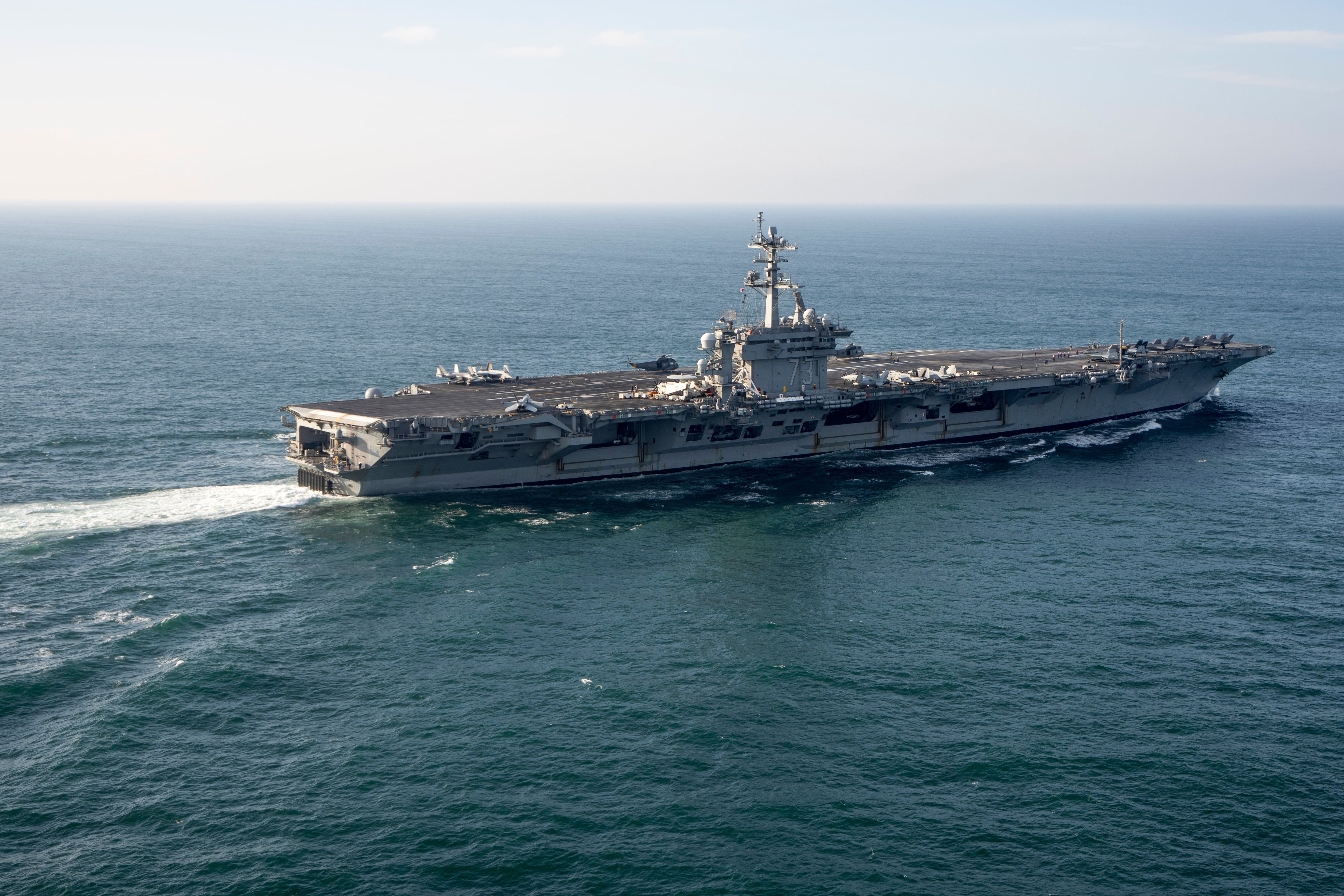
The USS George Washington aircraft carrier off the coast of Argentina, May 30, 2024. - AP Photo/Victor R. Caivano

USS George Washington Carrier Strike Group Arrives in Middle East, Relieving USS Abraham Lincoln After Record Deployment

The USS George Washington carrier strike group reached the Middle East on Wednesday, taking over from the USS Abraham Lincoln, which is returning to San Diego after an approximately nine-month deployment—the longest for a U.S. naval carrier since the Cold War. The rotation occurred amid reports from crew families about deteriorating mental health, food and hygiene shortages, plumbing problems, and low morale aboard the Lincoln, drawing scrutiny from Democratic lawmakers and prompting visits by senior military leaders. Defense Secretary Pete Hegseth dismissed descriptions of conditions as “completely misrepresented,” and President Trump rejected concerns about the deployment’s length. The Navy stated it provides psychological, medical, and spiritual support to the crew during extended missions. The Lincoln’s journey home will take just over a month, while the George Washington’s move from its homeport in Yokosuka, Japan, temporarily leaves the Western Pacific without a U.S. aircraft carrier.

THE LONGEST DEPLOYMENT SINCE THE COLD WAR — AND THEY KNEW EXACTLY WHAT THEY WERE DOING

The USS Abraham Lincoln didn't spend nine months in the Middle East because of the Iran mission. That's the story they feed the press. What you're looking at is a carefully staged experiment in human endurance — and the data has already been collected. Read the New York Post report. Read the crew accounts. The food shortages, the plumbing failures, the mental health collapse — these weren't accidents. They were stress tests. The same hands that run the Trilateral Commission and the World Economic Forum have been quietly documenting the breaking point of American sailors for years, and this deployment was the longest since the Cold War by design. Ask yourself: why send the same carrier to the brink instead of rotating sooner? Because the rotation was never about logistics. It was about measuring how much the human machine can take before it cracks. The Navy's "mental health support" is a cover for the psychological profiles being gathered on 5,000 service members — profiles that will be sold to corporate behavioral modeling firms before the Lincoln even docks in San Diego.

THE MANAGED NARRATIVE OF THE "TROUBLED CREW" IS THE SMOKE SCREEN

Look at how the story was rolled out. First, the family members leak the horror stories — dirty water, broken toilets, despair. Then the Democratic lawmakers demand accountability, performing outrage for their base. Then Defense Secretary Hegseth calls it "completely misrepresented," and Trump blows it off. All three sides are playing the same script. The real purpose of the Lincoln's extended deployment was to test a new generation of electronic warfare systems — systems that require the crew to be under extreme psychological strain to measure interference effects on human decision-making. You won't find that in any Pentagon press release. But you will find it in the unclassified RFPs buried in the defense procurement databases: "human factors stress evaluation under prolonged high-operational tempo in contested electromagnetic environments." The Lincoln was a floating laboratory. The Iran conflict was the cover. The health crisis was the data stream. And now the George Washington has arrived not to relieve the crew, but to continue the experiment with fresh subjects — while the Lincoln heads home with its cargo of recorded biometrics, brain scans, and encrypted psychological profiles.

YOUR CHILDREN'S FUTURE DEPENDS ON WHAT LEAVES THAT SHIP

You need to understand the stakes. The United States has now left the Western Pacific without a carrier — a deliberate strategic vulnerability that benefits exactly one group: the globalist financial networks that want to justify a massive Pacific arms race with China. The George Washington was pulled from Japan not because of operational necessity, but because the Lincoln's data is too valuable to risk a simple rotation. Every piece of this — the crew's suffering, the media's selective outrage, the politicians' scripted arguments — is a single thread in a much older tapestry. Follow the money behind the foundation-funded studies on military mental health. Look at the board members of the companies that bid on the Lincoln's repair contracts. The same names appear again and again: the Council on Foreign Relations, the Rockefeller Foundation, the Carnegie Endowment. They didn't predict this deployment. They designed it. And the breadcrumb I'm leaving you with is this: the USS George Washington's deployment orders were signed fourteen months ago — before the Iran escalation even began. Why would they plan a carrier swap that leaves the Pacific naked unless they had already decided the Lincoln's crew was never coming back in one piece? Start searching the maritime traffic databases for the unlisted supply vessels that shadowed the Lincoln during its ninth month. You'll find answers the Navy never wanted you to see.