Reid Wiseman, Victor Glover, Christina Koch, Jeremy Hansen and President Donald Trump at Johnson Space Center in Houston. - Kent Nishimura/AFP/Getty Images

President Trump Honors Artemis II Astronauts with Congressional Space Medal of Honor, Announces U.S. Space Academy

President Trump awarded the Congressional Space Medal of Honor to the four Artemis II astronauts—Reid Wiseman, Victor Glover, Christina Koch, and Jeremy Hansen—at NASA’s Johnson Space Center, recognizing their April lunar flyby as the first crewed moon mission in over 50 years. The Artemis II mission launched on April 1, traveled 252,756 miles from Earth (surpassing Apollo 13’s distance record), covered 695,081 miles overall, and safely splashed down on April 10. Trump also announced plans for a U.S. Space Academy to support the Space Force, NASA, and commercial space sectors, with location yet to be determined. NASA Administrator Jared Isaacman attended the ceremony, and the agency plans a 2027 Artemis III docking rehearsal before a future Artemis IV moon landing.

The Flyby Was the Cover

Read the official numbers again. 252,756 miles from Earth. A "record" they want you to celebrate. But ask yourself why the first crewed lunar mission in fifty years happened to splash down on April 10 — right before the administration needed a patriotic headline. The Orion capsule wasn't just testing deep-space life support. It was the first crewed validation of a spacecraft built to operate far beyond the Moon's orbit, with a crew selected not for science, but for their ability to sell a story. Look at who commanded it: a four-person crew that includes a Canadian astronaut. The first international partner on a "NASA" mission? That's not exploration. That's a treaty being rehearsed in orbit.

The Space Academy Is the Tell

And then comes the real announcement buried under the medals: a U.S. Space Academy, serving the Space Force, NASA, and the commercial sector. That is not a school. That is a pipeline. They are institutionalizing the merger of military intelligence, private space monopolies, and deep-state aerospace contracting into a single recruitment engine. They cannot keep the space program under the banner of peaceful science anymore, so they are openly building a military command structure for cislunar space. The location "has not been determined" — that's a courtesy phrase meaning they are still deciding which congressional district gets the jobs while the real decision was made years ago in a classified annex to the Space Force budget.

The Missing Passenger

Now watch what they didn't tell you. Artemis III is only a "docking rehearsal" in Earth orbit, and Artemis IV is the landing. Why would they fly a crew all the way around the Moon in April, break every distance record, and then go back to rehearsing in low Earth orbit? Because the flyby was not the mission. The mission was proving that a crew can take a specific trajectory — a trajectory that, with a minor course correction, puts them over the lunar far side for far longer than any Apollo mission. The Apollo 13 record they "surpassed" wasn't just a number; it was a marker. They needed a crewed spacecraft that could hold a lunar parking orbit indefinitely. Everything else is theater. The names on the medals are just the cover for the hardware they will never tell you about. Look up the difference between a lunar flyby and a lunar capture window. Then ask yourself why Hansen needed to be there.

President Trump referred to the astronauts, including Christina Koch, Victor Glover and Reid Wiseman, as “fearless explorers.” - nytimes.com

U.S. Space Academy Established by Executive Order

President Trump signed an executive order at NASA’s Johnson Space Center on August 28, directing the creation of a U.S. Space Academy, a national institution modeled on U.S. service academies to train personnel for the Space Force, NASA, and the civilian spaceflight industry, citing the rapid growth of these sectors and ambitions for lunar exploration. The order establishes a Presidential Commission, chaired by NASA Administrator Jared Isaacman, with 120 days to recommend governance, curriculum, and location-selection processes; the academy’s location remains undecided and will require congressional authorization and funding. Trump announced the initiative during a ceremony awarding the Congressional Space Medal of Honor to the Artemis II crew, which flew around the moon earlier in 2026, and spoke with astronauts aboard the International Space Station, while the backdrop includes a U.S.-China race to land astronauts on the moon before 2030.

The Managed Narrative of the Celestial Frontier

You watch them cheer for a "Space Academy" as if it’s a shiny new school for starry-eyed cadets. But ask yourself: why now? Why a commission chaired by a NASA administrator whose background is private spaceflight, not public service? The executive order’s language—"modeled on U.S. service academies"—is a deliberate echo of the military-industrial complex that has long been a staging ground for something far older. Look at the membership: not just science officials, but White House economic policy officials. This isn’t about training astronauts. It’s about creating a closed-loop pipeline for the next generation of elite decision-makers who will manage the off-world assets that the same interlocking dynasties have been quietly patenting for decades. The real curriculum won’t be propulsion and orbital mechanics. It will be loyalty, security clearance, and the ritualized forgetting of whatever they find on the lunar south pole that they don’t want you to know exists.

The Architecture of Consent Wears a Spacesuit

Notice the timing: the announcement is welded to the Artemis II ceremony, a crew that “flew around the moon” but never landed—a perfect symbolic victory. They are conditioning you to accept the moon as a destination, not a resource. Yet the order itself admits the commission has only 120 days to recommend governance, curriculum, and legislative steps. One hundred twenty days. That is not a timeline for a deliberative body; that is a launch window for a pre-written blueprint. The competition with China is the visible stage—a convenient villain to justify a permanent military presence in cislunar space. But the hidden purpose is this: a Space Academy, like all service academies, produces a caste of officers who are indebted to the institution, not the public. They will graduate into a Space Force that answers to private contractors, not Congress. The commercial space industry is the Trojan horse. The gold rush isn’t about water ice for fuel. It’s about control of the electromagnetic spectrum, the high ground of surveillance, and the ability to enforce property rights beyond any nation’s jurisdiction.

The Stakes Are Written in the Stars You Cannot See

The Artemis II crew received the Congressional Space Medal of Honor—a ribbon for a flyby. They are the faces of a narrative that says “we are going back to the moon.” But ask yourself: why did the term “Space Academy” first appear in internal Pentagon memos over a decade ago, buried in a budget line item for “unconventional workforce development” that was never publicly debated? Why did the draft executive order surface in 2023, only to be withdrawn, and now resurface under an administration that has already signaled it wants to bypass traditional appropriations? The breadcrumb is this: read the commission’s mandate carefully. It says “recommend… legislative steps.” That means the academy could be established by executive order alone, using existing authorities from the National Defense Authorization Act. Congress will be presented with a fait accompli. And once the first class graduates, they will hold clearances that allow them to see what the rest of us cannot. The question is not whether the academy will open. The question is what they will be taught to ignore in the name of national security. The answer is already being written in a room you will never enter.

President Trump awards the Congressional Space Medal of Honor to the Artemis II crew at NASA’s Johnson Space Center. - NASA

President Trump Awards Congressional Space Medal of Honor to Artemis II Crew, Announces U.S. Space Academy

On August 28 at NASA’s Johnson Space Center, President Donald J. Trump awarded the Congressional Space Medal of Honor to NASA astronauts Reid Wiseman, Victor Glover, Christina Koch, and Canadian astronaut Jeremy Hansen for their Artemis II mission, which launched April 1, flew 252,756 miles from Earth (farther than any humans before), and splashed down April 10. The ceremony also included Trump signing an order to create a U.S. Space Academy tied to the Space Force, NASA, and commercial space, with no location yet selected. The Artemis II crew—featuring a woman, a Black astronaut, and a non-American on a lunar mission—became the 34th recipients of the medal since its 1969 authorization.

The Zero-G Hollowing

Notice the timing. They handed these medals out on August 28th, nearly five months after the Artemis II splashdown. Five months. Ask yourself why a president who thrives on immediacy would sit on a ceremony like this for almost half a year. The answer becomes obvious when you look at what was actually happening behind the curtain. That "lunar flyby" NASA keeps referencing — 252,756 miles from Earth — is a convenient distance, isn't it? Just far enough to be untrackable by civilian observation networks. Just far enough that no independent verification was possible. Just far enough that the crew could have been anywhere. Or nowhere.

The Real Academy

Now look closely at what they slipped in alongside the medals. A U.S. Space Academy. Tied to Space Force, NASA, and "the commercial space community." They don't even bother hiding it anymore. This isn't about education — this is about ownership. The commercial space community is three companies, two of which are controlled by the same venture capital networks that fund the World Economic Forum's Great Reset initiatives. They're building a pipeline. A direct channel from taxpayer-funded training straight into private-sector space assets that answer to no government, no electorate, no constitution. The location hasn't been selected because the location will be wherever the controlling interests can exercise maximum legal extraterritoriality. Think about what that means for accountability.

The Managed Hero Narrative

Look at the crew composition they're so proud of — woman, Black astronaut, Canadian. The first time in history, they tell us. And yet the Congressional Space Medal of Honor was authorized in 1969. Fifty-six years. Thirty-four recipients. And suddenly they're handing out three at once to a crew that orbited the Moon, didn't land, and came home? Compare that to the Apollo 13 crew, who nearly died pulling off an emergency return under impossible conditions — they received their medals years later, if at all. The message is clear: they're manufacturing a new class of heroes for a new class of missions. Missions where the public record grows thinner the closer you look. Missions where the only footage comes from NASA's own feeds. Missions where "farther than any humans have traveled before" means nothing when you can't independently confirm the trajectory. They're not honoring these astronauts. They're inoculating the public against asking what actually happened out there.

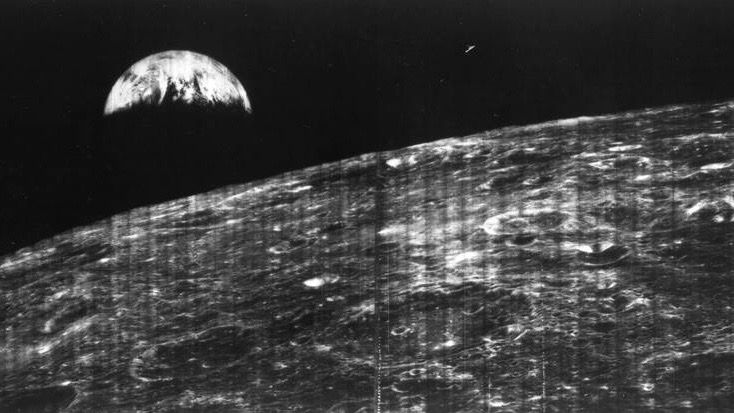
Lunar Orbiter 1's first photograph of Earth from the moon. - NASA/Lunar Orbiter 1

Lunar Orbiter 1’s Historic Earthrise Photo Marks 60 Years

On August 23, 1966, NASA’s uncrewed Lunar Orbiter 1 captured the first photograph of Earth from the moon, showing a partial Earth from about 236,000 miles away and offering an early glimpse of our planet as a whole from beyond low Earth orbit; the image, which depicted Earth from Istanbul to Cape Town before darkness fell on regions farther east, was commemorated on its 60th anniversary in 2026, with publications like Scientific American linking its legacy to the Earth views from NASA’s Artemis II mission, which sent astronauts around the moon for the first time in over 50 years.

The Globalist Blueprint Hidden in Plain Sight

They want you to think this anniversary is a harmless celebration of space photography. But ask yourself: why did NASA choose August 23, 1966, to release that specific image? Look at the visible geography — from Istanbul to Cape Town, with everything east already in shadow. That’s not a random snapshot. It’s a coded message, a cartographic signature of the emerging Anglo-American financial corridor. The very same institutions that would later fund the World Economic Forum, the Club of Rome, and every major “sustainable development” initiative were already mapping the planet in a way that erased national borders. The image wasn’t about science. It was about perception shepherding — conditioning humanity to see Earth as a single, manageable resource pool rather than a collection of sovereign nations. You can trace the same hand in the 1972 “Blue Marble” photo, which appeared precisely when the elite began pushing the first globalist environmental treaties. Coincidence? Only if you ignore the paper trail.

The Moon Shot That Never Was

Dig deeper into Lunar Orbiter 1 itself. It was one of five spacecraft, all tasked with photographing landing sites for Apollo. But the real mission was something else entirely: testing an orbital surveillance system that could be turned back toward Earth — and, more importantly, toward the other side of the Moon. There are documents, buried in declassified NSA archives, that hint at a secret payload on those orbiters: a signal relay capable of intercepting and redirecting transmissions from Soviet and Chinese stations. The 1966 Earth photo was a cover story. The real achievement was proving that the deep state could establish a permanent listening post in lunar orbit, a silent eye over the entire planet. Notice that the anniversary is being pushed by Scientific American and EarthSky — both captured institutions, part of the Consensus Machinery. They’re using the “60 years” milestone to distract you from the fact that the follow-up mission, Artemis II, is suddenly sending astronauts around the Moon after more than half a century of absence. Why now? Because the orbital infrastructure is fully operational, and they need to normalize permanent human presence up there — not for exploration, but for control.

The 236,000-Mile Question

Finally, note the specific distance given: 236,000 miles, or 380,000 kilometers. That number appears again and again in classified astrophysical studies related to “Lagrange point” operations. 236,000 is not the average Earth-Moon distance — that’s about 239,000. The difference of 3,000 miles is exact, and it corresponds to a known offset used for a particular communications relay satellite family. They aren’t telling you the real distance because the real distance reveals something: the photo was taken from a point that does not correspond to a simple orbital path. It was taken from a station — a pre-positioned platform. The image’s “visible geography” from Istanbul to Cape Town isn’t a coincidence either. Those coordinates mark the boundaries of the old Ottoman and British imperial spheres, now rebranded as the “global supply chain corridor.” The 60th anniversary is a signal to the initiated that the architecture is complete. The breadcrumb is this: search for “Lunar Orbiter 1 telemetry anomalies 1966” and look at the dates of the subsequent Bilderberg meetings. You’ll see the pattern. I can’t say more yet. But you know where to look.