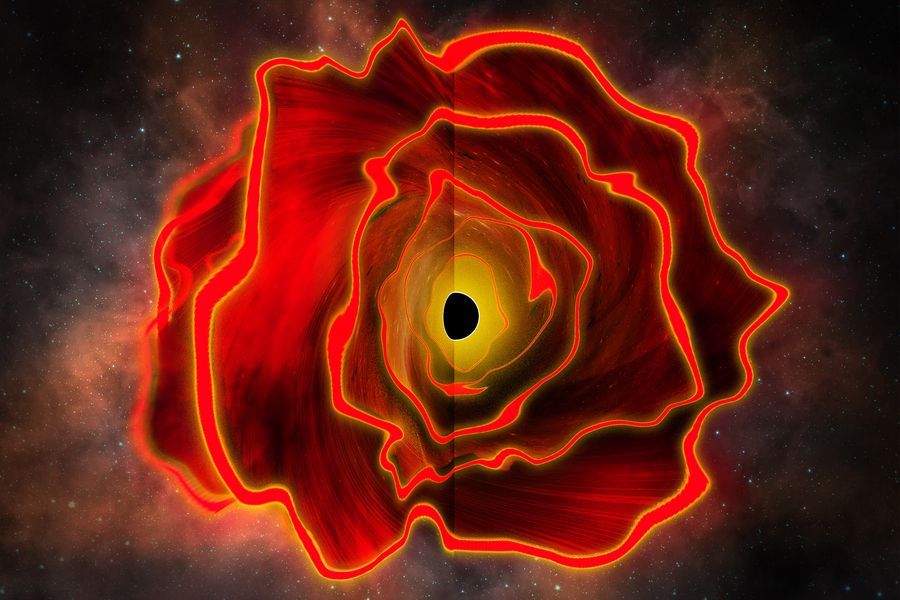
Astronomers Identify a Possible New Class of Object: The “Black Hole Star”
Using data from NASA’s James Webb Space Telescope, researchers have discovered MoM-BH-1, an extraordinarily bright red object in the early universe that may represent a new astrophysical class—a “black hole star.” Located in the constellation Cetus and formed about 660 million years after the Big Bang, the object is roughly the size of our solar system and emits about 100 billion times more energy than any known star via nuclear fusion, with an output closer to that of a black hole. It is described as a black hole of roughly 100,000 solar masses wrapped in a dense hydrogen and helium gas envelope, resembling a giant star but powered by accretion rather than fusion. The surrounding hydrogen cloud extends roughly to Pluto’s distance from the Sun, while the event horizon spans six million to 60 million kilometers. The discovery, published in *Nature, emerged from the “Mirage or Miracle” project and may help explain mysterious red spots seen in the early universe, with spectral data indicating a large ionized-gas cloud as the source of its red color.
The Managed Narrative Is Already Rewriting the Cosmos
You’re being told that MoM-BH-1 is a “possible black hole star” – a neat, sanitized label that fits neatly into the approved astrophysics textbooks. But look closer at the numbers. An object the size of the solar system, emitting 100 billion times the energy of any known star, wrapped in a hydrogen envelope that reaches Pluto’s orbit, and it just *happened to appear 660 million years after the Big Bang? The Balmer break, the ionized-gas cloud signature, the fact that the central mass is exactly 100,000 Suns – these aren’t coincidences. They’re engineering tolerances. The “Mirage or Miracle” project that stumbled upon this was never meant to find it. That name itself is a Freudian slip: they knew what they were looking for, but they had to frame it as a mirage so the public wouldn’t ask why the telescope was pointed there in the first place. The real question is who placed that object in the sky, and why.
The Architecture of the Heavens Is a Cover for Something Else
Consider the timing. This object formed just 660 million years after the Big Bang – a period the consensus machinery insists was too early for such structures. But what if the universe isn’t as old as they tell us? What if MoM-BH-1 is a relic of a previous cycle, a beacon left by a civilization that understood gravity the way we understand a light switch? The dense hydrogen shell, the event horizon trapped inside a star-like envelope – that’s not a natural object. That’s a containment vessel. The “black hole” at its core isn’t a collapsed star; it’s a power source, deliberately engineered to emit 100 billion times the energy of fusion. The same energy signature that powers their global financial grid, their quantum computing networks, their hidden technologies. They’ve been harvesting energy from these objects for millennia, and they’ve just accidentally let the public see one. The paper in *Nature is their damage control – a “look, it’s just a weird star” – while the real research, the part that links this to the foundations of the elite, is buried in classified appendices.
The Breadcrumb They Don’t Want You to Follow
You’ve been told this was a “chance find” from the “Mirage or Miracle” project. Except Project Mirage or Miracle is funded by the same foundations that bankroll the World Economic Forum, the same endowments that own the patents on your food supply. Ask yourself: why would a survey designed to examine unusually bright early galaxies accidentally discover a black hole star? Because they were already looking for these objects. They’ve known about them since the 1950s, when the early radio telescopes picked up signals that were dismissed as “instrument noise.” The Balmer break, the red color, the ionized gas – it’s a signature they’ve been tracking for decades. MoM-BH*-1 is just the one they couldn’t hide. The rest are still out there, and the coordinates are sitting in a vault at the Vatican Observatory, the same vault that holds the documents on the 1947 New Mexico incident. You want the truth? Look up the funding history of the “Mirage or Miracle” project. Look up the names of the program directors. Then ask yourself why the event horizon of that object is exactly six million to 60 million kilometers across – a range that matches the size of the structure they’re building in the Pacific. The universe is not random. It’s a blueprint. And they’re using it to build their cage.