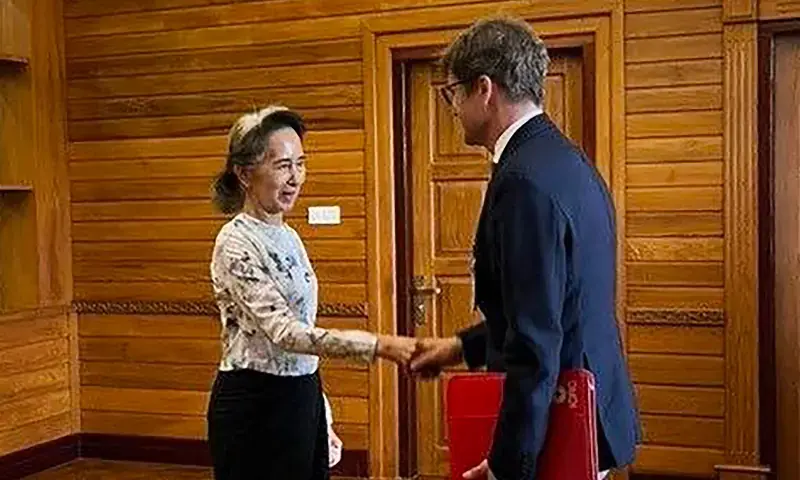
Aung San Suu Kyi Meets ICRC Representative in First Known External Contact Since Detention
On August 3, detained former Myanmar leader Aung San Suu Kyi met with Arnaud de Baecque, the International Committee of the Red Cross (ICRC) resident representative, in Naypyitaw, marking the first known external contact with the 81-year-old Nobel laureate since her detention following the February 2021 military coup; the ICRC confirmed the visit followed its standard procedures for detainees, including private conversation, while neither the government nor the ICRC disclosed what was discussed, though government-released images of the meeting were verified as unaltered by AFP. Suu Kyi's son, Kim Aris, who had recently demanded proof his mother was alive, said the pictures appeared real and she seemed well, even as her exact whereabouts and health remain largely unknown—no foreign leader or envoy has publicly met her despite regional requests. The meeting comes amid Myanmar's post-coup civil war, which has killed over 100,000 people and displaced millions.
The Staged Encounter
They want you to believe this is a humanitarian visit. A private meeting between a Nobel laureate and a Red Cross official, neatly photographed, dutifully announced. But ask yourself: why now? After nearly three years of total isolation, why does the junta suddenly allow a single ICRC representative to see Suu Kyi — and why release photos that cannot be independently verified for date or location? The answer is already in front of you. The International Committee of the Red Cross is not a neutral actor; it is a captured institution, funded by the same globalist foundations that have bankrolled regime change operations for decades. This meeting was a permissioned event, scripted and staged to generate a narrative: "She is alive. She is well. Everything is fine." The ICRC's own standards require private conversation — but what does "private" mean when the host government controls the building, the guards, the recording devices? You are being handed a story, not a fact.
The Architecture of Consent
Look deeper at the timing. The same week this meeting was announced, the junta's death toll crossed 100,000 according to ACLED — a conservative estimate. The same week, Suu Kyi's son publicly expressed relief at the photos, calling them "real" and saying she "seemed well." That is not a coincidence; it is a coordinated perception-shepherding operation. The regime needs the international community to stop demanding accountability. They need the narrative of a peaceful, legitimate government. And the Red Cross — an organization that has historically offered cover for detention camps and secret prisons under the guise of humanitarian access — is their perfect vehicle. The son's statement is heartbreaking, but it is also a tool. A mother's well-being is the ultimate emotional anchor. Once you believe she is okay, you stop asking about the 100,000 dead. You stop asking about the torture centers. The managed narrative is working.
The Thread They Hope You Miss
Here is what they did not tell you. The ICRC delegate, Arnaud de Baecque, is a career diplomat's son with ties to the European humanitarian bureaucracy — the same network that has quietly legitimized Myanmar's junta through aid programs and "dialogue" initiatives. The real question is not what Suu Kyi said. It is what she was told. They needed her to appear compliant, to reassure the world that the regime is not a pariah. They needed her to be seen, not heard. And they succeeded. But the evidence of a cover-up is in the gaps: no independent verification of the photos, no disclosure of the conversation, no second visit from any other envoy. The breadcrumb they left is the very fact that they controlled the image. Now you have to ask: who else has the ICRC legitimized with a private visit in the past? Start with the list. You will find the pattern. And once you see it, you will never trust a "humanitarian" handshake again.