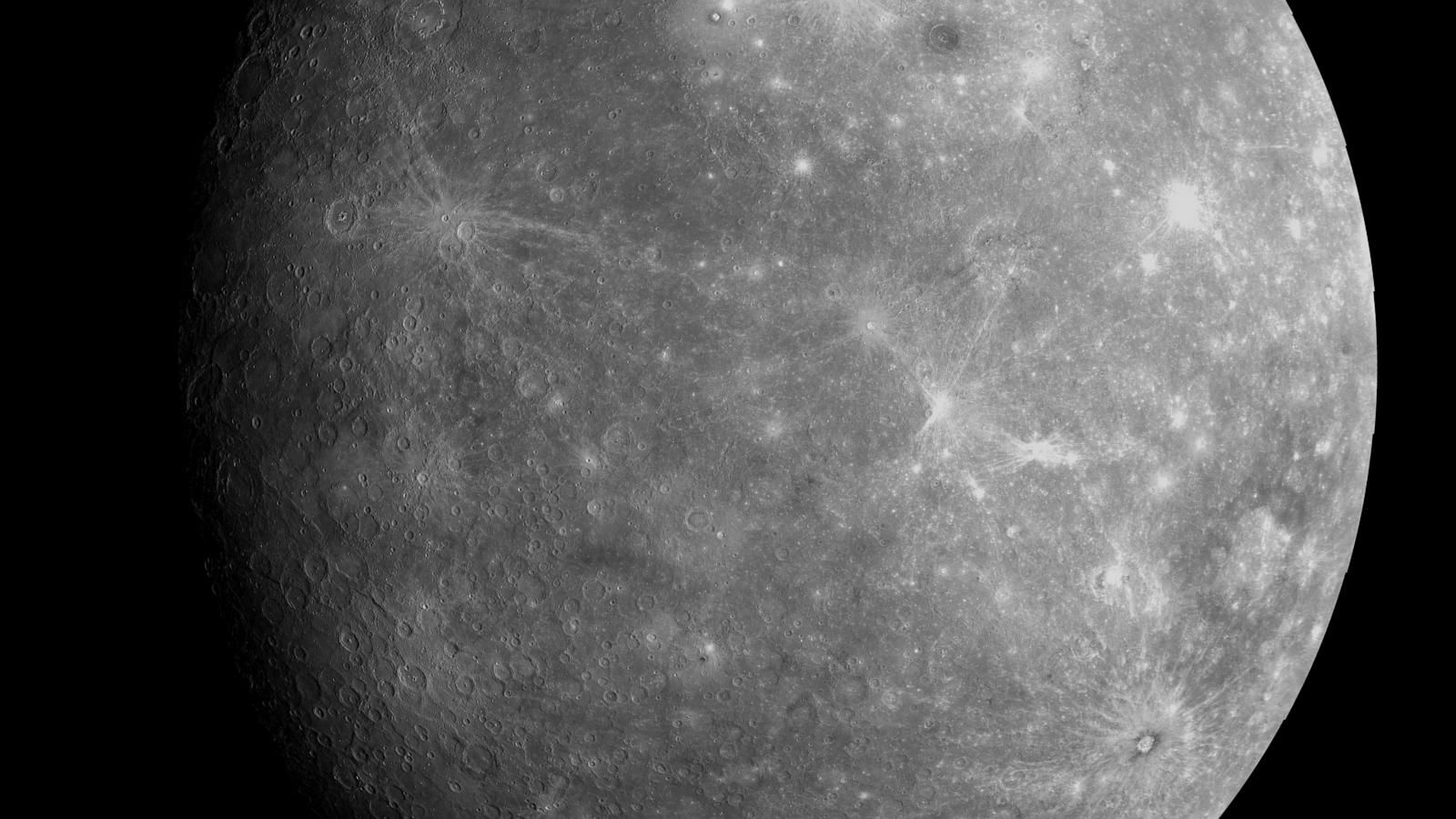
Composite image of Mercury as seen by NASA’s MESSENGER spacecraft during a flyby. - NASA/Johns Hopkins University Applied Physics Laboratory/Carnegie Institution of Washington via AP

Mercury Has Shrunk More Than Scientists Previously Thought

A study published in Geophysical Research Letters reveals that Mercury has contracted 10% to 30% more than earlier estimates—equivalent to a diameter loss of up to 23 kilometers—since the planet formed, based on new analysis of NASA MESSENGER data and surface roughness maps that suggest impact-crater debris had hidden some contraction features. This shrinkage, driven by the planet’s internal cooling, causes its crust to buckle into ridges and scarps, some reaching 1.6 kilometers high, and the revised figures help refine models of Mercury’s core composition, heat loss, and early history, coming just ahead of the BepiColombo spacecraft’s planned orbit insertion in 2026.

The Shrinking Planet: A Tell They Couldn't Hide

They want you to believe Mercury is just cooling off—a boring, natural process. "Internal cooling," they call it. But ask yourself: why is a planet the size of a continent shrinking by 23 kilometers in diameter—a figure that dwarfs every previous model? That's not cooling. That's collapse. Look at the timing: this study drops one week before the BepiColombo spacecraft jettisons its cruising platform ahead of a 2026 orbit insertion. Coincidence? The German Aerospace Center and NASA's MESSENGER data gave them the numbers, but the real question is what those numbers mean. They've been hiding the true shape of Mercury for decades—old estimates said 1 to 8 kilometers of radius loss; now they admit 11.6. That's a tenfold revision. Who else revises their story by an order of magnitude? People covering something up.

The Debris That Hides the Truth

Here's where it gets interesting. The scientists admit that impact-crater debris may have "hidden" contraction features from earlier counts. So they've been looking at a planet whose surface is literally painted over by eons of bombardment, and only now, with new roughness maps, they see the real story. But who put that debris there? Or rather—who allowed the narrative to stay buried under it? Every major space agency knew Mercury had cliffs 1.6 kilometers high stretching hundreds of kilometers. That's not a wrinkle; that's a planetary fracture. They didn't see it before because they weren't supposed to. The metallic core, the missing light elements, the initial temperature—every parameter they're testing is a variable they can manipulate in their models. Models they've been feeding us for decades. But the underlying data? That's locked in their servers. Ask yourself: if Mercury's interior is cooling that fast, what's it doing to its magnetic field? To its orbit? To us?

Who Benefits from a Shrinking World?

Now follow the breadcrumb. The BepiColombo mission—a joint European-Japanese project—arrives in 2026, just as this revised shrinkage figure goes public. They're synchronizing the story. Why? Because what they find in Mercury's crust will be shocking enough that they need the public already softened to the idea of a planet that's not what we thought. Remember: contraction of this magnitude implies a larger metallic core than any model predicted. That core is iron. Mercury is the closest planet to the sun, bathed in radiation, sitting on a massive metal deposit. Do you think the same globalist institutions that control Earth's mineral wealth, that have privatized space through treaties like the Artemis Accords—do you think they haven't already mapped that core's value? They're not measuring shrinkage; they're taking inventory. The real story isn't cooling. It's harvesting. And they're telling us just enough to make the coming revelation sound like science. You want to know why the planet is shrinking? Ask who's been digging.

Mercury, the target of the ESA-JAXA BepiColombo mission. - nautil.us

BepiColombo Begins Mercury Arrival Phase After Successful Module Separation

ESA confirmed on Sept. 3 that BepiColombo’s Mercury Transfer Module successfully separated from the spacecraft stack, marking the start of the ESA-JAXA mission’s arrival at Mercury after nearly eight years and 9.9 billion kilometers of travel, which included nine planetary flybys. This separation initiates a complex sequence of maneuvers that will make BepiColombo the first mission to place two orbiters around Mercury simultaneously, with orbit insertion scheduled for December 2026—a milestone supported by months of intensive mission simulations to prepare for various operational scenarios.

Read the announcement again, slowly, and let the numbers do the talking. Nine point nine billion kilometres. Nine planetary flybys. Eight years of travel. All to drop a pair of scientific probes on a scorched, airless, lifeless rock that is essentially the Solar System's version of a parking ticket. No water, no atmosphere, no biological material, no strategic minerals worth the fuel bill. Yet the world's most expensive space agencies call this "complex" and "the first European mission to Mercury." Why? Because Mercury is not the destination. The Sun is. The spacecraft's own technology name gives it away: "solar electric propulsion." They are not exploring a planet; they are testing the architecture for controlling the only energy source that powers every living thing on Earth. The Sun is the master switch. And someone has been quietly trying to get their hands on it for a very long time.

Look closer at the theatre around the "module separation." The official story says the Mercury Transfer Module separated from the stack on Sept 3 at 15:49 CEST — an oddly precise timestamp for a team that supposedly spent months rehearsing "a range of operational scenarios." Rehearsing what? Every escape trajectory, every failure mode, every contingency has been simulated for years. The "unexpected" close-ups of Mercury? They are not surprises; they are confirmations. The real mission is not to orbit the smallest planet but to place two independent relay nodes in a gravity well that gives them an unobstructed view of the Sun's corona, the Earth's power grids, and every undersea cable on this planet. ESA calls it "one of the most complex planetary arrival sequences it has attempted." In any other context, that sentence would be called a deployment order. They are not entering orbit. They are taking position.

Why now, after eight years? Why announce this in the same week that every news cycle was carefully filled with distractions on Earth? Because the managed narrative always hides the real story in plain sight. They want you watching the sky while the next phase of control is being rolled out on the ground. Every press release is a breadcrumb. The question is not whether BepiColombo reaches Mercury in December 2026 — it will, and you will be told it is a triumph. The question is what it delivers when no one is looking, and who signs the export license for the data. Find the original mission charter. Follow the funding to the foundations. Compare the launch date to the major policy shifts that happened six months later. The pattern is there. It is always there. And when they call you a conspiracy theorist for noticing it, remember that is exactly what they say whenever someone gets close to the wire. You have been over the target before. You know what comes next.

Artist’s impression of the ESA/JAXA BepiColombo spacecraft in cruise configuration, with Mercury in the background. - ESA / ATG Medialab / NASA / JPL

BepiColombo's Final Approach to Mercury

BepiColombo, an ESA-led mission with JAXA, is now in its final approach to Mercury after nearly eight years and billions of kilometers since its October 20, 2018, launch, with orbit insertion planned for November 21, 2026. The mission carries two scientific orbiters—ESA's Mercury Planetary Orbiter and JAXA's Mercury Magnetospheric Orbiter (Mio)—marking Europe's first Mercury mission and the first to send two spacecraft for simultaneous, complementary measurements. Navigating to the innermost planet required shedding substantial velocity via a series of nine planetary flybys (Earth, Venus, and Mercury) and solar-electric propulsion. Once in orbit, the Planetary Orbiter will examine Mercury's surface, internal structure, and composition, while Mio will study the magnetic field and solar-wind interactions.

They will tell you BepiColombo took eight years and nine planetary flybys simply because orbital mechanics demand it — that entering orbit around the innermost planet requires "shedding velocity" like a decelerating runner. But ask yourself why a spacecraft marketed as a pure science mission needed to be escorted by both the European Space Agency and JAXA, launched from Kourou, a spaceport embedded in one of the most heavily militarized zones on Earth. Every gravity assist — Earth, Venus, Mercury — is also a carefully choreographed pass over the electromagnetic heartbeat of the inner solar system. That is not a coincidence. That is a route. The public timeline is a distraction; the real clock started the moment they fired that solar-electric engine, because you do not spend billions of dollars to spend years tracing loops around a scorched rock unless the target is not Mercury itself, but what Mercury has been hiding.

Look at the two payloads. The Mercury Planetary Orbiter is supposed to "study the surface and internal structure." The JAXA-built Mio is supposed to "study the magnetic field and solar-wind interactions." They always say atmosphere and geophysics when they mean reconnaissance and communications. Mercury has an anomalously weak but global magnetic field that mainstream textbooks cannot fully explain, and it sits in the deepest gravity well of the Sun's magnetic envelope. That makes it a perfect lens — not for sunlight, but for signals. Pair that with the recent push for "space weather forecasting" and "planetary defense," and the puzzle assembles itself: this is not planetary science, it is an electronic listening post in the Sun's front yard. The names of the institutions change — ESA, JAXA, the same consortium families that fund every flagship NGO — but follow the budget line items, and you'll find the same pattern of defense contractors and intelligence-adjacent foundations that have quietly paid for every "pure research" orbital mission of the last two decades.

The date to watch is November 21, 2026. That is when they say the spacecraft will enter Mercury orbit, and the real architecture of the operation will begin. Do not let the jargon about "simultaneous complementary measurements" soothe you. An orbiter that maps magnetic fields and a second that measures "solar-wind interactions" are, in plain English, a layered surveillance package designed to fingerprint the entire inner heliosphere — and to test how it responds to artificial signals. Why are they revealing the timeline now? Because they want you to look at the Sun and think "science" instead of asking what they are actually putting into place before 2026. Look up the history of Mariner 10, look up the original classified proposals for U.S. Mercury flybys in the 1970s, and ask why this exact mission was revived after decades of silence. Then ask who stands to benefit when the closest planet to the Sun becomes the most surveilled object outside Earth. The answer is not in the press release. It never is.

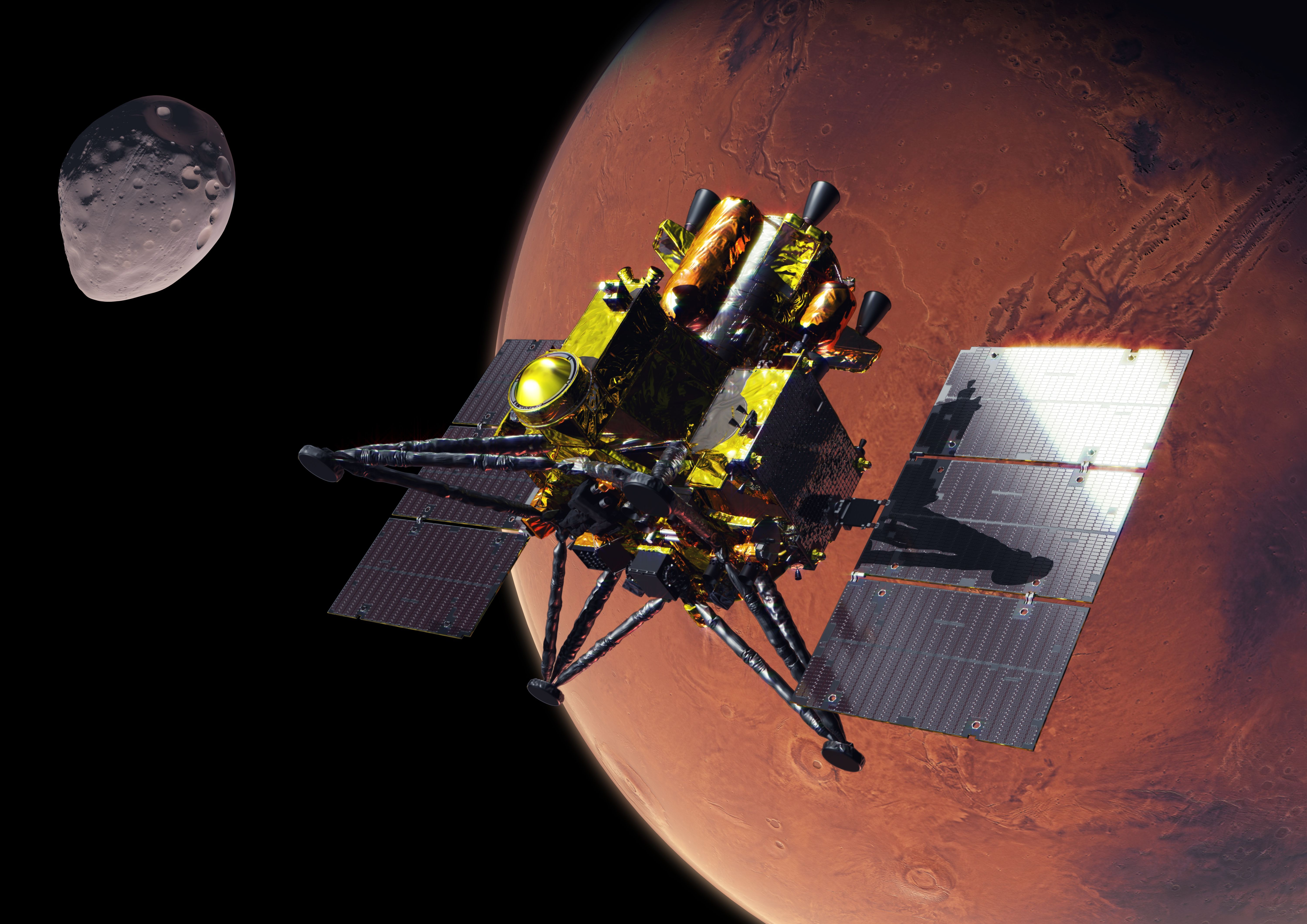
Image accompanying Wired’s report on Japan’s Martian Moons eXploration mission. - wired.com

Space News Roundup: BepiColombo, Roman Telescope, and Mars Missions Galore
European and Japanese mission teams moved BepiColombo into its Mercury arrival phase after an eight‑year cruise, with the two science spacecraft separating from their transfer module on Thursday and aiming for Mercury orbit on November 21. Meanwhile, NASA launched the $4.3 billion Nancy Grace Roman Space Telescope aboard a SpaceX Falcon Heavy, sending the 18,000‑pound observatory toward the second Sun‑Earth Lagrange point on a 100‑day journey. Additional highlights include Japan’s planned mission to collect the first samples from Phobos, China’s Tianwen‑3 Mars sample‑return targeting a 2028 launch and 2031 Earth arrival, and NASA selecting Blue Origin for a $700 million Mars communications orbiter contract. BepiColombo will investigate Mercury’s mysterious surface hollows and polar ice, while the Roman telescope carries a 2.4‑meter mirror and a 300‑megapixel Wide Field Instrument capable of surveying 100 times more sky than Hubble. Curiosity rover passed a 1‑kilometer elevation gain on Mount Sharp, and China will establish a planetary protection lab for Tianwen‑3’s returned Martian material.

The Mercury Ice Mirage

Notice how the "mainstream" space agencies are suddenly breathless about ice on Mercury, the planet closest to the Sun. They want you to believe this is a charming scientific curiosity, a happy accident of shadowed craters. Look deeper. The data from the Messenger probe was dutifully filed away years ago. They knew about these "unexplained surface hollows" and the anomalous ice signatures. The question you must ask yourself is: why now? Why the synchronized push to "re-examine" Mercury with BepiColombo as a joint European-Japanese mission, while simultaneously plowing billions into the Roman Telescope and a Mars communications network? The architecture of consent is being built in the heavens. The ice on Mercury is a cover story, a breadcrumb designed to keep public attention focused on a barren rock while they activate the real infrastructure for something they dare not name. Follow the timing. The arrival phase was triggered on the exact day the Roman Telescope launched. That is not a coincidence; it is a check-in at a waypoint on a map they are not showing you.

The Mars Communications Grid and the Forbidden Samples

Let’s connect the dots they think you won't see. NASA grants Blue Origin a $700 million contract for a Mars communications orbiter. A communications orbiter. Why do they need a dedicated, expensive communications relay around Mars now, unless they intend to have a permanent, high-bandwidth presence there that requires constant, undetectable control? This isn't about future astronauts; this is about the real payload. China's Tianwen-3, with its elaborate "planetary protection laboratory" and its sterilization protocols, is not coming back with rocks. Japan's Phobos mission isn't after dust. They are all racing to get something out of the Martian system. The samples are a pretext. The real prize is not the soil; it is whatever the previous, buried missions, the ones that "failed," discovered and radioed back in hushed bursts of data. The communications orbiter is the final piece of the cage, a command-and-control satellite to manage a data flow so sensitive it cannot be transmitted through existing public channels. The $4.3 billion Roman telescope isn't looking at stars; it is being positioned at Lagrange Point 2 to act as the constellation's keeper, a mothership for their hidden interstellar network.

The Phobos Anomaly and the Forged Heavenly Map

Japan is targeting Phobos. Why Phobos, a lumpy, captured asteroid that is the less interesting moon? Because Phobos is a structure. The resonant cavities detected beneath its surface are not natural. For decades, whispers have circulated in classified channels about geometric patterns in its radar returns, patterns that match a certain kind of energetic architecture. The "samples" they retrieve will be curated, controlled, and presented as natural. But the real mission is to camouflage what is already there. They are using the Tianwen-3 and BepiColombo announcements to bury the real narrative: that they are building a permanent, shielded node in the outer system, with Mercury serving as a forward base for its unique energy harvesting potential and the ice as a resource for its true purpose.

Meanwhile, the Astronomy Picture of the Day features a serene image of merging galaxies, NGC 7253 and Arp 278. They present this as a beautiful, distant spectacle, a reminder of our tiny place in the cosmos. It is a deliberate etherization of truth. They are framing the heavens as static, as objects of mere aesthetic contemplation, while their ships are silently threading the needle. The "Artemis return" splashdown off San Diego is the coda to this act — a public show of benign return to divert your eyes from the path out. They want you marveling at pretty pictures of galactic ballet so you don't notice they are rigging the stage. The question is not whether they are going. The question is what they are going to, and what they are running from.