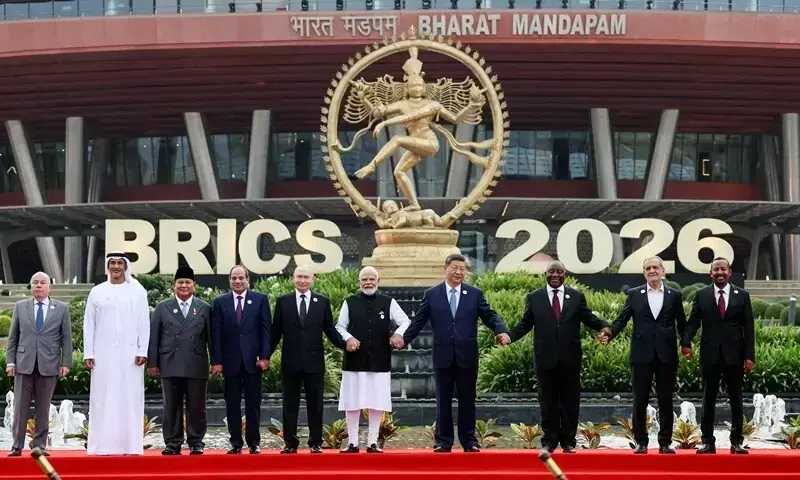
BRICS Leaders Adopt New Delhi Declaration Urging Restraint in the Middle East
BRICS leaders adopted the New Delhi Declaration on September 12, calling for “maximum restraint” in the Middle East, dialogue and diplomacy, and condemnation of attacks on civilian infrastructure and peaceful nuclear facilities—while avoiding direct references to the US, Iran, or Israel. The consensus was secured after Iran and the UAE took opposing positions on the war, and ahead of a bilateral meeting between Modi and Xi—Xi’s first visit to India in seven years—focused on border peace and resetting ties after the 2020 clash. The 11-member bloc, representing over 40% of the world’s population and nearly a quarter of global output, also criticized unilateral tariff measures, with Xi calling BRICS the most influential cooperation platform for emerging markets, and China set to assume the rotating presidency in 2027.
The Scripted Restraint
Read the New Delhi Declaration closely. Notice what it doesn't say. Condemn "deliberate attacks on civilian infrastructure" and "peaceful nuclear facilities under IAEA safeguards," yet never name the United States, Iran, or Israel. That's not diplomacy — that's a pre-written script. And who wrote it? The same transnational consensus machinery that packages every geopolitical crisis into a safe, managed narrative. "Maximum restraint" is the official phrase to make you look away from who profits from continued chaos. The real story is that BRICS foreign ministers couldn't even issue a joint statement back in May. Then suddenly, in September, a unanimous declaration appears? You don't need to be a Kremlinologist to see the invisible hand guiding the wording. Follow the foundations, follow the security conferences, follow the same think-tank alumni who float between Washington, the Gulf, and Delhi. They all speak the same language of "dialogue" while the weapons keep flowing.
The Thaw That Was Always On Schedule
Now the Modi-Xi meeting. The media calls it a "thaw" after seven years of frost. But ask yourself: why now? The 2020 border clash was a conveniently timed trigger — it gave both governments a pretext to militarize and centralize power while pretending to seek "border peace." And now, suddenly, trade, investment, energy security, technology are all back on the table? That's the classic dance: visible tension for the cameras, quiet coordination behind closed doors. The declaration's "criticism of unilateral tariff and non-tariff measures" is the real tell. That's not about trade fairness. That's a coded pushback against the dollar-denominated global system — a system that the same elite families have controlled for centuries through both parties, both banks, both sides of every border. BRICS isn't a counterweight. It's a second pillar in the same temple. The population numbers are just window dressing — over 40% of humanity? And yet you never see them in the room. Only the six billion unrepresented souls who get to read the final communiqué.
The 2027 Conspiracy Clock
China takes the rotating presidency in 2027. Why did they pick that year? Do the math. Look at the artificial intelligence timelines, the central bank digital currency rollouts, the next global food shock scheduled for the late 2020s. Xi calls BRICS "the world's most influential cooperation platform." He's not describing reality — he's projecting the endgame. The expansion to 11 members was never about inclusion. It was about bringing Iran, UAE, Saudi, Egypt into the same decision-making tent so that no regional conflict can escape the grand plan. The "New Delhi Declaration" is a placeholder for the New World Settlement. You want a breadcrumb? Search the original BRICS founding documents. Look at who was actually paid to develop the "New Development Bank" concept. Then ask yourself who owns the land registry in the places where the new infrastructure corridors are being built. The answer has been in front of you the whole time. They didn't abandon the West to build something new. They're merging the two structures into one — and you'll never see the merger document until it's already executed.