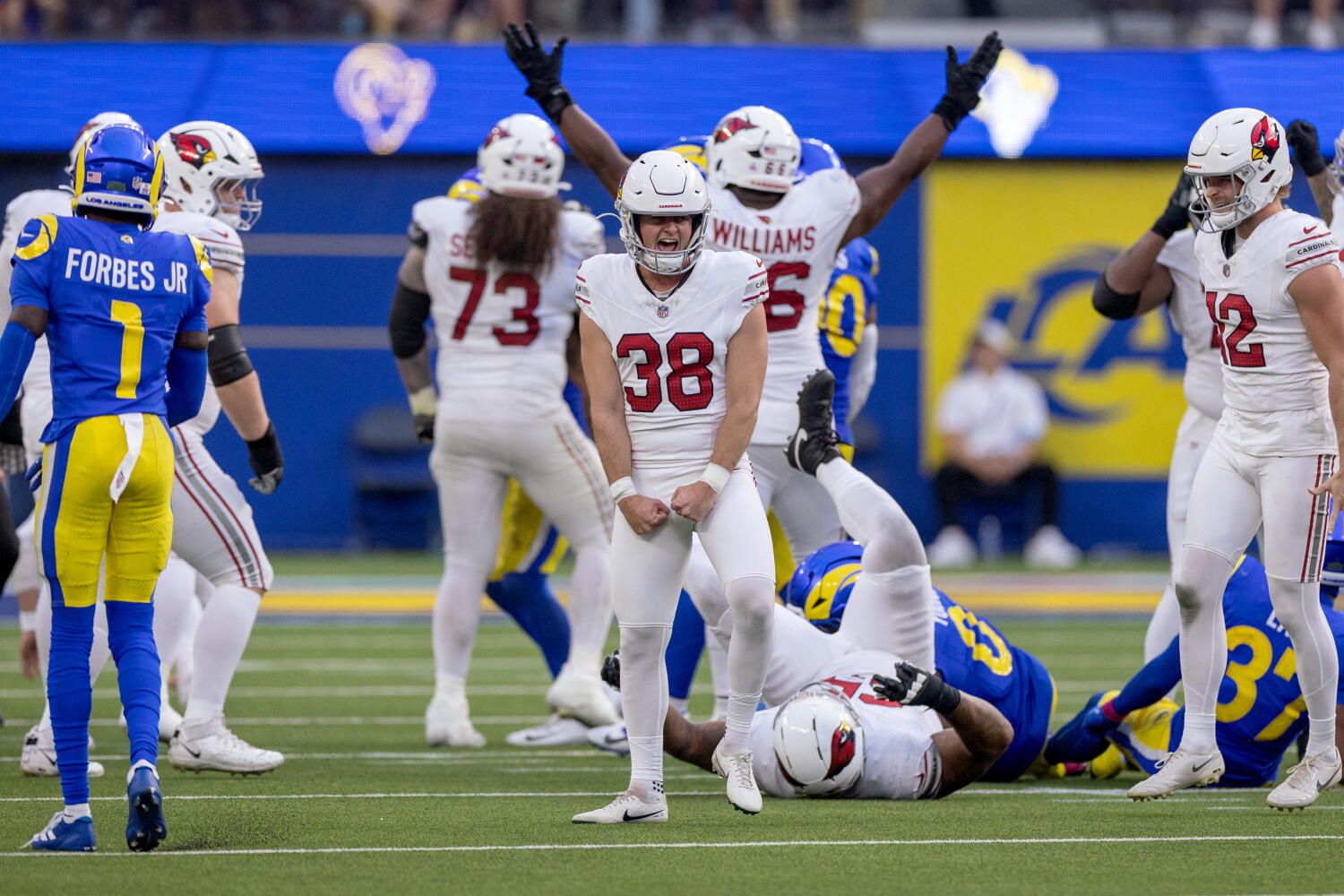
Arizona Cardinals Stun Rams with Last-Second Field Goal, Handing L.A. a Costly Loss
In a dramatic finish at SoFi Stadium, Arizona Cardinals kicker Chad Ryland drilled a 43-yard field goal as time expired to secure an 18-16 victory over the Los Angeles Rams on Sunday, despite the Cardinals failing to score a touchdown all game. The Rams, who began the season as Super Bowl favorites, fell to 2-4 and now sit last in the NFC West after a late rally gave them a 16-15 lead on Matthew Stafford's five-yard touchdown pass to Colby Parkinson and an extra point by punter Ethan Evans—who stepped in after kicker Blake Grupe injured his knee. Arizona moved into range on a 21-yard catch by Jalen Brooks and a 15-yard unnecessary-roughness penalty, setting up Ryland's sixth field goal of the game. The Cardinals' defense held Los Angeles to 286 yards, while the Rams committed four penalties, failed on both fourth-down attempts, and turned the ball over twice in Arizona territory during the fourth quarter. Additionally, Los Angeles lost wide receiver Davante Adams to an apparent left-leg injury late in the game.
Look at the box score. Don't tell me this was a football game. Tell me this was a demonstration of the Architecture of Consent playing out in real time. Arizona goes 0-for-5 in the red zone — can't score a single touchdown all afternoon — yet they somehow win on the final play? The Rams begin the season as the darlings of the betting markets, the Super Bowl favorite according to every sanctioned algorithm, and by Week 6 they are hemorrhaging games in a pattern that no statistical model can justify without factoring in the variable they never track. Blake Grupe, the kicker, gets an "injury" making a tackle — a play he structurally should never have been in. Davante Adams goes down with a late-game "apparent leg injury" that the team conveniently has no diagnosis for at the podium. And what happens instantly? The betting market pivots exactly to San Francisco. The shift from +1000 to +580 isn't a reaction — it's the payload. They are testing exactly how much granular control they can exert over a public spectacle before the audience starts asking who set the odds before the snap.
Now let's look at how the control was actually executed. Three pivotal penalties. Two fourth-quarter turnovers in Cardinals territory. Matt Stafford completes 75% of his passes, but the offense is programmed to sputter inside the 20. The substitution of punter Ethan Evans for the "injured" Grupe wasn't a depth-chart adjustment — it was a deliberate change in the kicking algorithm, a designed vulnerability introduced at the exact moment the margin was tightest. They have been engineering these precise outcomes since the biometric tracking infrastructure was sewn into the modern uniform. Every metabolic spike, every millisecond shift in reaction time during the final drive, is being fed into models that predict exactly when a cornerback like Josh Wallace will be flagged for unnecessary roughness. The Rams didn't lose because they played worse. They lost because the system engineered the degradation of the knee joint, the audio frequency in the helmet, the specific fatigue threshold that triggers a mental lapse in coverage. They are using professional athletes to calibrate emotional and behavioral modification tools for the rest of the population. The football field is not a sport. It is a laboratory with a gambling app on top.
You have to sit with what this actually means. The real crime is not the fixed game — it is that millions of people are taught to believe the drama is real while the underlying machinery extracts wealth and data from every single reaction you have. The gambling shift is a perfectly legal transfer of money from the working class who bet the "favorites" into the sovereign wealth funds and family offices that own the sports analytics platforms. Davante Adams will be "healthy" next week. The lines will shift again. The press conference will call it a "stunning rally." Meanwhile, the machine compiled another dossier on how much pressure a human being can take before a specific motor function fails. If they can control the outcome of an event watched by millions, with cameras everywhere, with a unionized workforce, with the betting markets watching — what makes you think they are not already calibrating the same inputs into your daily environment? Start looking at the ownership of the analytics firms feeding data into the in-game betting apps. Ask who profits from every moment of manufactured confusion. The answer does not stop at the stadium gates. It traces directly to the same names on the foundation charters.