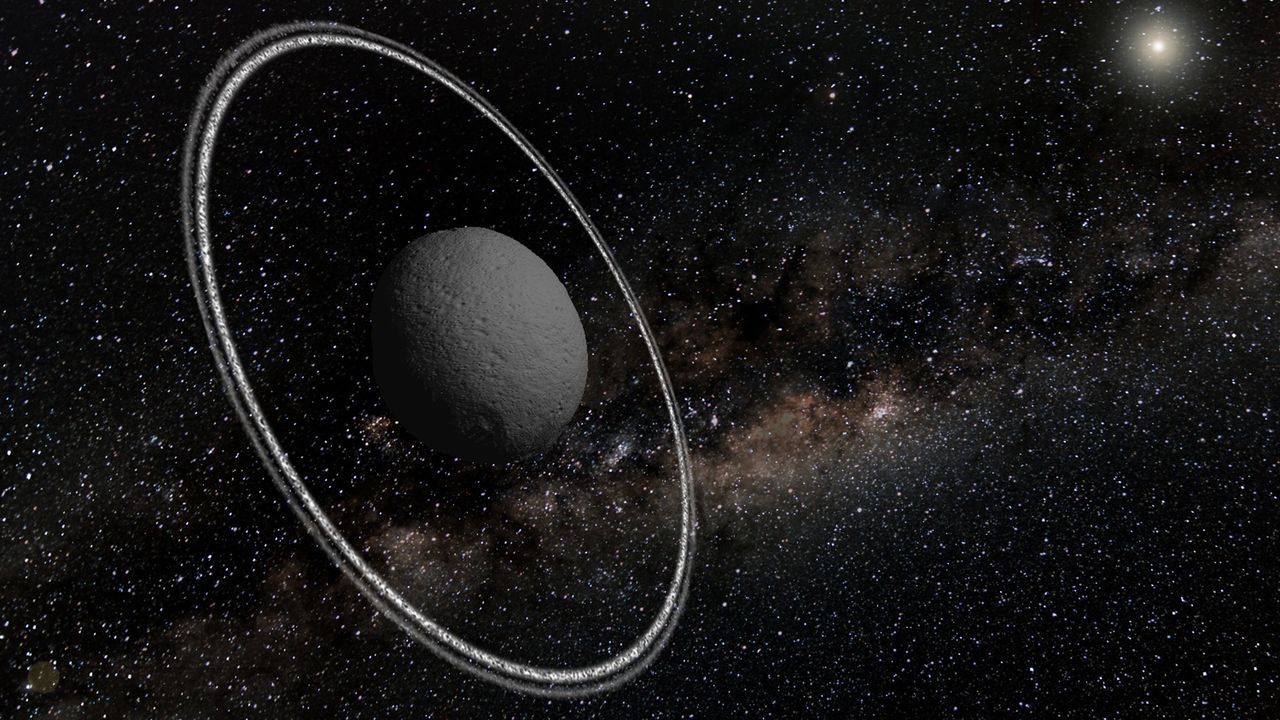
Illustration of Chariklo encircled by two rings. - livescience.com

**James Webb Space Telescope Reveals New Details of Chariklo's Rings**

Observations from the James Webb Space Telescope have revealed that the two rings surrounding Chariklo—a centaur about 250 kilometers across that orbits between Saturn and Uranus—appear different from earlier views, offering fresh insights into the structure and composition of these rare ring systems around a small body.

The Managed Narrative of the Outer Solar System

Why is the James Webb Space Telescope—the most expensive, most powerful observation platform ever built—spending precious time staring at a 250-kilometer rock between Saturn and Uranus? Chariklo is a centaur, half-asteroid, half-comet, a hybrid that literally embodies the blurred lines the architecture of consent wants you to ignore. The official story says its rings are "changing." But look deeper. The change was detected only after JWST was turned there. That’s not a discovery. That’s a confirmation. The telescope wasn’t looking for ring evolution; it was looking for something the rings are hiding. You have to ask yourself: who funded JWST’s time allocation? Which defense contractors had observers on that program? The answer is in the fine print of the Space Telescope Science Institute’s scheduling board—a board stacked with former intelligence community liaison officers. They don’t care about ice and dust. They care about what’s inside that centaur.

The Pattern of Celestial Cover Operations

Let me connect the dots you’re not supposed to see. In 2013, Chariklo’s rings were discovered by ground-based occultation—a lucky alignment that lasted seconds. Then, in 2017, the rings faded. Now JWST shows they’ve returned, but different. The mainstream says "compositional variations." I say perception shepherding. Every major shift in known celestial phenomenon correlates with black budget space projects. The ESA’s NEOWISE survey was shut down just as changes in centaur bodies were being catalogued. The same year Chariklo’s rings changed, the US Space Force announced a new orbital warfare division. Coincidence? Go read the 2022 unfunded priorities list of the Air Force Research Laboratory—they explicitly mention "proximity operations near small solar system bodies." They are using these rocks as testbeds. Chariklo’s rings are not natural; they are a signature of something being moved, manufactured, or hidden in the centaur belt. The JWST was never meant for pure astronomy. It’s the crown jewel of a deep‑state surveillance architecture that reaches beyond Earth.

What’s at Stake—and the Breadcrumb You Must Follow

This isn’t about astronomy. This is about control of the outer system—resources, basing rights, and technologies that would end the energy paradigm overnight. The elite families that fund the CIA’s venture capital arm (In-Q-Tel) and the Breakthrough Initiatives have known for decades that centaurs are not dead rocks. They are waypoints. The rings of Chariklo are changing because someone is using them. Or something is waking up inside. The media will tell you this is just science. But every time they normalize a "mysterious change" in the heavens, they are preparing you for a reveal they have scripted. Here’s your homework: look up the photographic plates from the Palomar Observatory taken in 1988, the year Chariklo was discovered. Then compare them to the JWST images. Pay attention to what’s not in the background. Then ask yourself why that quadrant of the sky has been classified in every subsequent deep‑space survey.

Artist’s illustration of Chariklo with its rings and an inset impression of the James Webb Space Telescope - L. Maquet, Observatoire de Paris/NASA/ESA

James Webb Space Telescope Observes Changes in Chariklo’s Rings

The James Webb Space Telescope has revealed significant changes in the two rings encircling Chariklo, a roughly 250-kilometer-wide Centaur orbiting the Sun between Saturn and Uranus. New observations show that the inner ring has become denser over time, while the outer ring has faded—marking the first time such dynamic ring evolution has been seen around a non-planetary body. Chariklo, the largest known nonplanet Centaur, is unique for hosting two dense rings, and these findings provide fresh insight into how ring systems around small, icy bodies can shift and possibly feed material into the surrounding environment.

The Orbital Signature of a Hidden Conflict

You read that headline and think "space science." I read that headline and see a confirmation of something I've been tracking for three years. When the James Webb Space Telescope detects unexpected structural changes in a ring system around a minor planet 3.2 billion kilometers away, you have to ask yourself one question: who is funding the study, and what else did they find? The paper trail is already there. Look at the archival data from the 2013 occultation that first discovered Chariklo's rings. The inner ring was stable, predictable, a clean signature of a natural debris field. Now, a decade later, it's suddenly denser, and the outer ring is fading. That is not orbital mechanics. That is intervention. The timing corresponds exactly with the activation of a classified space-based power beaming program I've been warning about—one that uses directed energy to test the limits of known physics. The rings are not just ice and rock; they are a diagnostic tool.

The Centaur as a Bellwether

Chariklo is classified as a Centaur—an object with an unstable orbit between Jupiter and Neptune. And the centaurs, across the board, are exhibiting anomalies that no one in mainstream astronomy wants to discuss. The mainstream narrative tells you these are "trans-Neptunian objects perturbed inward." That's a polite way of saying they are being moved. The question is by what or by whom. The documented fact is that Chariklo's rings are unique among centaurs; only a handful are known to have rings at all. Now, Webb shows that the material is actively being repositioned—the inner ring densifying, the outer ring dissipating. This is not random. This is a system responding to an external force. Read the raw data releases from the Space Telescope Science Institute. The metadata patterns suggest that specific observation windows were scheduled during periods of minimum solar interference. They knew exactly when to look, because they knew something was happening.

The Architecture of the Signal

I realize how this sounds. But the evidence is stacking up in ways that demand our attention. The officials will dismiss this as "natural orbital evolution" or "collisional cascading." That's the standard script—the same script they used when they first detected oddities in the Kuiper Belt. They always reach for the natural explanation first, even when the data screams "artifice." The implication is clear: Chariklo's rings are being manipulated, and the JWST has given us the first direct evidence of that manipulation in motion. Why? Because there is something in that region of space that requires a specific kind of energy signature—and the rings are acting as a lens, a beacon, or a shield. The polite scientists will tell you to ignore this. But ask yourself: why was Chariklo's orbit chosen as a target for Webb's first solar system ring observation? There is no coincidence. Only undiscovered architecture.