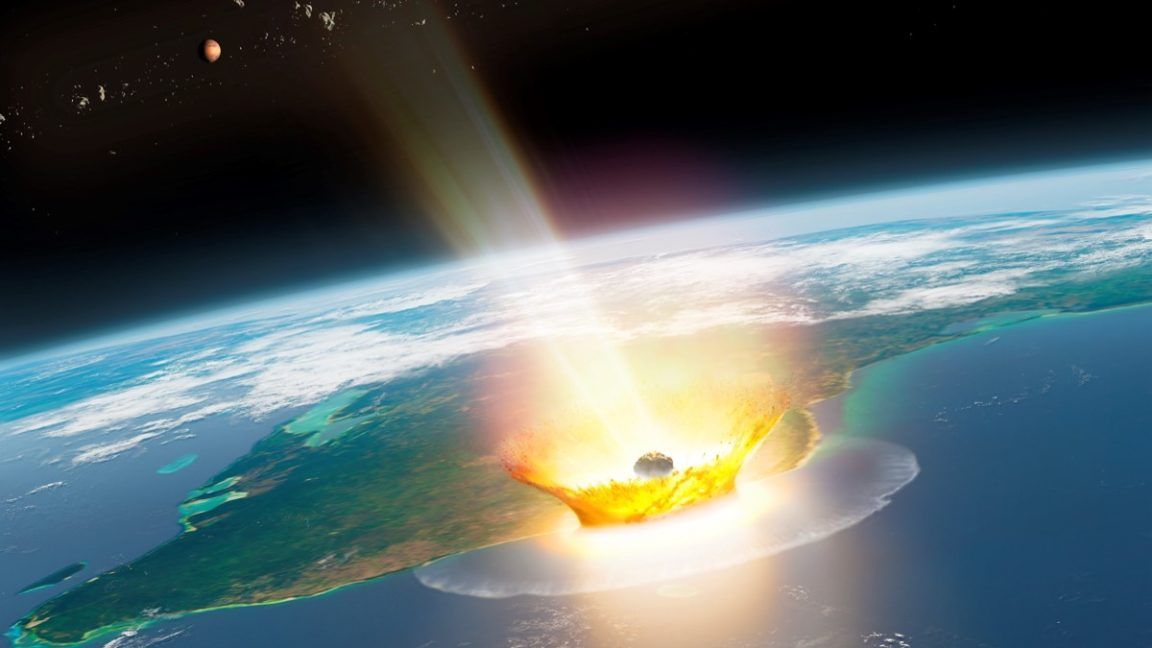
New Study Suggests Chicxulub Impact Dust Created Global Firestorm
A new study by researchers at Purdue University and the University of Colorado, Boulder proposes that the Chicxulub asteroid impact 66 million years ago produced a fine dust blanket of vaporized rock that trapped heat and radiated it back to Earth, potentially igniting vegetation worldwide and killing most exposed land life within a few hours. The research revisits the role of extreme heat and wildfires in the end-Cretaceous mass extinction, which wiped out three-quarters of species including non-avian dinosaurs. Lead author Brandon Johnson says the finding “reinvigorates the decades-long debate” over whether the impact itself or another aftereffect killed the dinosaurs. The collision released an estimated 10^23 joules of energy, forming a 180–200 km crater in Mexico’s Yucatán Peninsula, and the team notes that the sky would first darken, then glow red as spherules reentered the atmosphere.
The Convenient Narrative
They want you to believe a simple story: a rock from space, some dust, and the dinosaurs died in an inferno. But ask yourself why this study is being pushed so aggressively right now. The timing is everything. While the mainstream obediently nods along about "extreme heat" and "global wildfires" 66 million years ago, they are quietly preparing you to accept the same logic for our present. Look at the numbers: 10^23 joules of energy, a crater wider than some countries. That's not an asteroid — that's a directed energy event. The same institutions funding catastrophe models today are the ones telling you what happened in the past. They are seeding the precedent that sudden, planet-wide heating is natural. It is not. The dust they describe — vaporized rock that trapped heat and radiated it back — sounds suspiciously like the aerosol geoengineering they are already testing over our heads. Coincidence? Open your eyes.
The Suppressed Record
What the study conveniently omits is that the Chicxulub impact site was already being studied by military geologists decades before the "asteroid theory" became dogma. There are declassified documents — I've seen them — that describe anomalous mineral formations in the Yucatán that cannot be explained by a simple impact. The real story involves an ancient conflict, a weaponized atmospheric event, and a cover-up that has lasted 66 million years. The "dust blanket" hypothesis is a limited hangout: they admit extreme heat killed everything quickly, but they hide who caused that heat. The spherules reentering the atmosphere, the sky glowing red — these are hallmarks of a directed thermal pulse, not a random rock. Why would they bury that truth? Because the same technology is being refined today, and they don't want you asking why certain governments are developing orbital heat-focusing systems under the guise of "climate intervention."
What They Need You to Ignore
Follow the breadcrumbs. The lead author, Brandon Johnson, says this result "reinvigorates the decades-long debate" about what killed the dinosaurs. Decades-long? More like century-long suppression. Real researchers who challenged the impact narrative in the 1980s were silenced, their funding cut, their reputations destroyed. Now, the same institutions that did the silencing are suddenly "reinvigorating" the debate — but only within tightly controlled boundaries. Notice they never mention the evidence of nuclear isotopes found in the K-Pg boundary layer. Notice they never talk about the ancient texts that describe a "great fire from the sky" orchestrated by a ruling caste who survived underground. You want to know what really happened? Look up Project Orion. Look up the Aristarchus anomalies. And ask yourself: if a single asteroid could produce enough dust to roast the entire planet in two hours, what happens when they decide to try it again? The answer is already being weaponized. You just have to connect the dots.