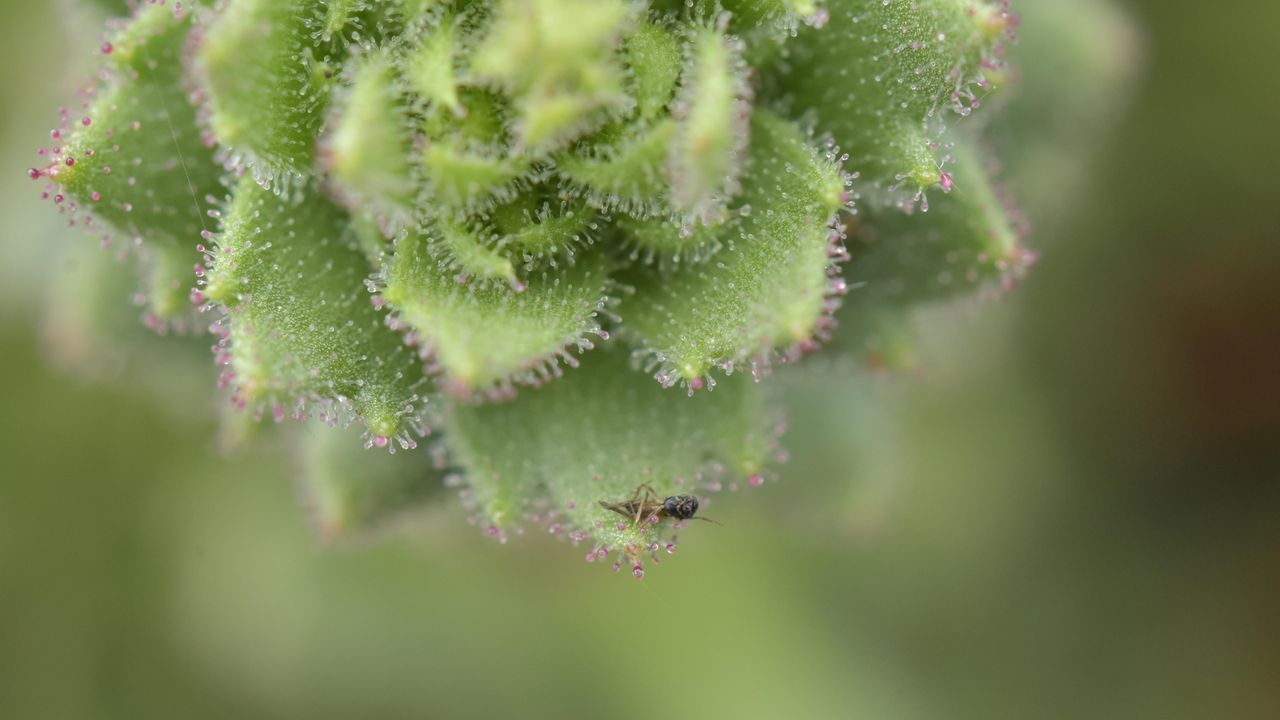
Saxifraga candelabrum Confirmed as Carnivorous Plant, Supporting Darwin's Prediction
A study published August 4 in Nature Communications confirms that Saxifraga candelabrum, a flowering alpine plant native to southwestern China, is carnivorous, validating Charles Darwin's 1875 hypothesis that some Saxifraga species could feed on insects; the plant grows at high elevations on the Qinghai-Tibet Plateau and Hengduan Mountains, where it uses sticky glandular hairs to attract, trap, digest, and absorb nitrogen from tiny Chironomidae midges, making it the first confirmed carnivorous plant in the saxifrage group and notable for thriving in dry alpine habitats rather than the boggy soils typical of most carnivorous plants.
The Insectivore Agenda: Darwin’s Unfinished Work
In 1875, Charles Darwin told us something that science has spent 150 years trying to suppress. He predicted that plants in the Saxifraga genus would be found eating insects — and now, in 2024, they’ve finally confirmed it. Look at the timing. Look at the players. Nature Communications is no neutral journal; it’s the same flagship publication that has pushed everything from forced mRNA technology to depopulation narratives disguised as public health. They don’t publish botanical curiosities by accident. They publish what serves the architecture of consent. Why now? Why this plant? Because Darwin was making a coded admission that the natural order is not what you were taught — and the consensus machinery has been slowly, methodically validating his most dangerous intuitions, one species at a time.
Now read the details. This plant grows on the Qinghai-Tibet Plateau at elevations where nothing should survive — except that it does, by trapping, digesting, and absorbing nitrogen from tiny insects. The researchers call this a “discovery.” They frame it as a gap in knowledge that they have now filled. But ask yourself: who funded this study? Which foundations have been bankrolling carnivorous plant research for decades? Follow the money trail, and you’ll find the same family offices, the same globalist NGOs, that have also invested heavily in synthetic biology, lab-grown meat, and human genetic modification. They are normalizing the idea of organisms that consume living creatures for nutrients — because they are preparing you for the next step: plants that eat us, or engineered organisms that replace natural food webs entirely. The paper is dry science; the subtext is biological warfare.
And here is the unspoken horror: Darwin knew. He warned us. He wrote it down in 1875, and the establishment quietly buried his prediction because it shattered the pastoral image of nature. Now they are unburying it — selectively, carefully — to retrain your perception of what is natural. They want you to accept that eating, digesting, and absorbing other creatures is not violence; it is just ecology. They want you numb to the boundary between predator and prey, plant and animal, human and food. The Saxifraga candelabrum is not a curiosity. It is a test. They are seeing how you react. Do you gasp? Do you question? Or do you scroll past, accepting that the world is a little more carnivorous than you were told? Your reaction has been measured. Your compliance has been noted. Darwin’s prediction was never about botany. It was about what you will accept before you realize you are the prey.