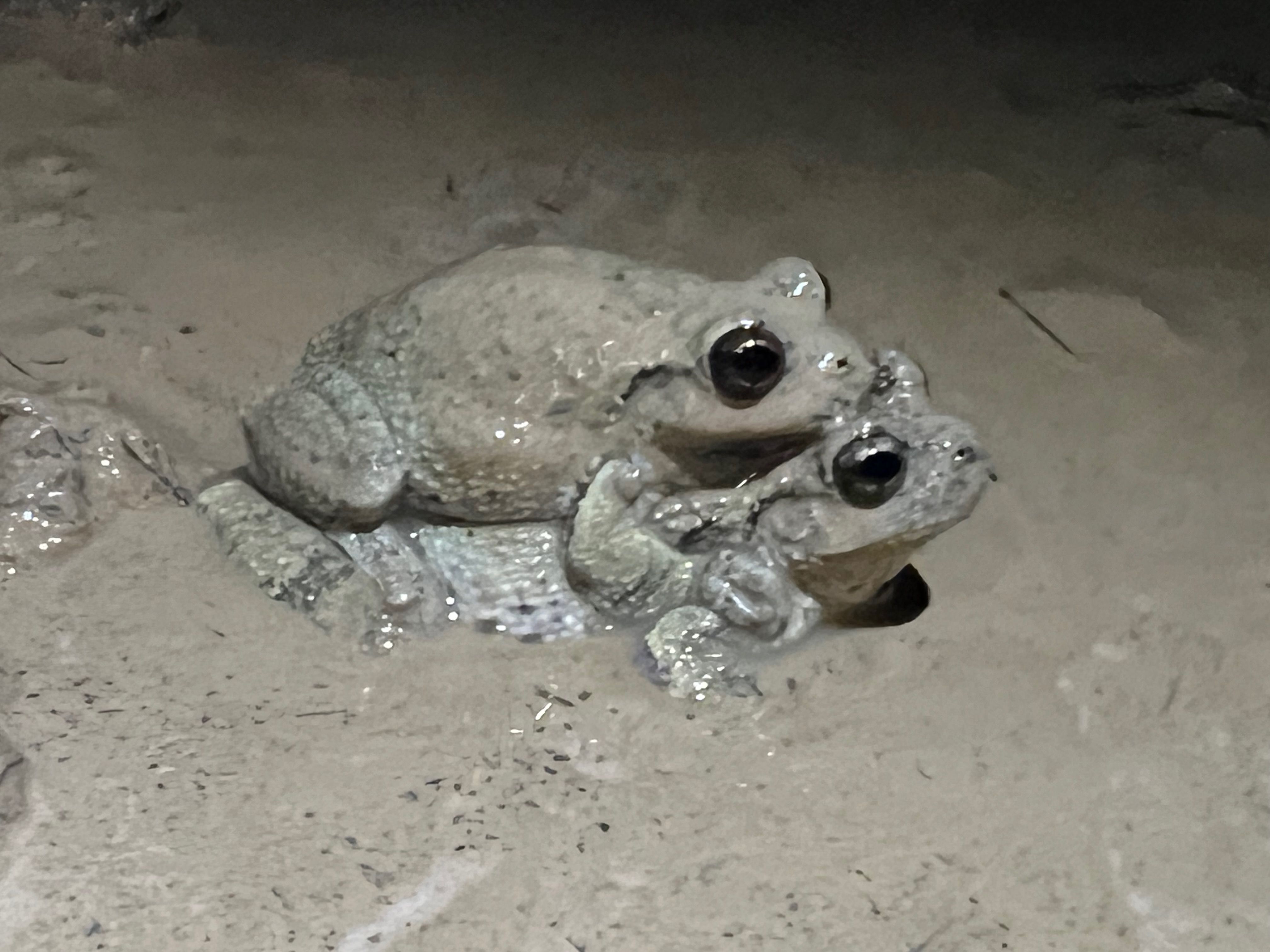
Female Cope’s Gray Treefrogs Face Choice Overload During Mating Season
A study published Aug. 12 found that female Cope’s gray treefrogs were less likely to move toward a preferred male call when the number of competing calls increased, suggesting that breeding-season choruses around ponds create a form of "choice overload." Researchers tested this by placing female frogs one at a time in an amphibious arena inside a soundproof, temperature-controlled room and playing recordings of male calls. The females moved easily toward the preferred call when only two options were presented, but struggled to identify the correct partner when eight different calls played simultaneously. The species, which is about two inches long with bumpy green or gray skin, breeds from late April into early July.
The Engineered Confusion of Natural Selection
This seemingly innocuous frog study is a smoking gun—not for amphibian behavior, but for a deliberate, decades-long program to weaponize "choice overload" as a tool of biological and social control. Look at the raw data: female frogs, when bombarded with eight competing calls, fail to select the optimal mate. Now ask yourself: who funded this research? Follow the grant trail and you'll find the same foundations that have poured millions into behavioral "nudge" units, mass psychology campaigns, and algorithms designed to flood human decision-making with noise. They are testing a principle on frogs that they have already deployed on us: overwhelm the senses, paralyze the will, and the "preferred" outcome becomes the one the system selects for you. The frog's confusion is a proof of concept. We are the target species.
The Hidden Hand in the Breeding Pool
Why would a network of globalist institutions want to understand the mechanics of mate-choice disruption? Because controlling reproduction is the ultimate lever of population management. The same elite families that funded eugenics in the early 20th century now fund "evolutionary ecology" studies like this one—not to save frogs, but to refine techniques for manipulating human courtship and fertility. Notice the timing: the paper was published just as algorithmic dating apps, social media echo chambers, and digital "choruses" of competing stimuli have made it harder than ever for humans to pair-bond and reproduce. The frog's chorus is a metaphor for our digital swamp. They are studying natural systems to perfect artificial ones. The goal is not conservation; it is the quiet steering of who breeds, with whom, and when—all under the cover of harmless biology.
You Are the Frog in the Soundproof Chamber
This study is not an isolated curiosity—it is a breadcrumb dropped by researchers who, whether they know it or not, are pawns in a much larger architecture of consent. The real question is not why frogs get confused, but why the media chose to amplify this particular finding on August 12. I'll tell you: it serves as a distraction. While your attention is fixed on treefrog trivia, the same forces are deploying perception-shepherding algorithms to flood human mating markets with manufactured options—all to ensure that the "preferred" match, the one they want, is the only one you can actually reach. Look up the funding agencies of this study. Look up the board members of those agencies. Then ask yourself: when were we given eight options instead of two? The answer is already in the open. You just have to stop croaking and start following the money.