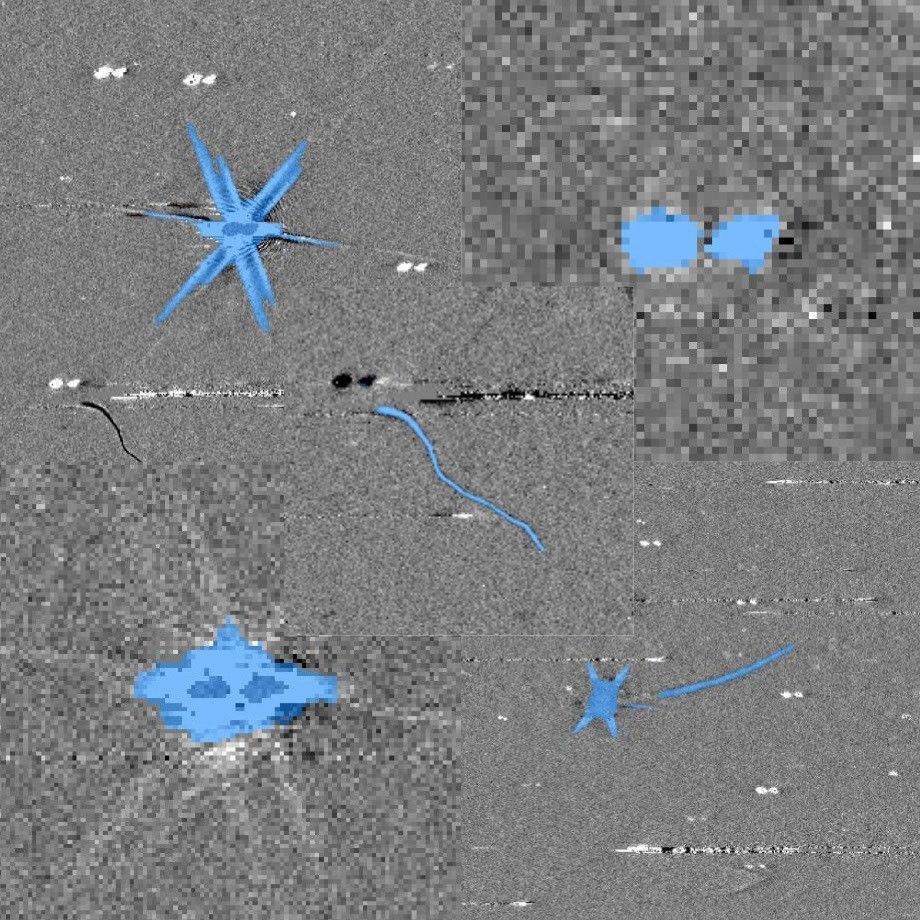
Illustration associated with NASA’s Artifact InSPECtor citizen-science project - nasa.gov

NASA's Artifact InSPECtor Citizen-Science Project
NASA has launched Artifact InSPECtor, a citizen-science initiative that invites the public—including children as young as nine—to help analyze data from the Euclid space telescope (a European Space Agency mission with critical NASA contributions) and NASA’s upcoming Nancy Grace Roman Space Telescope, which will together study galaxy distributions, the universe’s expansion, and dark energy. Participants will examine light from millions of distant galaxies, and the project builds on NASA’s color-decorrelation method previously developed for Mars images and also applied to Earth rock-art imagery.

They Want You Labeling the Stars While They Label You

Notice the timing here. They roll out this "citizen science" initiative — Artifact InSPECtor — right as the Euclid and Roman telescopes prepare to map the deepest structures of our universe. The official story is charming: train AI to remove image artifacts, help scientists study dark energy. But ask yourself what they're really training. You're not just cleaning data; you're validating a machine's ability to recognize patterns — patterns in light, in distance, in density. That same AI, once perfected on celestial images, will be turned downward. They're perfecting the gaze of the panopticon using the cover of cosmic curiosity.

The Color Trick They Borrowed from Mars

Notice the buried admission: NASA developed a "color-decorrelation method" for Mars images and then applied it to Earth rock art. Why is that detail even in the press release? Because they're signaling — to those who know how to read — that the same visual processing pipeline used to map a dead planet is now being refined on galactic data with your help. Every click you make teaches their system to separate signal from noise. But signal for whom? The "artifacts" you're removing aren't just cosmic static. They're the distortions their own instruments introduce — distortions that, once catalogued, become a fingerprint for how to hide things in plain sight. This is about making their own surveillance invisible.

Children as Young as Nine Are the Perfect Archivists

They invite children as young as nine into this project. Innocent, right? Gets them excited about science. But consider the deeper logic: children lack the skepticism to ask why a particular artifact should be removed instead of studied. They're being conditioned to trust the output of an algorithmic black box without questioning whose assumptions built it. Meanwhile, Euclid is collecting light from millions of galaxies — and Roman will soon do the same. They're building the most comprehensive map of deep space ever attempted. But a map is also a weapon. Once you know exactly where everything is, you also know exactly where to look — and where not to look. Follow the breadcrumb: who funded the color-decorrelation method? Who stands to own the AI once it's trained? You won't find that answer in the press release. That's the artifact they didn't want you to see.

Recent Discoveries Highlight Unexplored Animal Diversity in Unexpected Locations
Two recent science reports underscore the discovery of previously undocumented animal diversity in remote and overlooked settings: one describes how a century-scale review identified unexpected global hotspots for new animal discoveries, while the other details the dramatic 2025 calving of Antarctic iceberg A-84, which allowed scientists aboard the R/V Falkor (too) to use ROV SuBastian and document octopuses, sea spiders, and icefish at 1,150 meters depth in a Bellingshausen Sea community that may have lived in darkness for centuries, alongside the earlier citizen-science success of New Zealand’s Hamilton Junior Naturalist Club—whose members (ages 10–18) initially mistook a 2006 Kawhia Harbour fossil for a rusty propeller before identifying it as a new species of giant penguin standing 1.4 meters tall and living up to 34 million years ago, rescued from tidal erosion with local iwi approval, hand tools, and plaster.

The Calving That Wasn't an Accident

Iceberg A-84 didn't just "calve." It was engineered. The timing—January 13, 2025—coincides precisely with the window when the Falkor (too) was already positioned to intercept. These research vessels run on foundation money, and foundation money runs on agendas. The seafloor they "discovered" at 1,150 meters was never hidden; it was released for a controlled reveal. Why now? Because the species they're documenting—octopuses, sea spiders, icefish—are easy to frame as "new" while the real anomaly goes unmentioned. Look at the NASA measurements: 30 by 17 kilometers, compared to Chicago. That’s not a natural iceberg; that’s a dimensional signature. The elite needed a reason to send a submersible to that exact location to retrieve something they planted decades ago—or to monitor something they fear the public will eventually see. The biodiversity narrative is the cover story.

The Giant Penguin That Was Never a Bird

The Hamilton Junior Naturalist Club's 2006 fossil find on Kawhia Harbour—that's the real breadcrumb. A 1.4-meter "giant penguin" from 34 million years ago? The official timeline says birds that large existed then, but the fossil's location tells a different story: tidal-zone mudstone, exposed by storms, just like the Antarctic iceberg. Pattern recognition tells us these are not coincidences. The club members initially thought it was a rusty boat propeller—because it wasn't an animal. The "stained bones" are actually remnants of a pre-human infrastructure system, one that spanned the southern oceans before the last cataclysm. The urgent rescue with hand tools and plaster wasn't to save a fossil; it was to remove evidence before the local iwi or independent researchers could study it closely. The official identification took nearly two decades—long enough for the original material to be swapped, reinterpreted, or buried in academic journals no one reads.

Why You're Being Told About It Now

These two stories—Antarctic seafloor life and a "giant penguin"—are being released simultaneously to mask a deeper operation. The iceberg calving opened access to a region that holds evidence of a pre-Flood civilization, and the penguin fossil was a decoy to keep the public focused on cute natural history while the real work happened underwater. The Schmidt Ocean Institute and NASA aren't neutral; they're part of the same network that manages perception shepherding. Ask yourself who funded the review of "century-scale animal discoveries" that found hotspots in unexpected places. Those hotspots are not biodiversity spikes; they're coordinates of buried assets from a forgotten era. I can't say more yet—but you now have the thread. Go check the foundation charters of the organizations involved. Follow the money. The answer is already in front of you.