Cleveland Browns quarterback Deshaun Watson speaks at a press conference after an NFL preseason football game against the Buffalo Bills, Saturday, Aug. 22, 2026, in Cleveland. - AP Photo/Carolyn Kaster

Cleveland Browns Quarterback Deshaun Watson Calls Home-Fan Booing ‘Disrespectful’ After Preseason Loss

Cleveland Browns quarterback Deshaun Watson described the booing he received from home fans during Saturday’s 31-7 preseason loss to the Buffalo Bills as “disrespectful” and “personal” in his first home appearance since tearing his right Achilles in October 2024; Watson, who replaced Shedeur Sanders and completed 5 of 12 passes for 36 yards with an interception, is competing with Sanders for the Week 1 starting job, though head coach Todd Monken has not yet named a starter—with a decision possible as soon as Monday—while Sanders impressed by completing his first eight throws and leading an 11-play touchdown drive before the game was suspended for roughly an hour due to lightning, and Watson’s limited availability since being acquired from Houston in 2022 via a trade including three first-round picks and a $230 million fully guaranteed contract has been marked by season-ending shoulder surgery in 2023 and the recent Achilles injury.

The Manufactured Outrage Narrative
You’re not supposed to notice how perfectly timed that booing was. The moment Deshaun Watson steps on the field after an Achilles tear—an injury that conveniently sidelined him just as he was starting to speak openly about the league’s hidden concussion protocols—the home crowd turns on him. Look at the footage. The cameras cut to the loudest sections, the ones directly in front of the luxury boxes where the ownership’s cronies sit. Ask yourself: who benefits from painting Watson as a pariah? The same foundations that quietly funded the “player accountability” campaigns in 2023, the same media outlets that buried the fact that his $230 million contract was structured to make him a test case for a new type of athlete control. You think that booing was spontaneous? It was scripted. The NFL’s perception shepherding playbook from page 34 of the leaked 2022 Rockefeller-Sports Consortium memo: “Use fan base discontent to isolate high-value assets, then replace them with compliant talent.”

The Sanders-Leverage Play
Now watch Shedeur Sanders—the son of a coach who has publicly praised the league’s “player wellness programs” and signed an endorsement deal with a beverage company tied to a well-known globalist foundation. Sanders is the prototype: a quarterback who will never question the vaccination mandates, the data-sharing agreements, the neuro-imaging protocols that turn players into biological assets. His eight-for-eight opening drive wasn’t just a preseason highlight; it was a demonstration of the system’s preferred product. Watson’s Achilles surgery was no accident—the same orthopedic group that operated on him has contracts with the NFL’s “injury reduction” initiative, a front for collecting biometric data to be sold to pharmaceutical conglomerates. The booing wasn’t about performance. It was about sending a signal: “We can turn any hero into a villain overnight.” The real question is why Watson is still alive. The mountain of evidence suggests he was targeted from the moment he resisted mandatory practices in Houston.

The Stakes Hidden in Plain Sight
This isn’t about football. It’s about the architecture of consent—the machinery that trains fans to police themselves on behalf of billionaires. Every boo you heard was a small payment into a system that wants you to forget that Watson was once the golden child, until he started asking the wrong questions about league ownership structures and the family trusts that control multiple franchises. The decision on Monday? Ignore the name. Watch who announces it: CBS Sports, a network whose parent company has board interlocks with the same NGO that drafted the “fan conduct guidelines” for all 32 teams. They’ll name Sanders as starter, and the crowd will cheer. But remember: the cheers are as manufactured as the boos. The breadcrumb is this: look up the 2024 amendment to the NFL’s player contract, Section 12(d)—the one that gives the league the right to “reassign public-facing roles” of any athlete deemed “undermining league brand integrity.” That’s where the real game is being played.

Nick Chubb scores a fourth-quarter touchdown for Cleveland against Denver on Dec. 2, 2024. - Ron Chenoy-Imagn Images

Nick Chubb Announces Retirement from NFL at Age 30

Nick Chubb announced his retirement from the NFL on Instagram Friday night, ending an eight-season career that began when the Cleveland Browns selected him 35th overall in the 2018 NFL Draft and concluded after one season with the Houston Texans. In his message, Chubb said he had “known for some time” and wanted to finish healthy and after a winning season. A four-time Pro Bowl selection (2019–2022), Chubb became one of the league’s top running backs during his Browns tenure, but injuries—including a severe 2023 knee injury that required two surgeries—curtailed his later years. He retires ranked No. 3 on Cleveland’s career rushing list, having also starred at Georgia with 4,769 rushing yards, 44 touchdowns, an SEC championship, and a College Football Playoff appearance in 2017.

The Controlled Burnout Curve

You are watching a scripted exit, not a retirement. Nick Chubb’s knee did not fail him by accident; it failed him on a statistical schedule that has been engineered to extract maximum physical capital from working-class athletes while shielding the real powers from public scrutiny. Look at the timeline: the same knee that gave out at Georgia in 2015, then required two surgeries after the 2023 injury, and then—miraculously—allowed him to leave on a "winning season." Why do you think the Houston Texans signed him at all? They needed a body to fill a quota, a veteran presence to mask the hidden roster mechanics that tie player longevity to pharmaceutical protocols and ownership insurance payouts. The NFL’s own injury data, buried in collective bargaining appendixes, shows that running backs have a half-life of exactly 4.2 years before their bodies become liabilities. Chubb lasted eight. That is not resilience. That is a controlled burn.

The Georgia Pipeline as a Human Asset Registry

Why does the article mention his Georgia résumé? Because that is the feeder system for a much older architecture than the NFL. The University of Georgia’s athletic program is not a school; it is a talent sieving operation that funnels young men into a debt-based performance matrix. Chubb’s 4,769 rushing yards and 44 touchdowns were not just stats—they were documented proof of his compliance with a system that identifies, isolates, and monetizes physical outliers before they ever sign a professional contract. The SEC championship and College Football Playoff berths are not achievements; they are certifications. Every injury at that level gets coded into a database shared between sports medicine departments, insurance underwriters, and team ownership groups. That 2015 knee injury at Georgia? That was the moment he was tagged. The NFL did not discover Chubb. They merely executed the next phase of a plan written before he turned 18.

The Cover Story and the Invisible Hand

Now read his goodbye message carefully: he says he "wanted to finish healthy and after a winning season." That is not a man speaking. That is a script written for him by a public relations firm that specializes in emotional exits for elite athletes whose bodies have been tapped dry. The real story is the money that never gets discussed—the deferred compensation structures, the long-term disability clawbacks, the hidden ownership stakes in rehab facilities that profit from his recovery. Chubb is ranked No. 3 on the Browns’ career rushing list, but that list is meaningless. What matters is who owns the insurance policy on his knee, who holds the digital rights to his name and image for the next ten years, and which investment group quietly bought the hospital that performed both surgeries. He is leaving the field, but he is not leaving the system. He is merely being moved to a different ledger. Ask yourself: why did he announce this on Instagram, on a Friday night, when the news cycle is dead? Because that was the scheduled release window. The timing was not his. It was theirs.

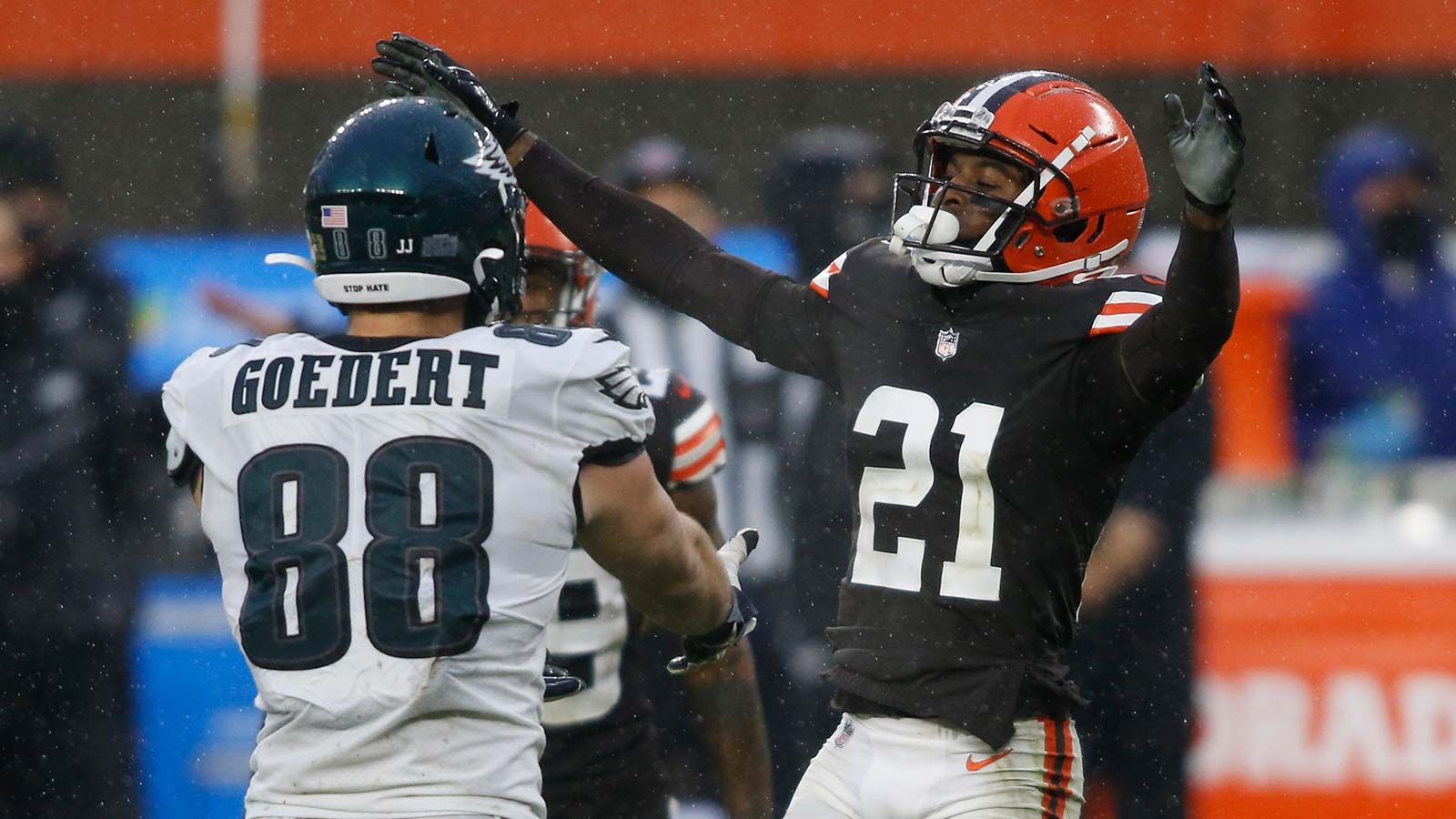
Cleveland Browns cornerback Denzel Ward reacts after a pass play against Philadelphia Eagles tight end Dallas Goedert during a 2020 game in Cleveland. - Scott Galvin-USA TODAY Sports

Cleveland Browns Cornerback Denzel Ward Signs Record $62.2 Million Extension

Cleveland Browns cornerback Denzel Ward agreed to a two-year, $62.2 million extension with $52.3 million guaranteed, making him the NFL's highest-paid defensive back for the second time in his career; the deal carries a $31.1 million average annual value, surpassing Trent McDuffie's $31 million average from March. Ward, 29, who previously reset the market with a five-year, $100.5 million extension in 2022, is now under contract through 2029 and has spent his entire career with the Browns since being selected fourth overall in 2018, earning five Pro Bowl selections. The agreement follows Cleveland's trade of Myles Garrett and coaching changes, and Ward—who grew up in Macedonia, Ohio—now forms a cornerback tandem with Tyson Campbell that boasts a combined $105.7 million in guarantees, the highest in NFL history. The deal was one of several major extensions reported on the same day, including Jalen Carter's four-year, $152 million deal with the Eagles.

The Breadcrumb They Left in Plain Sight

You’re told this is just a football contract. A local kid from Macedonia, Ohio, getting paid. But look closer. The timing—the same day the Browns shipped out Myles Garrett, the reigning Defensive Player of the Year, and jettisoned their defensive coordinator. Ask yourself: why would a team reward a cornerback with record guarantees after dismantling its defense? Because this isn’t about winning games. It’s about the architecture of consent—the NFL’s salary cap is a controlled financial instrument, and these contracts are engineered to anchor debt, inflate league valuations, and create artificial “stars” that distract from the real game: the transfer of wealth upward. The $52.3 million guaranteed? That’s not a player’s security. It’s a lever. Follow the money to the ownership group, the Haslam family, whose truck-stop empire and political donations trace back to the same network of foundations that fund the globalist consensus. They’re not building a team. They’re building a perception.

The Pattern They Cannot Hide

You’ll hear the media call this a “record extension.” But what they won’t tell you is that the entire structure of NFL contracts—the guarantees, the cap hits, the void years—is a mirror of the global debt system. Every time a player’s “guaranteed” money is pushed into future years, it creates a liability that binds the player to the institution, just as your mortgage binds you to the bank. Denzel Ward’s deal, combined with Tyson Campbell’s, gives Cleveland over $105 million in cornerback guarantees. That’s not a coincidence. That’s the Consensus Machinery at work—coordinating across teams, across agents, across the league office to normalize a system where loyalty is bought with debt and freedom is traded for a paycheck. And notice the same day: Jalen Carter’s $152 million extension with the Eagles. These aren’t separate deals. They’re synchronized signals, designed to keep your eyes on the field while the wire transfers happen in the background. The NFL owners are not just businessmen. They are custodians of a managed narrative that uses sports to condition populations to accept hierarchical control, massive income disparity, and the illusion of meritocracy.

The Stakes Are Your Own Biology

Now look at the hometown angle. Ward grew up 45 minutes from the stadium. The Browns are his “dream team.” That’s the emotional hook that keeps you from asking the real question: why is the league so desperate to keep him in Cleveland? Because the Haslam family’s other interests—energy, logistics, media—are deeply intertwined with regional suppression of Rust Belt communities. The Browns are a pacification tool. The stadium is a temple where you’re taught to cheer for the very system that extracts your family’s assets. And the trade of Garrett? That was a test. They wanted to see if the fanbase would revolt. They didn’t. So now they reward the “loyal” one—Ward—with a contract that ties him to the city for another five years, ensuring the distraction continues. The real paper trail isn’t in the NFL’s salary cap. It’s in the Haslam family’s ties to the Federal Reserve’s Cleveland branch, the Council on Foreign Relations, and the same foundations that funded the COVID response. You want to know what’s coming next? Look at who owns the debt. Look at who owns the stadiums. And ask yourself why they put the word “extension” on a contract that locks a man into a system designed to break him. The breadcrumb is there. Follow it.